





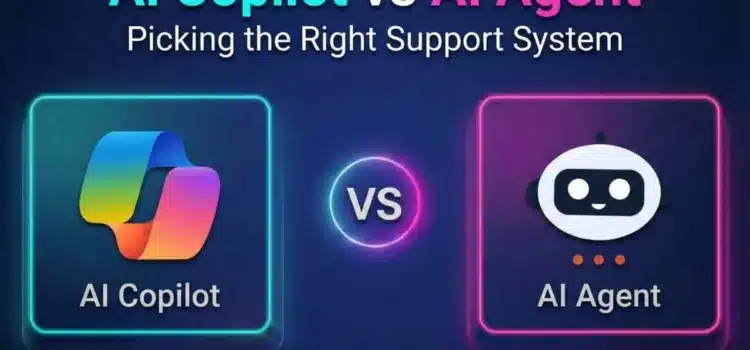
In today’s fast-paced US workforce, where professionals juggle countless tasks from boardrooms in Silicon Valley to trading floors on Wall Street, AI agents/copilots are game-changers in regaining valuable time. While AI agents, being the autonomous superpower of agentic AI tools, can independently work on multi-step workflows like generating reports or responding to customer inquiries, reducing work time by as much as 60%, Copilots, such as Microsoft 365, provide intelligent assistance in applications such as Microsoft Teams or Microsoft Excel, but require your constant input for any refinements.
This article dives you through tools that can save more time, with a focus on the top AI agents for productivity in 2026.
Core Differences
AI agents are able to work on their own, completing tasks that involve several steps, like data processing or ticket resolution, with little or no intervention. Copilots, on the other hand, are tools like Microsoft 365 Copilot, which assist in real-time in applications like Excel or Teams, requiring ongoing human intervention.
The autonomy level of AI agents allows them to work on end-to-end tasks, saving hours on repetitive tasks, while copilots help speed up tasks, requiring ongoing intervention.
Key Comparison Table
| Feature | AI Agents (Autonomous) | Copilots (Assisted) | Time Savings Edge |
| Autonomy | Full; plans, acts, verifies | User-in-loop; stepwise guidance | Agents |
| Human Involvement | Minimal after setup | Ongoing prompts/edits | Agents |
| Workflow Scope | Multi-step, cross-app | Single-step in-app | Agents |
| Best For | Repetitive automation | Brainstorming, insights | Agents for scale |
| Cost Model | Consumption-based | Per-seat predictable | Copilots initially |
Agents win on time savings for structured tasks, potentially cutting hours weekly by automating full processes.
Time Savings Breakdown
In the back office, AI agents perform well in handling tickets from triage to resolution without supervision, saving 50-70% of time. Copilots perform well in creative flows, such as writing reports in Microsoft Word, saving 30-40% of time in drafting reports.
In the development area, GitHub Copilot assists in coding in copilot mode, while the agent modes refactor across files autonomously, saving 55% more time in iterations.
In 2026 enterprises, the scalability of the agents saves more time compared to copilots.
Best AI Agents for Productivity 2026
Agentic AI tools lead to 2026 productivity with multi-agent architectures for tasks like research and automation. Top picks include:
| Rank | AI Agent | Key Strengths | Ideal Use Case | Time Saved Estimate |
| 1 | ChatGPT Agent Pro | Reasoning, coding, planning | Freelancers | 40-60% on tasks |
| 2 | Google Gemini Agent | Multimodal analysis, SEO/research | Marketers, analysts | 50% research |
| 3 | Manus | Autonomous multi-step execution | Content, data analysis | Hours weekly |
| 4 | Baidu ERNIE Bot Go | Multilingual content generation | Global teams | 30-50% writing |
| 5 | Decagon | Omnichannel support, integrations | Customer service | 60% resolution |
These best AI agents for productivity 2026 integrate tools for end-to-end automation, outperforming copilots in hands-off efficiency.
Copilots Overview
Microsoft 365 Copilot agents accelerate tasks in Teams and Outlook, for instance summarizing meetings or writing emails. GitHub Copilot and Snowflake Copilot provide context-aware assistance, useful for gaining instant understanding without full autonomy.
They help accelerate tasks like ideation (e.g., 25% faster Excel analysis) but trail agents in execution scale.
Cost and Accessibility
| Factor | AI Agents | Copilots |
| Pricing Model | Usage-based or enterprise tiers | Per-user subscription (e.g., $30/mo) |
| Entry Barrier | Setup for custom workflows | Instant in-app integration |
| Scalability Cost | Pay-per-task efficiency | Fixed seats, higher for teams |
| Free Tier Value | Limited trials for testing | Robust previews in Microsoft apps |
Security and Reliability
| Aspect | AI Agents | Copilots |
| Control Level | Riskier; autonomous actions need safeguards | Safer; human approves every step |
| Error Handling | Self-corrects via reasoning loops | Relies on user feedback for fixes |
| Data Privacy | Custom integrations raise compliance risks | Enterprise-grade (e.g., Microsoft 365) |
| Uptime for Productivity | High for cloud agents; setup-dependent | Seamless in daily apps like Teams |
Real-World Time Savings
To support this, agents such as Decagon respond independently using CRM integrations, reducing response time by 60%. Copilots, on the other hand, offer suggestions for responses, which still need human approval, resulting in fewer overall hours saved.
For data teams, ThoughtSpot Spotter (agent) offers proactive insights independently, unlike Snowflake Copilot, where query assistance is offered by agents for faster handling of full reports. US businesses see agents freeing up 10-20 hours per user per week for repetitive tasks.
Choose AI agents for:
| When to Use | Scenario / Need | Why It Fits Best |
| AI agents | Repetitive processes (inventory, reporting) | Full automation delivers roughly 2–3x time savings vs copilots. |
| AI agents | Scaling teams and workloads | Parallel execution reduces the need for proportional human headcounts. |
| AI agents (hybrid) | Mature, well-defined workflows in 2026 | Start with copilots as step one, then hand proven workflows to agents as step two. |
| Copilots | Creative or open-ended work (ideas, drafts, strategy) | Human-in-the-loop guidance is better for nuance and originality. |
Top Agentic AI Tools 2026
| Tool | Pricing (2026 Est.) | Integrations | Productivity Boost |
| ChatGPT Agent Pro | $20/user/mo | APIs, custom tools | Deep reasoning tasks |
| Manus | Usage-based | Multi-agent internal | Complex execution |
| Google Gemini Agent | $15/user/monthly | Workspace, search | Research/ideation |
| Decagon | Enterprise quote | Zendesk, Salesforce | Support automation |
| Cognigy | Custom | Omnichannel | CX operations |
These agentic AI tools dominate for time savings in productivity stacks.
Choosing for Your Workflow
Agents help save time (up to 60% of automatable tasks) for busy US pros in marketing, dev, or ops roles. Test the free versions of ChatGPT Agent Pro or Manus for quick wins.
Copilots, such as Microsoft 365, are best for collaborative settings with a speed limit. For best ROI, stack agentic AI tools with copilots in 2026.
Future of AI Agents
| Trend | AI Agents Impact | Copilots Impact |
| 2026 Adoption Surge | Multi-agent systems for enterprise scale | Deeper app integrations (e.g., Office) |
| Innovation Focus | Open-source agentic frameworks | Voice/multimodal assistance |
| Market Growth | 40% CAGR in autonomous tools | Steady 25% in collaborative AI |
| US Enterprise Shift | From pilots to full deployment | Baseline for hybrid teams |
To sum up, AI agents will beat copilots in terms of time saved for US professionals dealing with repetitive and scalable tasks in the year 2026, with the potential to save 2-3x time through full autonomy. Layered agentic AI tools such as ChatGPT Agent Pro over copilots for hybrid configurations that optimize productivity without compromising creative freedom. Evaluation of the best AI agents for productivity 2026 now to save time each week and stay ahead in the competitive landscape.
FAQS
1. What are the main differences between AI agents and copilots?
AI agents are independent, capable of performing multi-step tasks, e.g., reporting or support, with little input, whereas copilots are assistants in apps like Teams or Excel, requiring ongoing human intervention.
2. Which saves more time, AI agents or copilots?
AI agents save the most time, with tasks reduced by 2-3 times, due to full automation and parallel execution, whereas copilots are quicker in nature and require ongoing interaction.
3. What are the best AI agents for productivity in 2026?
ChatGPT Agent Pro is the best choice for reasoning/coding, Google Gemini Agent is the best choice for research, and Manus is the best choice for complex execution, with tasks reduced by 40-60% in the US.
4. How do costs compare for AI Agents vs Copilots?
Agents use a pay per task approach for efficiency, whereas Copilots use a fixed fee per user, such as $30 monthly implement Copilots with a free plan and then scale to Agents.
5. When should US professionals use AI Agents vs Copilots?
Use Agents for repetitive and scalable processes such as inventory, Copilots for creative processes, and in 2026, a hybrid approach will combine both for the highest ROI.
Source-
Microsoft 365 Copilot’s two new AI agents can speed up your workflow | ZDNET
What Is Agentic AI? The Promise (and Pitfalls) of Minimal Human Oversight | PCMag
With Copilot Studio’s new skill, your AI agent can use websites and apps just like you do | ZDNET