





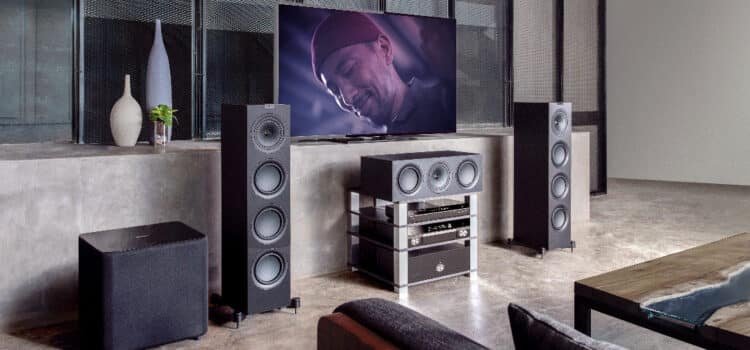
While a TV screen may be the first thing people notice about your living space, it’s the sound quality that truly transforms a living room into a home theater. Whether you want to invest in a high-quality surround system, a Dolby Atmos soundbar, or a bookshelf speaker system, we’ve got you covered. Whatever route you decide to go with soundbars or discrete surrounding sound, there should be something here to bring movie theater magic to your living room.
You don’t have to be an audio expert to have an excellent home audio system. Here’s what you need to get a listening experience beyond a smartphone with earbuds, Bluetooth, or another type of wireless speaker.
Why Stereo?
Stereo provides a listening experience where sounds are placed across two channels to create a stage. Music mixing places some sounds to the left and others to the right of a primary listening position. Sounds placed in both the left and right channels (such as vocals) come from a phantom center channel between the left and right speakers. In short, it creates an audio illusion of sound coming from different directions.
What You Need for a Home Stereo System
A home audio stereo system can be pre-packaged or assembled from separate components with the following core features:
Stereo amplifier or receiver: Serves as a hub to connect and control content sources and speakers.
Speakers: Stereo systems require two speakers, one for the left channel and another for the right.
Sources provide access to music content. You must plug in external sources on systems with an integrated amplifier. If the system has a receiver, it will have a built-in tuner and, in some cases, Bluetooth or internet streaming. Other sources need to be connected.
Pre-Packaged Stereo Systems
If you’re a casual listener, have a small room, or are on a limited budget, a compact pre-packaged system may be the optimal choice. It provides everything you need (including an amplifier, radio tuner, receiver, and speakers) to listen to music.
Depending on the system, additional features can include a built-in CD player, extra inputs for connecting one or more external sources, and Bluetooth to stream music wirelessly. However, one downside of this is that these systems might not have adequate power or good enough speakers to provide high-quality sound for a larger room.
Best AV gear for a dedicated home theater
The size of your home theater room greatly influences the projector and screen you choose. Most projectors come with a chart to help you determine throw distance (the distance required between the screen and the front of the lens), and you should confirm what your room can accommodate before you buy any gear.
A basement rec room measuring about 300 square feet (20 by 15) is large enough to easily fit a 100- to 120-inch screen and a standard, long-throw projector, but you can use an online calculator to figure out what’s right for your room.
The Epson Home Cinema LS11000 delivers a theater-worthy image with great contrast, detail, and color. This 4K projector is also bright enough for more casual, everyday TV watching, and its laser light source should last through the next decade or longer, with no need for you to pay for replacement bulbs. The motorized focus, zoom, and lens adjustments make it easier to precisely position the image on your projection screen, even from the back of the room. The LS11000 is also great for gamers because it produces low input lag and is one of only a few 120-hertz projectors that have high-bandwidth HDMI 2.1 inputs to work with the most advanced gaming consoles.
The BenQ HT2060 has the best picture quality of the HD (1080p) projectors. The long-lasting LED light source delivers the brightness needed for a great-looking, big-screen movie image. Plus, this DLP projector supports 3D playback and the input of a 4K HDR video signal (downconverted to 1080p). Many budget projectors rely on digital key stoning and zoom to position the image on the screen, which hurts image resolution. The HT2060 offers physical adjustments (1.3x zoom, vertical lens shifting, and adjustable feet) to help preserve picture quality, and its fan noise is quiet in operation.
Best home theater screens
The 100-inch Silver Ticket STR Series offers sharp image quality with a minimal amount of tint, and it’s comparatively easy to assemble. There are several shapes and sizes to choose from, but we recommend the standard 16:9 shape that’s ideal for HDTV and most movies. You can get it in sizes from 92 to 200 inches.
If you want to hide your screen when it’s not in use, we recommend the pull-down Elite Screens Manual Series. It proved to be even more color-neutral than the Silver Ticket STR Series, and you can order the metal casing in black or white to suit your room. This pull-down screen is available in assorted shapes and sizes, ranging from 80 to 150 inches in the 16:9 shape.
Best AV receiver
The AV receiver is the hardest-working component in a home theater, serving as both the amplifier for your speakers and the signal processor for your sources. All of the audio and video input signals route through the receiver, which processes them and passes them on to your projector and speakers.
Look for a receiver that offers enough input for all of your sources. This could include a Blu-ray player, a game console, a media streamer, and more. You want the receiver to have sufficient power to drive all of your speakers, a good room-calibration system that tailors the system’s performance to your space, and the most up-to-date HDMI connections for your audio and video gear.
The Denon AVR-X1800H is a great-sounding receiver that holds your hand through the setup process and is loaded with features. It has seven amplifier channels that can power a surround-sound speaker system or a Dolby Atmos or DTS:X home theater setup with two overhead speakers. It can also wirelessly stream music via Bluetooth, Apple AirPlay 2, and the Heos wireless streaming platform. Three of its six HDMI inputs are HDMI 2.1 compatible, so it’s great for gaming on more advanced systems, such as the Sony PlayStation 5 and the Microsoft Xbox Series X.
Best home theater speakers and subwoofer
The passive Sony SS-CS5M2 speaker pair has a lively yet natural sound that works great for both music and movies. It delivers decent bass on its own, and the solid engineering will satisfy audio enthusiasts. At 13.2 by 7 inches by 7.25 inches (HWD), it can conveniently be placed on speaker stands or TV furniture, and Sony offers matching center and Atmos-enabled speakers to create a surround-sound system.
If you think subwoofers are nothing but big, ugly boom machines, the Rogersound Labs Speedwoofer 10S MKII is likely to be a refreshing surprise. It has practically everything one could want in a mid-priced subwoofer, offering the power necessary for action-movie soundtracks and the subtlety and precision required for great sound on music recordings. It incorporates a 10-inch woofer in a ported enclosure, driven by a 400-watt internal amplifier, and it has the necessary connections to be added to most any audio setup. Plus, it measures a relatively compact 16 by 15 by 16.75 inches (HWD).
Best 4K TVs for a living-room home theater
Flat-screen TVs, especially large models, are the ideal display for a living room theater. Because a TV is brighter than a projector-and-screen setup, you can watch with the lights on or the blinds open. And today’s ultra-large flat panels are generally light enough to fit in most TV wall mounts, so you can keep them secure and save space.
Smart TVs have evolved into the ultimate living‑room hub. These advanced TVs let you stream movies, control smart‑home gadgets, work out with fitness apps, and even binge educational content. What’s interesting is that all these features can be accessed without leaving the couch. Thanks to leaps in display tech (OLED, Mini‑LED, QD‑OLED), faster connectivity, and AI‑driven interfaces like webOS 25 and Google TV, premium picture and voice‑controlled convenience are now affordable across the board.
A user should be clear about the purpose of buying a smart TV. OLED displays like LG and Sony are perfect for cinematic contrast. They are ideal for dedicated movie rooms. QLED and Mini-LED TVs like Samsung, TCL, and Hisense provide brighter performance. These models are perfect for sunny living rooms and gamers.
Gamers should check refresh rates, console compatibility, and cloud gaming services before purchasing a smart TV. Another important consideration is the screen size relative to viewing distance.
Final Thoughts
The main challenge in the living room is accommodating the room’s space, shape, and light. Living rooms aren’t always nice rectangles suitable for a theater orientation, and they often open to dining rooms, foyers, and kitchens. They may be L-shaped or have stairs, doors, and windows in all the wrong places.
You can assemble a system using a separate receiver or integrated amplifier, speakers, and source devices. This type of system provides flexibility for your preferences and budget, as you can choose the individual components and speakers you want.
FAQs
1. Do I need to be an audio expert to set up a home audio system?
No, you don’t need technical expertise. With basic guidance and the right components, anyone can set up a great-sounding home audio system.
2. What is the difference between stereo sound and surround sound?
Stereo sound uses two speakers to create directional audio, while surround sound uses multiple speakers to immerse you in sound from all directions.
3. What are the essential components of a home stereo system?
A basic setup includes a stereo amplifier or receiver, two speakers, and at least one audio source such as a streaming device, tuner, or media player.
4. How does room size affect my home audio or home theater setup?
Room size determines the type of speakers, projector or TV size, and power output needed to deliver balanced and clear sound without distortion.
5. What should I look for when choosing an AV receiver?
Look for enough input ports, sufficient power for your speakers, support for modern audio formats, and room-calibration features for optimal performance.