



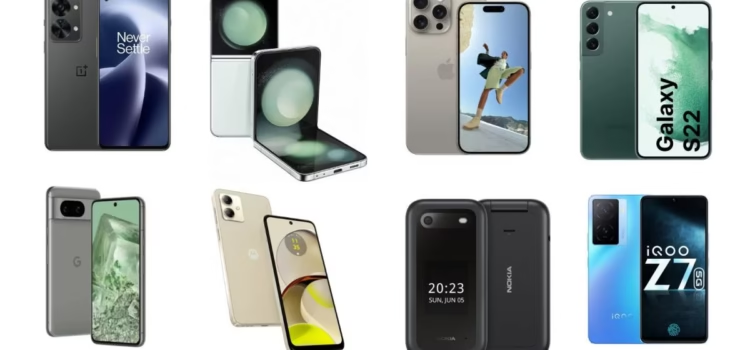
Walk into any US carrier store and it’s clear that big phones still dominate the shelves, but compact smartphones are no longer an afterthought. In 2026, smaller phones have quietly evolved from niche options into fully capable flagships. Devices under 6.3 inches now ship with top-tier processors, advanced camera systems, brighter OLED displays, and years of guaranteed software updates, without the compromises that once defined “small” phones.
Apple, Samsung, Google, and select Chinese manufacturers have all doubled down on compact designs that fit better in pockets, work comfortably with one hand, and appeal to users who value usability as much as raw specs. For US consumers tired of oversized slabs, bulky cases, and screen fatigue, these phones strike a rare balance: flagship-level performance in a size that actually feels practical. Below are some of the best compact phones in 2026 that you can actually buy.
Samsung Galaxy S25
Equipped with a fast processor, great cameras, and seven years of software and security updates, you get tremendous outcomes for your buck along with a comfortably pocketable size.
Pros
- Smaller form factor with slim bezels
- Snapdragon 8 Elite for Galaxy chipset with 12GB RAM
- New and improved Galaxy AI features
- One UI update is fresh, fun, and genuinely great
- Refined design with Gorilla Glass Victus 2 on front and back
Cons
- Lacks UWB support
- Relatively small 4,000mAh battery
- Slow 25W wired charging speeds
Galaxy S24
The Galaxy S24 is one of the best last-gen compact phones thanks to its handy size and great software. It’s nearly as powerful as the S25 and has the same set of cameras.
Pros
- Compact 120Hz AMOLED display
- Long software support
- Snapdragon 8 Gen 3 processor
- Strong battery life
Cons
- Inconsistent camera performance
- 25W charging is starting to feel slow
Google Pixel 9a
Retailing for under $500, the Pixel 9a boasts outstanding camera tech, the same processor found in the Pixel 9 and Pixel 9 Pro, and a sleek and compact design.
Pros
- Fantastic battery life
- Bright and vivid display
- Lots of access to Gemini AI features
- Seven years of OS and security updates
- Wonderful Macro Focus photos
Cons
- There isn’t much on-device AI
- Charges very slowly
Google Pixel 10
The Google Pixel 10 might not seem particularly impressive over a Pixel 9 at first glance, but the changes to the design, the larger battery, and its new AI features kind of make up for the increase in price. The Pixel 10 has similar dimensions to the Pixel 9, so it’s compact and sleek though a tad thicker with a wider camera bar.
Pro
- Convenient built-in Qi2 support via Pixelsnap
- Upgraded telephoto lens
- Long battery life, fast charging
- Excellent AI features
Cons
- Still lacks some Pro features
- Not ideal for gaming
- Display isn’t as eye-friendly as more premium options
Sony Xperia 5 IV
Sony Xperia 5 IV has a compact OLED display, which enables creators to operate its manual camera controls. This system includes front-facing speakers that deliver audio optimized for watching movies and taking photographs.
Pros
- Easy to handle with one hand and fits in pockets.
- A large 5,000 mAh battery provides long-lasting, all-day power.
- Includes a 3.5mm headphone jack and supports wireless charging
Cons
- Users report overheating during 4K video recording
- The Camera Pro app requires manual adjustments
- Shorter lifespan for major Android OS updates compared to competitors
Samsung Galaxy Z Flip 6
Galaxy Z Flip 6 is a pocket-friendly model that provides flagship-level performance. It also offers improved durability, better cameras, and practical multitasking through its refined cover display.
Pros
- Fantastic performance
- Refined design matches the Galaxy S24 series
- Clean software with seven years of support
- Fun and useful Galaxy AI features
- Official rating for dust resistance
Cons
- No telephoto lens
- More expensive
- Limited cover screen experience out of the box
Asus Zenfone 11
Asus Zenfone 11, with its 5.9-inch display, near-stock Android experience, and flagship processor and strong thermal control, remains a favourite among users who value performance.
Pros
- Equipped with the Snapdragon 8 Gen 3 chipset
- Useful for high-end gaming and multitasking
- 2-day battery life with normal use
- Features a bright 144Hz AMOLED display
Cons
- It struggles to match top-tier competitors like Samsung or Google
- The optical, under-display sensor can be less accurate
Motorola Razr
Enjoy the best of both worlds for less than you’d pay for a traditional phone with this snazzy device that folds out to reveal a 6.9-inch screen. But when it’s closed, you get a super-compact size and a useful 3.6-inch external screen for accessing basic tasks.
Pros
- Compact, durable form factor
- Available in fun colors, textures
- Satisfying, titanium-reinforced hinge
- Long battery life, fast charging
- Solid 50MP main camera sensor
- Cover screen is useful for basic tasks
Cons
- Some critical Moto AI features don’t run on device
- Processor occasionally lags
- Limited software support
- Rear camera lenses are dust and fingerprint magnets
OnePlus 13 Mini
OnePlus 13 Mini achieves 120Hz display capability through its Snapdragon processor, which delivers high-speed performance. The Plus 13 Mini device offers two features: rapid battery charging and the standard OxygenOS user interface.
Pros
- Comfortable grip for one-handed use
- Equipped with the powerful Snapdragon 8 Elite chipset
- Strong performance for gamers
Cons
- Less immersive for media consumption
- Struggle to dissipate heat during prolonged gaming sessions
Google Pixel 7a
The Google Pixel 7a is a top-tier compact smartphone, featuring a 6.1-inch display, flagship Tensor G2 performance, and an excellent camera in a manageable, one-handed form factor.
Pros
- Excellent Tensor G2-powered features
- Strong performance
- Water-resistant
Cons
- Battery does not last all day
- Only three years of OS update support
- Only 90Hz display
Which One is Good for You?
Those who prefer the smaller screen experience can still choose from a fantastic selection of both new and previous-gen devices. This includes both standard bar-style phones as well as foldables that give you a tiny screen for glanceable information and a bigger one only when you really need it.
When it comes to our performance, the Galaxy S25 is an easy choice with the latest Snapdragon 8 Elite SoC powering it, and excellent software support from Samsung promising seven years of Android updates. Compared to the Samsung Galaxy S24, the S25 has increased RAM right from the base variant and is slimmer and lighter.
The Google Pixel 9a may not be what everyone considers “small” but it has amazing specs across the board, comes in at a price that’s more than reasonable.
If you want a foldable, you can’t go wrong with the Samsung Galaxy Z Flip 6. But consider the Galaxy Z Flip 7 if you don’t mind something a smidge better, noting that it’s also much thinner, too.
Final Thoughts
The resurgence of compact flagships displays changing user preferences. As phone screen sizes grew, many buyers began prioritising comfort and daily usability over a larger display alone. Advances in chip efficiency, battery technology, and camera software have removed most technical limitations once associated with smaller devices.
FAQs
1. What screen size qualifies as a compact phone in 2026?
Most compact phones today feature displays under 6.3 inches, offering better one-handed usability without major feature compromises.
2. Which compact phone offers the best overall performance?
The Samsung Galaxy S25 stands out with its Snapdragon 8 Elite chipset, refined design, and long-term software support.
3. Which compact phone has the best camera quality?
Google Pixel models, especially the Pixel 9a and Pixel 10, are known for their excellent computational photography and camera consistency.
4. Do compact phones compromise on battery life?
Modern compact phones benefit from efficient processors and improved battery technology, allowing many to deliver all-day battery life.
5. Who should consider buying a compact smartphone?
Compact phones are ideal for users who value comfort, portability, one-handed use, and flagship features without carrying a bulky device.
Ref: Compare smartphones- Galaxy S25 Ultra, Galaxy S24 Ultra.