






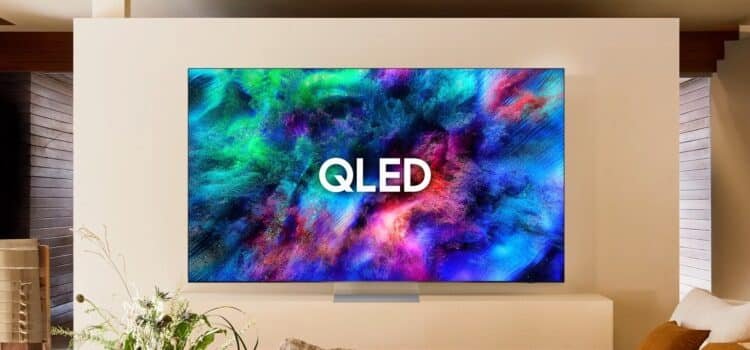
Whether you’re shopping for an entry-level set or a premium OLED, Samsung has a TV for nearly every price range, screen size, and viewing style. That said, not every model is created equally. The best Samsung TVs stand out by delivering the right balance of picture quality, smart features, and overall value.
Samsung releases a fair share of new models every year, so if you find yourself searching the internet for the best Samsung televisions, you might become overwhelmed by the number of options. We can help narrow down your options to find the best Samsung television for your needs and budget.
Samsung TV Buying Guide
What is LED?
LED stands for light-emitting diode and simply refers to the backlight that lights up your TV. But not all LED TVs are created equal – the technology around them varies, and so too will your picture quality. This is why OLED and QLED TVs are seen as superior displays. With standard LED TVs, you’ll find big differences not only in the number of LEDs but the quality of each LED. This can lead to big differences in colour, contrasts, and the brightness of pictures you see on TV.
What is an OLED TV?
OLED stands for organic light-emitting diode. Unlike standard LED TVs, which use a backlight to produce colours, OLEDs produce both light and colour from a single diode or pixel. Their ability to be self-illuminating means they produce ‘real’ blacks. Deeper blacks allow for higher contrasts and richer colours, which in turn leads to a more natural and realistic image.
This innovation means that OLED TVs no longer need a separate backlight and instead produce bright, colourful pictures from individually operated pixels.
What is Neo QLED?
Samsung Neo QLED technology is an advancement of Samsung’s QLED technology. Samsung’s Neo QLED range boasts Quantum Mini LEDs. These are only 1/40th of the size of traditional LEDs – approximately the size of a grain of sand. These lights are expertly controlled, so you get better contrast and detail across the screen.
And, since their size means the TV can fit more Mini LEDs in, Neo QLED TVs have a higher brightness level and exceptional picture quality on every inch of the screen. The light from Quantum Dots is now even more efficient, allowing Neo QLED TVs to be brighter, richer and more colour accurate compared to previous models
Neo QLED vs OLED: Which is better?
Both come with their own unique benefits, so really it comes down to personal preference and what you value most out of a TV. Here is a quick rundown of how the two display technologies differ.
Best Samsung TVs in 2026
Samsung S95F OLED
The Samsung S95F OLED is the best Samsung TV. Like any OLED, you get unrivaled black levels, so blacks are deep and inky in a dark room. Since it uses a QD-OLED panel, you also get incredibly bright and vibrant colors that can’t be matched by traditional WOLED displays. A lot of OLED models don’t fare well in bright rooms, but this TV is the only OLED on the market that features a matte screen coating.
Reflections are almost invisible on this TV, so overhead lights and even direct light sources facing the screen are non-factor. Combined with its amazing peak brightness, visibility isn’t an issue at all on this TV. Another positive is that it has a very wide viewing angle, so it’s great for group settings. It comes with Samsung’s unique Slim One Connect Box, which gives you quick access to the inputs when the TV is wall mounted and offers versatility for your setup.
The TV is also equipped with a plethora of modern gaming features like four HDMI 2.1 ports, 4k @ 165Hz, and VRR, making it a great option for pairing with modern consoles and gaming PCs. It also has nearly instant pixel transitions, so motion is crisp and clear.
In addition to that, it has exceptionally low input lag for a responsive feel. Home theater enthusiasts may be put off by Samsung’s lack of Dolby Vision and DTS audio passthrough, but if you can live without those features, the S95F is one of the best TVs on the market.
Samsung S90F OLED
Samsung S90F OLED comes in, which is the best Samsung TV in the upper mid-range category. Being a QD-OLED, you still get the same perfect black levels and similarly vibrant colors as its older sibling. You also get impressive HDR brightness, so HDR content is impactful. Unfortunately, the TV isn’t nearly as bright in SDR as the S95F, and it’s not nearly as good with reflection handling due to its glossy coating, so there are some visibility issues in bright rooms.
Still, you can watch TV and not be distracted by glare in moderately lit rooms. You also get the same wide viewing angle as the more expensive model, so it’s great for wide seating arrangements.
Despite not offering 165Hz support, you can still game in up to 4k @ 144Hz with VRR on any of its four HDMI 2.1 ports. The TV has the same nearly instant pixel transitions and low input lag, so you get a sharp and smooth gaming experience.
Like any Samsung TV, it doesn’t support Dolby Vision or DTS audio passthrough, but it still offers HDR10+. If you’re considering this TV, just keep in mind that only some sizes have a QD-OLED panel, and even that varies by region.
Samsung S85F OLED
If you want an OLED, but the two picks above are out of your price range, consider the Samsung S85F OLED. It’s not as bright as the Samsung S90F OLED, and it caps out at 4k @ 120Hz, but outside of that, the two TVs are remarkably similar. You still get the perfect black levels, vivid colors, wide viewing angle, and the nearly instant response times QD-OLEDs are known for.
Even though the TV isn’t as bright as its more expensive siblings, you can still watch SDR content in a room with a few lights on and not be distracted by reflections. There’s a larger disparity in HDR brightness compared to the other two Samsung OLEDs, so highlights in dark scenes and entirely well-lit scenes don’t pop out as much, but you still get a decently impactful HDR experience.
Some PC gamers might feel like they’re missing out by not having a 144Hz refresh rate, but the TV still offers four HDMI 2.1 ports capable of 4k @ 120Hz with VRR, so the TV is fully compatible with the features offered by modern consoles.
Unfortunately, like the S90F, there’s a catch. In North America, only the 55-inch and 65-inch models use a QD-OLED panel, whereas the larger options utilize a normal WOLED panel. The rest of the world gets a WOLED panel throughout all size options. You can determine what type of panel it has by looking at the model code.
Samsung QN80F
Samsung QN80F is the best lower mid-range Samsung TV. It’s a lot brighter than the Samsung S85F OLED in SDR, so it overcomes more glare in a well-lit room. Although the Samsung has local dimming to help deepen blacks, you don’t get anything close to the inky blacks you get from OLEDs, and there’s haloing around highlights.
It has about the same HDR brightness as the S85F, but since its contrast ratio is much lower and it doesn’t display as wide a range of colors, HDR content doesn’t look as good on it. The TV’s viewing angle is pretty narrow, so it’s not as good for wide seating arrangements as the OLEDs above.
Fortunately, it has HDMI 2.1 bandwidth, up to 4k @ 144Hz, and VRR, so it pairs excellently with modern gaming consoles. The TV’s input lag is low on this model, but pixel response times are a lot slower than they are on OLEDs, so fast motion is a bit blurry. Like almost any Samsung model, it supports HDR10+, which helps HDR content look as good as it can on this model
Samsung Q7F
The Samsung Q7F is the best budget Samsung TV available. Samsung doesn’t release many budget models anymore, and the ones they do release tend to have mediocre image quality. That’s the case here, as the Q7F doesn’t have local dimming to help deepen blacks, which leads to dark scenes looking washed out. The TV is also too dim to handle much glare at all in a room with the lights on, so it’s best suited for a dimly lit environment.
Its lack of brightness also means that HDR content looks underwhelming, since highlights don’t stand out like they should. Colors are also more muted on this TV, and the image lacks vibrancy. Like the Samsung QN80F, it has a narrow viewing angle, so it’s best viewed from directly in front of the screen.
Unfortunately, this is a 60Hz TV that’s pretty bare-bones in terms of gaming features. It doesn’t have VRR to reduce screen tearing, and motion is blurry due to its slow pixel response times. However, 4k @ 60Hz gaming has decently low input lag, so at least gaming feels responsive.
You still get HDR10+, which makes HDR content look a bit better, but that format doesn’t save this TV from looking underwhelming. If you really want a budget Samsung TV, it’s not the worst choice, but most people are better off shopping for a budget model from brands like TCL and Hisense.
What Makes Samsung TVs Special?
Samsung’s high-end models are some of the best TVs we’ve tested. They don’t excel in just one category; they’re well-rounded and offer great performance for various uses.
Perform well in dark and bright environments.
Their QLED TVs, especially those with VA panels, have high contrast and get bright, so they’re good for dark and bright rooms.
Samsung is a leader in gaming features, and even their mid-range models have variable refresh rate (VRR) and ALLM support.
Downsides of Samsung TVs
Uniformity issues.
Samsung models typically don’t have the best gray uniformity and have some dirty screen effect, which could get distracting during sports or PC use.
TVs can be costly, and may not offer good value.
Samsung’s high-end TVs can get costly, so while they provide the best performance, they may not have the best value compared to other brands. There are often cheaper TVs that you can get with no compromises.
Few budget models.
Although Samsung used to offer a wide range of budget models, in recent years, they’ve really scaled down their budget lineup. Their budget models typically aren’t worth buying when you can get better picture quality and performance from companies like Hisense and TCL.
No Dolby Vision or DTS audio support.
Although Samsung has their own dynamic HDR format in HDR10+, none of their TVs support the more widely used Dolby Vision format. They also don’t include support for advanced DTS audio formats, which are prevalent in physical media.
What You Should Know Before Buying a Samsung TV?
Samsung’s lineup covers everything from budget to high-end models. As a rule of thumb, the higher the number, the better it is, although sometimes the improvements aren’t worth it. Samsung releases four main TV lineups, and they use a consistent naming scheme for the top three lineups, which makes it very easy to understand what you’re buying simply by looking at the model number.
Samsung uses the prefix ‘Q’ to denote their mid-range QLED models, and the last letter of these models also reflects the model year. They introduced the Mini LED lineup in 2021, denoted by the prefix ‘QN’ in the model name, like the Samsung QN90D. Their entry-level models follow a slightly different naming structure in 2025, with a single ‘Q’ used to identify their lower-end options. For example, the Q7F is a normal LED model without features like local dimming.
Both OLED and Neo QLED displays have incredible colour accuracy, volume and brightness making them excellent choices. Each TV will have its own display specs. If you’re seeking a brighter image with a higher level of contrast between light and dark areas onscreen, it’s worth looking for TVs that have a vast colour gamut (that is the spectrum of colours) and HDR technology. Neo QLED in particular has high HDR brightness levels and a wide HDR range.
Final Thoughts
Samsung TVs are versatile and can provide good-to-excellent picture quality. Samsung introduced their new Neo QLED TV lineup in 2021, which is an improvement on their more traditional QLED lineup as it introduces Mini LED backlighting. When combined with the quantum dot layer, their high-end TVs provide great picture quality.
Along with Sony, they also released the first QD-OLED TV in 2022 to compete with LG’s OLED lineup, which improves color vibrancy over traditional WOLED panels. Samsung has continued to improve this QD-OLED technology over the past few years, and their high-end OLEDs are still equipped with QD-OLED panels.
FAQs
1. Which is the best Samsung TV to buy in 2026 overall?
The Samsung S95F OLED stands out as the best overall Samsung TV in 2026, offering exceptional picture quality, gaming features, and performance in both dark and bright rooms.
2. What is the main difference between Samsung OLED and Neo QLED TVs?
OLED TVs use self-lit pixels for perfect blacks and contrast, while Neo QLED TVs use Mini LED backlighting for higher brightness and better performance in well-lit rooms.
3. What is Neo QLED technology and how is it better than QLED?
Neo QLED uses Quantum Mini LEDs that are much smaller and more precisely controlled than traditional LEDs, resulting in better contrast, brightness, and picture uniformity.
4. Does Samsung support Dolby Vision on its TVs?
No, Samsung TVs do not support Dolby Vision. Instead, they use HDR10+ as their dynamic HDR format across most models.
5. What should I check before buying a Samsung TV?
Consider room lighting, viewing habits (movies, gaming, sports), panel type (OLED vs Neo QLED), refresh rate, HDR support, and whether the model offers features like HDMI 2.1 and VRR.