




Evolution of Smart Speakers:
Early Beginnings: The concept of voice-controlled technology has been around for decades, but the smart speaker revolution took its modern form in 2014 when Amazon released the Echo based on Alexa. The innovation took voice interaction from the niche to the mainstream. Competitors such as Google through Google Home, Apple through HomePod, and subsequently other manufacturers including Samsung and Sonos soon followed, building on features and making it more accessible across the globe.
Advancements in Technology: Smart speakers soon adopted artificial intelligence, natural language understanding, and cloud computing to enhance responsiveness and accuracy. Initial models were script-driven, but modern devices can recognize context, identify individual voices, and conduct sophisticated operations such as controlling smart home systems, managing calendar events, and delivering real-time data. Converging multiple ecosystems such as smart lighting, thermostats, and entertainment systems has made smart speakers ubiquitous control hubs in contemporary connected homes.
Enlarging Roles and Uses: Apart from convenience, smart speakers have also become central to learning, enterprise, and accessibility. They help people with disabilities by providing hands-free usage, providing translation in different languages, and even interactive learning tools for kids. The integration of machine learning and cloud connectivity means that the devices keep evolving and refining themselves through constant upgrades.
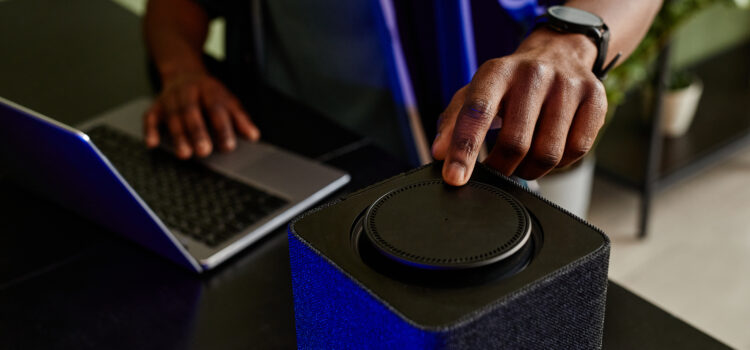
Smart speakers are wireless devices which are very innovative devices. Virtual assistants to provides hands-free operation for multiple functions via voice commands. smart speakers have been used in house management. Smart speakers are used to listening to music, streaming multimedia, and even task management.
Commonly linked through Wi-Fi or Bluetooth, smart speakers employ AI-driven assistants like Amazon Alexa, Google Assistant, and Apple Siri to execute natural language commands. This helps users to operate various devices like home appliances like (lights,fans,security camera’s).
Top models 2025 (Echo, Nest, HomePod):
Amazon Echo (4th Generation): Amazon’s Echo continues to be a top pick in 2025, weighing sound quality, value, and home automation support. The new Echo boasts a 3-inch woofer and a pair of tweeters that produce excellent bass and crisp audio at high volumes. Alexa support provides wide support for smart home products and third-party services. The integrated Zigbee and Matter support make it an ideal center hub for many connected devices, which works perfectly for a smart, efficient home configuration.
Google Nest Audio: Google Nest Audio shines in delivering natural, clear sound with impressively well-balanced frequency response vocals and instruments sound crisp and real. Nest Audio’s best aspect is its integration with Google Assistant, which responds promptly and correctly to voice commands. Ambient IQ technology adjusts volume according to ambient noise, helping podcasts and audiobooks. Nest Audio offers great value to those committed to Google’s ecosystem without being unreasonably expensive for most homes.
Apple HomePod (2nd Generation) : The Apple HomePod (2nd Gen) focuses on computational audio that adapts automatically to the room, enhancing powerful bass and enveloping spatial audio. Siri integration is effortless for users of Apple devices, providing a unified experience for music, messaging, and controlling the smart home. The HomePod is ideal for Apple enthusiasts who want superior sound and in-depth connectivity between Apple devices, but its increased price is most warranted for those already in the Apple ecosystem.
Voice Assistant Privacy in 2025:
What Users Need to Know?
Voice assistants like Amazon Alexa, Google Assistant, and Apple’s Siri have become fixtures in homes, helping with everything from playing music to automating smart devices. However, their always-listening nature raises significant privacy concerns. These devices constantly monitor audio to detect wake words but can inadvertently collect sensitive data such as location, contacts, browsing history, and private conversations. Research indicates Amazon’s Alexa gathers more than 28 data points, whereas Google Home gathers as many as 22, possibly connecting personal profiles with the audio data gathered. It poses threats to user privacy if data is misused or distributed without open consent.
Consumers need to actively control privacy by reviewing the device’s privacy settings on a regular basis, silencing the device when not in use, clearing stored voice recordings, and establishing robust access controls and voice recognition tailored to household members. Some privacy-driven brands such as Josh.ai prioritize local data processing, transparent user data ownership, and visual cues for when voice assistants are in listening mode, raising the bar for privacy protections.
Voice Assistant Shopping Guide: Sound, Home Automation, and Cost When choosing a voice assistant in 2025, there are three principal considerations: music sound quality, smart home automation features, and cost.
Music quality: The new devices, including the Echo Studio and Sonos Era 300, provide remarkable room-filling sound with deep bass and spatial audio capabilities. Nonetheless, the Echo Studio does justice to quality and price with a cost around $100-$200, whereas Sonos models can reach more than $400 for high-quality audio performance.
Smart home control: Alexa has wide support for Zigbee devices and extensive smart home integrations. Google Assistant has superior natural language support and services integration. More privacy-oriented platforms might process commands locally but could have fewer third-party integrations.
Price factors: Budget voice assistants range from $50-$100, which provide fair sound and automation for light users. Luxury models can cost more than $400, targeting audiophiles or users who require advanced smart home management. Premium features like improved AI or emergency services may incur subscription charges.
Verdict and Recommendations: In 2025, voice assistants are worth their weight but need to be managed carefully when it comes to privacy. Amazon Echo devices give great value to most users with good music and automation capabilities, but users need to know Amazon’s data-gathering habits.
Privacy-oriented users can opt for alternatives such as Josh.ai or open-source alternatives such as Mycroft, which emphasize local data processing and user autonomy over data. Establishing strong privacy settings, silencing devices when not in use, and periodic voice data clearing are crucial steps to take.
Q1: What are the top-rated smart speakers in 2025?
A1: The best smart speakers of 2025 are the Sonos Era 300 for best sound quality and spatial audio, Amazon Echo Dot (5th Gen) for budget Alexa experience, Apple HomePod (2nd Gen) for users of Apple, Google Nest Hub Max for smart speakers with display, and Bose Portable Smart Speaker for outdoor and portability.
Q2: Which smart speaker provides the best sound quality for music enthusiasts?
A2: The Sonos Era 300 is a best one for music lovers with its immersive Dolby Atmos spatial audio support and room filling sound.
Q3: What is the most affordable smart speaker with solid Alexa support?
A3: The Amazon Echo Dot (5th Gen) is a nominal cost of about $50, providing good Alexa integration and can be used at home.
Q4: What is the top smart speaker for Apple users?
A4: The Apple HomePod (2nd Gen) is perfect for Apple users, provides high-fidelity spatial audio, easy connectivity with Apple devices, and a privacy-centric design.
Q5: Are there smart speakers with screens?
A5: Yes, Google Nest Hub Max also features a 10-inch display, which is hands-free controlled, visually engaged, and smart home managed by Google Assistant.