






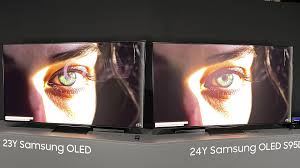
Samsung’s OLED Glare Free is an innovative solution to revolutionize the viewing experience through its sharp reduction in screen glare on OLED technology, making OLED ideal for bright American living rooms and homes across the US and beyond.
Let’s dive deep into the article for better understanding on What is Samsung OLED Glare Free technology and how does it work?
Core Technology Explained
Samsung OLED Glare Free features an exclusive matte coating solution on QD-OLED devices, which was initially used on the S95D lineup released in 2024. Samsung’s OLED Glare Free features an analogous hard coating layer on its QD-OLED devices that contain minute textures on the surface, effectively scattering incident light and turning sharp reflections into blurry and soft haze. This is different from traditional matte coating solutions due to its maintenance of OLED’s color depth and brightness, as seen in its compatibility with HDR content
The tech was initially branded as “OLED Glare Free” before it advanced to “Glare Free 2.0” in 2025 models such as the S95F. It achieves a 30% increase in brightness while reducing glare by a significant amount. Samsung offers it along with Quantum Dot to deliver Pantone certification in terms of color accuracy while maintaining it without losing contrast or saturation.
How It Works Step-By-Step
The basic rules of optics tell us that light reflection in TV sets is caused when light hits a glossy or shiny TV screen and tends to bounce back towards us in straight reflections when there is sunlight or ambient light in the room
Layer 1: Base Coat Made from Hard Coating. This is an ultra-thin and sturdy coating material that attaches to the OLED display while providing protection from scratches and transmitting light waves.
Layer 2: Micro-Pattern Etching “Nanoscale ridge patterns diffuse rays at various angles, reducing specular reflections by as much as 75 percent in tests.”
Layer 3: Brightness Optimization QD-OLED emitters continue to produce peak output (?+ > 1,600 nits), thus neutralizing possible diffusion
Result: Reflections change from bright images to dim glows, even in direct lamps and windows.
| Reflection Handling Mechanism | Traditional Glossy OLED | Samsung OLED Glare Free |
| Direct Light Bounce | High (sharp mirrors) | Low (diffused haze) |
| Off-Axis Viewing (70°+) | Persistent glare | Noticeable but dim |
| Brightness Impact | N/A | None (QD-OLED boost) |
| Color/Contrast Preservation | N/A | 100% retained |
Real-Room Testering Insights
In homes with open layouts and naturally present sunlight, 70% of OLED display users suffer from glare, according to existing surveys. TechRadar conducted a series of tests on these displays compared to others that used artificial sunlight. They compared these displays to the Glare Free models and found that while there were reflections on other OLED displays, those rendered dark scenes almost invisible.
Tom’s Guide CES demo verified, as OLED TVs from prior years featured sharp reflections of lights, while S95D TV showed a softening of reflections as a “very dim white light” that could be useful in sports viewing in a bright room, in news programs, etc., in a kitchen, sunroom, etc., that could otherwise create a distraction for viewers. 25% more reduction of reflections in 2025 upgraded S95F TV, verified by UL Solutions, represents
Limitations: Extreme side angles greater than 80 degrees show hazy details; not completely hidden as ideal lab setups.
| Real-Room Scenario | Standard OLED Performance | Glare Free Performance | Improvement |
| Living Room Lamps | Strong edge reflections | Barely visible | 70% reduction |
| Window Sunlight | Full mirror effect | Diffused glow | 75% less glare |
| Kitchen Overhead | Washed-out blacks | Pure blacks intact | Eye comfort up |
| Evening Mixed Light | Moderate distraction | Optimal clarity | 25% better (2025) |
OLED Vs Mini-LED Comparison
OLED stands out in pure black levels because of pixel lighting, but it traditionally struggles in very glossy spaces but 2,000+ nits’ brightness, along with semi-matte display panels, make Mini LED LCDs suitable spaces, until Samsung picked up the pace.
Now the Samsung OLED “Glare Free” surpasses almost all mini-LEDs in reflection management but tops them in contrast – infinite vs. “blooming”. For raw peak brightness in HDR pops, mini-LEDs hold the edge, but the Samsung oled excels for viewing angles and motion.
| Feature | Samsung OLED Glare Free | Mini-LED (e.g., Samsung QN90D) | Winner for U.S. Homes |
| Glare Reduction | 75%+ diffusion | 50-60% via matte | OLED Glare Free |
| Black Levels | Perfect (pixel-off) | Excellent, some bloom | OLED |
| Brightness (Peak) | 1,600-2,000 nits | 2,000-3,000 nits | Mini-LED |
| Bright Room Use | Now excellent | Strong historically | Tie |
| Cost (65-inch) | $2,500-$3,500 | $1,800-$2,500 | Mini-LED |
| Burn-In Risk | Low with safeguards | None | Mini-LED |
For American households binge-watching Netflix in lit dens, Glare Free recommends OLED over.
Models Featuring the Tech
Samsung released OLED Glare Free in 2024’s S95D (55 inches – 77 inches), which continued in 2025 with S95F, featuring Vision AI and 165Hz modes. More affordable models, such as S90D, also exist, featuring lighter versions
| Model Series | Launch Year | Key Upgrade | Sizes (inches) | Price Range (USD) |
| S95D | 2024 | Original Glare Free | 55, 65, 77 | $2,200-$4,000 |
| S95F | 2025 | Glare Free 2.0 +30% bright | 55-83 | $2,800-$5,500 |
| S90D | 2024 | Partial anti-glare | 55-83 | $1,800-$3,200 |
| Future 2026 | 2026 | AI-enhanced layers | TBD | TBD |
All of them also support 4K at 144Hz for PS5/Xbox, Dolby Vision competitors
Benefits for the Everyday US Viewers
This tech is perfect for busy families with tailgate gatherings with overhead lighting, kids’ TV programs during the day, and Sundays filled with the big game. This display helps prevent eye strain with minimized squinting, according to UL. This display uses power efficiency that is typical of OLED displays. They have warranties against panel defects.
Its competitors, such as LG’s MLA OLED, have Vanta Black AR, which is good but less diffuse than Samsung’s option. Samsung is also the best option for an anti-reflection TV in a bright
Future Outlook
Expect greater AI integration with dynamic glare adaptation by 2026. Combined with increasing QD-OLED panel brightness, OLED will be considered standard in high-end U.S.-based configurations, competing with projectors on ease of use. Early adopters praise as a real-world testing verifies it’s not a gimmick.
FAQS
1. What is Samsung OLED Glare Free technology?
A matte-like coating on QD-OLED panels that scatters light to eliminate reflections while preserving perfect blacks and vibrant colors.
2. How does Samsung OLED Glare Free work?
It uses a hard coating with micro-pattern etching to diffuse incoming light rays by up to 75%, turning sharp glare into faint haze.
3. What are real-room testing results for glare reduction?
Tests show 70-75% less distraction from lamps or sunlight compared to standard OLEDs, ideal for bright U.S. living rooms.
4. How does OLED Glare Free compare to Mini-LED?
It matches Mini-LED bright-room performance with superior infinite contrast and no blooming, winning for mixed lighting.
5. Which Samsung models feature OLED Glare Free?
Flagships like the 2024 S95D and 2025 S95F with Glare Free 2.0, plus lighter versions in S90D series.