




Project Kuiper is Amazon’s low-Earth-orbit satellite network. Its goal is to close the digital gap by bringing fast, affordable internet to communities without reliable access through traditional means.
To get online with Kuiper, customers install a rugged outdoor antenna called a customer terminal that connects directly with satellites racing overhead. Past versions of this equipment were often too bulky, complex, or expensive, preventing LEO satellite networks from fully realizing their vision. Now, Kuiper aims to change the game.
Project Kuiper targets tens of millions of customers, setting an early goal to build a customer terminal for under $500. Engineers met this in 2020 by inventing a compact, lightweight antenna. They’ve continued refining designs to make terminals even smaller, cheaper, and more powerful.
Building on these advancements, Amazon recently shared the results of its ongoing work. Read on to discover more about the small, powerful antennas and the technology that makes them possible.
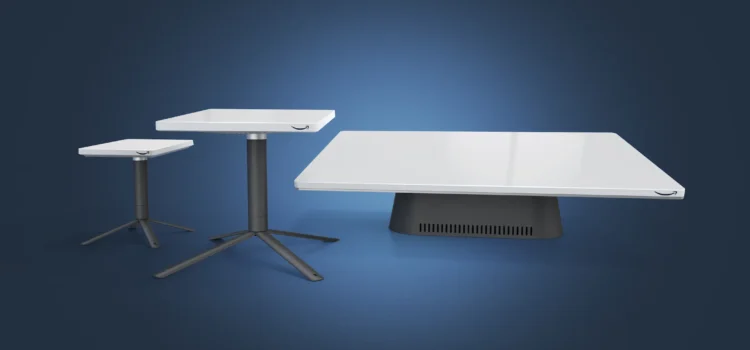
Continuing this momentum, at a satellite industry conference in Washington, D.C., Amazon provided a first look at three engineering models that will anchor its customer terminal portfolio.
The standard customer terminal is for homes and small businesses. It is compact, less than 11 inches square, 1 inch thick, under 5 lb, and it will deliver up to 400 Mbps. Amazon expects to produce it for under $400.
An Ultra-Compact Design To Help Connect Even More Customers
The 11-inch-square design will be Project Kuiper’s smallest and most affordable customer terminal, weighing just 1 pound and offering speeds up to 100 Mbps. It offers portability and affordability, creating opportunities to serve even more customers worldwide. This design will connect residential customers who need an even lower-cost model, as well as government and enterprise customers pursuing applications such as ground mobility and the Internet of Things (IoT).
Project Kuiper’s largest terminal meets demanding needs for businesses, government, and telecom users. It measures 19 by 30 inches and delivers speeds up to 1 Gbps.
“Our mission with Project Kuiper goes beyond simply connecting the unserved and underserved it’s about delivering outstanding quality, reliability, and value,” said Rajiv Badyal, Amazon’s Vice President of Technology for Project Kuiper. “Every choice has pushed us to raise the bar for experience, and our diverse terminals prove our commitment.”
Powered by Amazon Design Custom Chips
Project Kuiper customer terminals are powered by an Amazon-designed baseband chip, code-named Prometheus. This chip combines:
- The processing power of a 5G modem found in modern smartphones
- The ability of a base station to handle thousands of users simultaneously
- The strength of a microwave backhaul antenna for robust point-to-point connections
All of these features are combined into one custom chip.
Format as: Powers Project Kuiper customer terminals, satellites, and ground gateway antennas enabling each satellite to process up to 1 terabit per second (Tbps) of traffic.
Getting Ready To Offer Commercial Service
Drawing from its history of mass device production, Amazon is leveraging this expertise as Project Kuiper designs and produces its customer terminals. To meet the anticipated demand, the team is expanding infrastructure to prepare for producing tens of millions of units.
Following these preparations, Project Kuiper is getting ready to launch its first two prototype satellites on the first flight of the United Launch Alliance (ULA) Vulcan Center rocket. This mission will provide engineers with real-world data on how the systems operate in space and will allow them to test the full communications network simultaneously.
Project Kuiper is expanding its operations to prepare for commercial services. For instance, the team has started building a dedicated satellite production facility in Kirkland, Washington, and plans to begin mass-producing satellites by the end of 2023. Project Kuiper aims to launch the first production satellites in the first half of 2024 and plans to offer this service to its earliest customers later that year.
Source: Here’s your first look at Project Kuiper’s low-cost customer terminals