






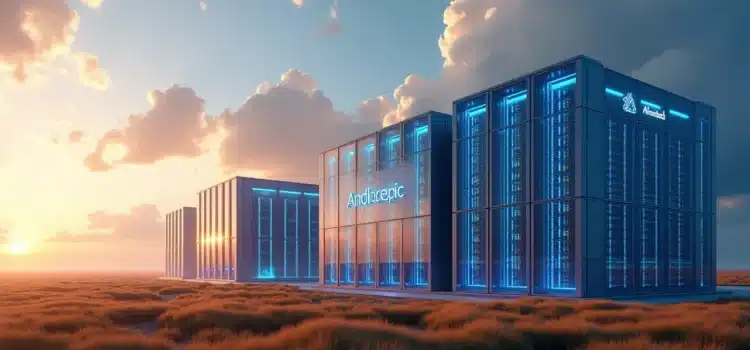
Anthropic’s intention to allocate $50 billion towards new data centers in the United States highlights the significant scale and urgency associated with AI infrastructure. Information that the United States would soon receive AI investment was first disclosed by Reuters. Given Reuters’ reputation, the United States is likely to have Anthropic AI soon. Reuters placed Anthropic among the foremost developers of AI infrastructure to date. Furthermore, this announcement highlights a broader challenge for executives to lead responsibly in the face of increasing global demand for data capacity.
Below is what Anthropic’s $50 billion investment means for the U.S. AI ecosystem
Anthropic funding in AI data centers is likely to boost U.S. AI growth, help create much-needed jobs, and enable people to lead more fulfilling lives. The project is estimated to create approximately 800 permanent jobs and 2,400 construction jobs, with sites coming online throughout 2026. Additionally, it will help advance the objectives of the Trump Administration’s AI policy, which aims to fuel U.S. AI growth and maintain American leadership in AI, thereby strengthening the country’s domestic technology infrastructure.
We are approaching a stage where artificial intelligence can enhance scientific discovery and address intricate challenges in ways previously deemed impossible. Achieving this potential necessitates a robust infrastructure that can facilitate ongoing advancements at the cutting edge, stated Dario Amodei, CEO and co-founder of Anthropic, as well as Claude AI.
When Leadership Assumes the Role of the Regulator
Leadership decisions are currently setting the benchmark in the absence of substantial regulatory networks. Decisions regarding site selection, energy sourcing, and community environment determine whether new initiatives bolster or burden the areas that accommodate them. Executives are assessed not only on the subject matter but also on the output they provide, as well as their ability to harmonize innovation and public confidence.
Transforming Constraints Into Opportunities
An analysis by the World Economic Forum highlights how European leaders are transforming environmental limitations into innovative solutions. In Sweden, the Stockholm Data Parks Initiative harnesses waste heat from local data centers to provide warmth to adjacent homes, aiming for an industry objective of no heat wasted. Meanwhile, in Finland, Microsoft is developing what it describes as the largest heat-recycling project globally, which is anticipated to supply energy to over 250,000 residents in three cities. In Ireland, waste heat generated by an Amazon data center is now utilized to heat schools and public buildings, thereby preventing more than 1,000 tons of CO2 emissions annually. Therefore, Anthropic’s Infrastructure, Expansion plans, and European Office launches (Paris, Munich) are looking forward to achieving the same objectives.
The MIT Energy Initiative has documented how leading technology companies, such as Google, Microsoft, and Amazon, are reconfiguring their energy strategies. Each company is investing in small modular reactors, renewable microgrids, and long-term nuclear collaborations to address the increasing energy requirements of AI while pursuing sustainability objectives. Perhaps the Anthropic Economic Futures Programme has similar objectives.
These decisions illustrate a significant distinction in leadership mentality. Certain organizations, such as Anthropic AI, focus solely on fulfilling compliance requirements. In stark contrast, others leverage these limitations as drivers of innovation, resulting in net benefits for both communities and the environment. The irony lies in the fact that this forward-thinking strategy frequently paves the way for future expansion. When companies prioritize visible local advantages, they cultivate the trust that results in increased approvals rather than a decrease. Conversely, organizations that grow without a systems-oriented approach encounter rising opposition, as recent instances in the United States clearly demonstrate.
When Leadership Falls Short
In Tucson, Arizona, a proposed AI data center has encountered significant community opposition due to anticipated groundwater extraction, prompting local authorities to impose stricter regulations on industrial water consumption, according to a report from the Associated Press. An investigation by Inside Climate News revealed that approximately $64 billion worth of data center initiatives in the U.S. have been either postponed or scrapped due to increasing concerns about land use, noise, pollution, and environmental consequences. The report published by the Associated Press is an indicator of how investors are responding to Anthropic’s move.
Iceland’s AI education pilot, in collaboration with Anthropic, is not expected to have a substantial direct effect on the competition in artificial intelligence among major players such as OpenAI and Google. However, it serves as a model for the responsible integration of AI and may shape future policies and collaborations, potentially boosting both demand and competition within the AI sector.
The initiative focuses on local needs and values, providing a standard for how other nations can ethically implement AI in public services.
The AI education pilot in Iceland is relatively small-scale and is unlikely to have a direct impact on AI competition with OpenAI and Google. Iceland does not challenge the core technology of artificial intelligence. Instead, their project focuses on incorporating AI into its educational system for local benefit.
The pilot model serves as a global model for other countries to establish a framework for responsible and ethical use of artificial intelligence in education, aligning with national values. Such successful pilots can result in increased demand for AI tools specifically designed for education, encouraging more competition in this particular niche.
With a focus on responsible integration, the pilot project in Iceland may influence how AI development is directed, prompting companies to prioritize ethical considerations and societal impact more. Additionally, such initiatives could lead to more partnerships between countries and AI companies, thereby fostering a global network of educators and AI.
Anthropic’s Path is propelled by its highly skilled technical team, its commitment to safety, and its cutting-edge research, encompassing groundbreaking work in alignment and interpretability. Each day, an increasing number of businesses, developers, and power users are placing their trust in Claude to help them address their most difficult challenges. -Anthropic caters to over 300,000 business clients, and the number of their large accounts (clients that contribute more than $100,000 in annual revenue) has surged nearly sevenfold in the last year.
Anthropic chose Fluidstack as its partner due to its ability to move with exceptional agility, enabling the rapid delivery of gigawatts of power. Fluidstack was established precisely for this moment, said Gary Wu, co-founder and CEO of Fluidstack. We are proud to partner with frontier AI leaders such as Anthropic to accelerate and deploy the infrastructure necessary to realize their vision.
The scale of this investment is essential to meet the ever-increasing demand for Claude from hundreds of thousands of businesses while keeping anthroposcopic research at the frontier. We will continue to prioritize cost-effective, capital-efficient approaches to achieve this scale as our growth continues.
Initially, the facilities planned by Anthropic will likely be developed in Texas and New York, forming the foundation of Anthropic’s long-term strategy to power its growing suite of AI tools and services. Anthropic has mentioned that additional locations across the U.S. are also under consideration.
The disclosure by Anthropic about this significant investment comes at a time when technology firms worldwide are rushing to add data center capacity, which forms the backbone of large-scale AI models. Such centers require years to complete and vast amounts of electricity to operate. Anthropic has recently partnered with Google to expand its access to the Claude infrastructure and high-performance chips. Therefore, the $500 billion investment in U.S. AI is likely to provide a boost to President Trump’s initiatives.



