





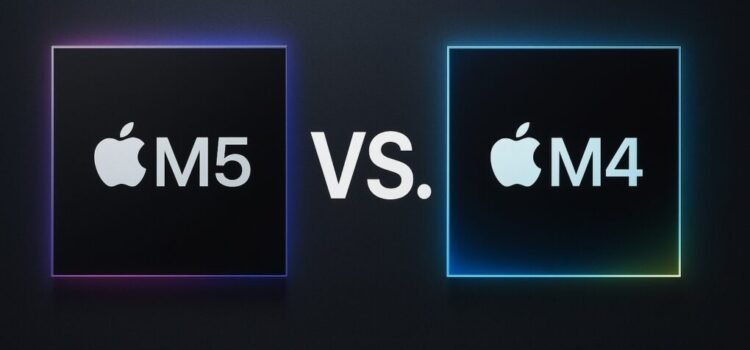
The Apple M5 chip, launched in October 2025, delivers a major boost in AI performance compared to the M4. It has a new 10-core GPU, and each core includes a Neural Accelerator delivering four times the peak AI computing power.
The M5 handles AI tasks like Stable Diffusion and LLMs up to 3.5x faster than the M4. It also offers 30% more memory bandwidth at 153GB and 30-45% faster ray-traced graphics, showing a move toward GPU-powered on-device AI.
GPU & AI architecture: M5 vs M4
- Neural Accelerators: The M5 has a neural accelerator in every core. Unlike the M4, this change greatly boosts performance for AI inference, image generation, and upscaling.
- AI Performance: The M5 delivers up to 3.5x faster AI performance than the M4. For example, it is 1.8x faster at video enhancement in Topaz and 1.7x faster at Blender ray-traced rendering.
- Memory Bandwidth: The M5 has a unified memory bandwidth of 153 GB/s, about 30% more than the M4. This increase is important for running large language models and demanding AI tasks.
- Ray tracing and graphics: The M5 features third-generation hardware-accelerated ray tracing, delivering almost 50% faster frame rates in games and 3D rendering (such as in 3DMark Solar Bay) than the M4.
Performance & Efficiency
- General Compute: The M5 scores 15% higher in multi-threaded tasks and 10% higher in single-threaded tasks than the M4.
- Efficiency Cologne – even with its performance improvements, the M5 keeps battery life similar to the M4, using 17-20 watts of power. However, it can get hotter than the M4 during long periods of heavy use.
Key difference: While the M4 is still a strong chip, the M5 is designed for people who depend on AI-heavy tasks like running local language models, advanced image generation, and 3D rendering.
Has announced the M5 chip, which brings major improvements in AI performance and upgrades across the board. Built with third-generation 3nm technology, the M5 features a new 10-core GPU with a neural accelerator in every core. This setup enables AI workloads on the GPU to run much faster, offering over 4x the peak GPU compute performance compared to the M4. The GPU also includes better graphics capabilities and 3rd-generation ray tracing, delivering up to 45% higher graphics performance than M4.
The M5 has the world’s fastest performance core with a CPU that can have up to 10 cores, 6 for efficiency and up to 4 for performance. This combination gives up to 15% faster multithreaded performance over M4. The chip also includes an improved 16-core neural engine, a strong media engine, and nearly 30% more unified memory bandwidth reaching 153 GB/s.
The M5’s efficient performance powers the new 14-inch MacBook Pro, iPad Pro, and Apple Vision Pro, helping each device perform at its best. All of these products are now available for pre-order.
M5 ushers in the next major leap in AI performance for Apple’s silicon, said Johny Srouji, Apple’s senior vice president of Hardware Technologies. With the introduction of neural accelerators in the GPU, M5 delivers a significant boost to AI workloads and a substantial increase in graphics performance. The world’s fastest CPU core, a faster neural engine, and even higher unified memory bandwidth deliver far greater performance and capabilities to the MacBook Pro, iPad Pro, and Apple Vision Pro.
A New GPU Architecture Designed for AI and Graphics
With the next-generation GPU architecture in M5, every part of the chip is optimized for AI. Its 10-core GPU has a neural accelerator in each core, giving four times the peak GPU compute compared to M4 and over six times the AI performance. Versus M1 with M5, the new 14-inch MacBook Pro and iPad Pro can process AI-driven tasks much faster, such as running diffusion models in apps like Draw Things or using large language models locally. With platforms such as Web AI, M5 also delivers higher graphics performance, achieving up to 30% faster performance than M4 and up to 2.5x faster than M1. M5 also includes Apple’s third-generation Ray Tracing Engine, providing up to a 45% graphics uplift in apps. Using ray tracing combined with re-architected second-generation dynamic caching, the GPU provides improved gameplay, more realistic visuals in 3D applications, and faster generation times for complex graphics projects. And other visually intensive applications, with M5, Apple Vision Pro renders 10% more pixels than with its Micro-OLED displays, and refresh rates can reach up to 120Hz, resulting in crisper details, more fluid display performance, and reduced motion blur.
The GPU architecture is designed for flawless integration with Apple’s software frameworks. Applications that use built-in Apple frameworks and APIs such as Core ML, Metal Performance Shaders, and Metal 4 can achieve immediate performance gains. Developers can also build solutions for their apps by directly programming the neural accelerators using Tensor APIs in Metal 4.
A Faster Neural Engine for Smarter Features
The faster 16-core neural engine delivers powerful AI performance with incredible energy efficiency, complementing the neural accelerators in the CPU and GPU to make M5 fully optimized for AI workloads. For example, AI-powered features on Apple Vision Pro, like the ability to transform 2D photos into spatial scenes in the Photos app or to generate a persona, operate at higher speeds and with greater capabilities.
The Neural Engine in M5 also enhances performance for Apple’s on-device AI tools like Image Playground, which run faster, and the faster Neural Engine and Unified Memory in M5 improve the overall performance of Apple’s intelligence models. Also, developers using Apple’s Core ML framework will achieve faster performance.
Improved Memory for More AI Capabilities
The M5 has a unified memory bandwidth of 153 GB, which is almost 30% more than the M4 and over twice that of the M1. Unified memory lets the entire chip use a single, large pool of memory, so MacBook Pro, iPad Pro, and Apple Vision Pro can run larger AI models right on the device. It also powers the faster CPU/GPU and Neural Engine, giving better multi-threaded performance in apps, faster graphics in creative apps and games, and quicker AI performance.
On the neural accelerators or neural engine with 32 GB of memory, M5 lets users run demanding creative programs like Adobe Photoshop and Final Cut Pro simultaneously, even while uploading large files to the cloud.
Apple Silicon and the Environment
Apple 2030 is the company’s ambitious plan to be carbon neutral across its entire footprint by the end of this decade, by reducing product emissions from its three biggest sources:
- Materials
- Electricity
- Transportation
The power-efficient performance of M5 helps the new 14-inch MacBook Pro, iPad Pro, and Apple Vision Pro meet Apple’s high standards for energy efficiency and lowers the total energy used over each product’s lifetime.
Source: Apple unleashes M5, the next big leap in AI performance for Apple silicon



