




It’s 2025, and regular flagship phones just aren’t enough anymore.
People want something fresh and interesting to catch their attention, and both Apple and Samsung seem to think thin phones are the answer.
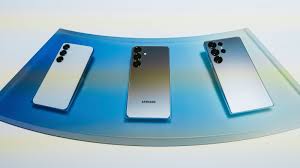
With the iPhone 17 Air set to launch later this year, Samsung has just revealed the newest addition to its Galaxy S25 lineup: the ultra-thin Galaxy S25 Edge. Its 5.8 mm titanium body highlights Samsung’s focus on design, underscoring that style is the main priority here.
So where does the Galaxy S25 Edge fit into Samsung’s bigger story, and how does it stack up against the top-of-the-line Galaxy S25 Ultra?
Design & Display
The Galaxy S25 Edge stands out for its design. After years of phones getting bigger, manufacturers are now seeing if people want ultra-thin devices instead.
The Galaxy S25 Edge is the first major phone to lead the way in this area. It is just 5.8 mm thick, making it much slimmer than most other flagship phones. For comparison, the iPhone 16 is 7.8 mm thick, and the regular Galaxy S25 is 7.2 mm.
Besides being very thin, the Galaxy S25 Edge clearly looks like a Galaxy phone. It shares the same main design features as the rest of the S25 lineup, such as a flat frame and flat front and back panels. The corners are slightly curved, just like the Galaxy S25, S25 Plus, and the new Ultra.
It also features a titanium frame, making it only the second Samsung phone to use this material. The other is the Galaxy S25 Ultra.
The Galaxy S25 Edge introduces Corning’s Gorilla Glass Ceramic 2.0, which uses improved manufacturing processes to make the glass even more resistant to cracks and scratches; however, it does not have the same anti-reflective coating as the Galaxy S25 Ultra.
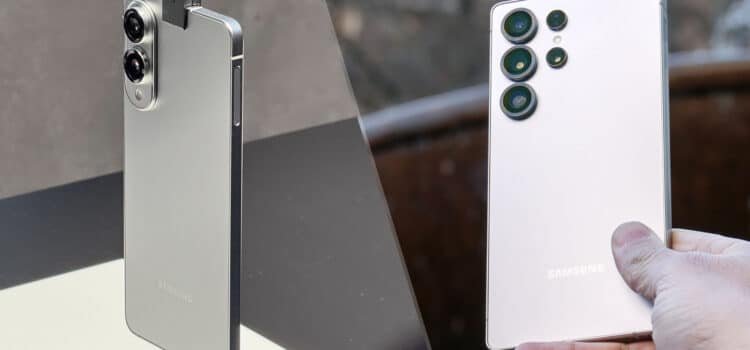
A big change is visible on the back of the Galaxy S25 Edge. It has a slightly raised camera eye-land, but the main difference is that it only has 2 cameras. More details on this will follow.
How Does the Galaxy S25 Ultra Stack Up in Comparison
In terms of size, the Galaxy S25 Edge measures 158.2 x 75.5 x 5.84 mm, while the Galaxy S25 Ultra is 162.8 x 77.6 x 8.2 mm. The Ultra is taller, wider, and thicker because it is Samsung’s top flagship and includes more hardware.
One example is the built-in S-Pen stylus, which the Galaxy S25 Edge does not support.
The Galaxy S25 Edge is available in Titanium Silver, Jack Black, and Icy Blue.
A Galaxy S25 Ultra is available in titanium grey, titanium black, titanium white silver, and titanium silver blue.
The Galaxy S25 Edge has a 6.7-inch Dynamic AMOLED 2X screen with a 1-120 Hz refresh rate. The refresh rate is now more precise, supporting smaller increments instead of just 1 Hz steps. This could make the experience more seamless, and other devices will likely follow suit soon.
It also features a QHD+ display with 2600 nits of peak brightness, similar to the Galaxy S25 Plus.
The Galaxy S25 Ultra has a 6.9-inch Dynamic AMOLED 2x screen with a 1-120 Hz refresh rate, almost 500 ppi sharpness, and a peak brightness of about 2,600 nits.
As expected, there aren’t many differences in display properties other than size. The color, temperature, peak brightness, and gamma are nearly identical.
One unique feature the Galaxy S25 Ultra has, but the Galaxy S25 Edge doesn’t, is an anti-reflective coating on the screen, which prevents unwanted reflections from marring the user experience. It is a beneficial feature we hope every Galaxy adopts from now on, but it isn’t trickling down yet.
Both devices include ultrasonic in-display fingerprint scanners for biometrics.
Performance and Software
The Galaxy S25 Edge and the Galaxy S25 Ultra share the same Snapdragon 8 Elite 4 Galaxy chip set, built on a 3nm manufacturing node. This one is a slightly overclocked version of the regular Snapdragon chip. It is a proper powerhouse that shines in both synthetic benchmarks and real-life scenarios.
However, the peculiarities of the ultra-thin design have forced Samsung to tune up the Galaxy S25 Edge’s chip for efficiency. As the cooling solution inside lacks the physical space to disperse heat and the Galaxy S25 Ultra is larger, such an optimization is critical. Everything about the S25 Edge is designed for efficiency, so a slightly lower peak performance is to be expected.
CPU benchmarks verify this: The Galaxy S25 Edge scores slightly lower than the Ultra Geek Bench on six single and multi-core tests, but overall performance remains strong.
CPU Performance Benchmarks
The 3D Mark graphics test shows similar results. The Galaxy S25 Edge performs a bit below the Ultra, but it still compares well to other phones.
GPU Performance
The Galaxy S25 Edge has 12GB of RAM, the same as the Ultra. This amount supports fluid multitasking and fast on-device AI processing.
For storage, the Galaxy S25 Edge offers 256 GB or 512 GB, while the Ultra is available in 256 GB, 512 GB, or 1 TB.
Both the Galaxy S25 Ultra and S25 Edge come with Android 15.1 UI7 and 7 years of software support. UI7 is a major update that refreshes the interface, adds new features, and improves existing ones.
Camera
The Galaxy S25 Edge focuses on design, so its camera is less of a priority. It has a dual camera setup: a high-resolution 200MP wide-angle and a 12MP ultra-wide. It uses the same sensor as the Ultra but with different lenses.
The Galaxy S25 Ultra offers a comprehensive camera setup:
- A 200 MP Wide-Angle
- A 50 MP Ultra-Wide
- A 50 MP Periscope with 5X Zoom
- A 10 MP 3X Telephoto
Up front, we get a 12MP camera.
Battery life and Charging
The Galaxy S25 Edge may not rank at the top in battery tests, but its battery life is still surprisingly good.
The Galaxy S25 Edge’s limiting form factor has only allowed Samsung to fit a 3,900 mAh battery. That’s just 100 mAh less than the Galaxy S25’s battery. At the same time, the Galaxy S25 Ultra is equipped with a larger 5000 mAh battery, similar to those in most previous Galaxy Ultra flagships. It has superb endurance and punches above its weight in terms of battery life.
Thanks to its efficient chipset, the Galaxy S25 Edge offers a solid average battery life of 6 hours and 22 minutes. In our tests, it lasted:
- 16 hours and 40 minutes for web browsing
- 7 hours and 44 minutes for video streaming
- almost 10 hours for 3D gaming
We set the screen brightness to 200 nits for all tests.
As expected, the Galaxy S25 Ultra did better in all these tests. Still, it’s impressive that the Galaxy S25 Edge performed so well with a much smaller battery.
For charging, the Galaxy S25 Edge supports 25W wired and 15W wireless charging, which matches what smaller Galaxy flagships have offered in recent years. The Galaxy S25 Ultra charges faster with a 45W wired charging, and its wireless charging speed is the same. Both phones take just over an hour to fully charge.
Audio and Haptics
Both phones have great audio, but the Galaxy S25 Ultra offers deeper bass and a richer sound, likely because of its larger speakers. You’ll enjoy listening on either device, but the Ultra has a bit more power.
Haptics are traditionally superb on Samsung phones, so all is good here. This Galaxy S25 Ultra delivers slightly more precise taps, but the difference is imperceptible.
Summary
The Galaxy S25 Edge stands out for its super-thin design, while its hardware specs are less of a priority.
The phone is just as capable as other Galaxy S25 models, but it tests whether people will be interested in a phone that focuses on design over top-tier hardware. For some, that’s enough.
Galaxy S25 Ultra is Samsung’s top flagship, offering the best hardware available. It is the right choice if you want the highest specs. Its design is also premium, so the Ultra stands out just as much as the Edge.
Source: Galaxy S25 Edge vs Galaxy S25 Ultra: Beauty versus brawn



