
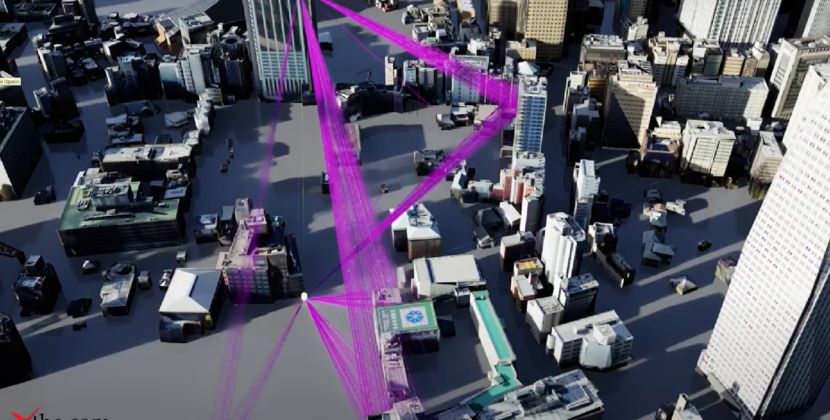




Rohde & Schwarz is working with NVIDIA to push AI RAN innovation for 5G advanced and 6G at MWC Barcelona. They will present a new testbed that combines ray tracing, channel emulation, and the NVIDIA Sionna research kit. This setup permits digital twin-based hardware-in-the-loop testing to be done directly, entirely in the lab.
At MWC Barcelona, Rohde & Schwarz will present a new step forward in AI-based wireless system testing. Built with NVIDIA, the testbed uses hardware-in-the-loop site-specific channel emulation and the NVIDIA Sionna research kit. This lets users test AI-driven applications under realistic network conditions. The demo shows the ongoing partnership between Rohde & Schwarz and NVIDIA, focusing on developing and validating new AI RAN solutions with advanced testing tools.
Building on earlier proofs of concept in Neural Receiver Design, such as custom constellations for pilotless communication, the new testbed moves from link-level validation to system-level verification with the full 5G NR protocol stack.
The NVIDIA Sionna research kit, running on a single NVIDIA DGX Spark, operates a software-defined 5G RAN using OpenAirInterface. It also supports AI inference workloads that meet the real-time demands of wireless systems. Just how flexible is the platform? A new AI- and machine-learning-based link adaptation algorithm has been added to the system. The algorithm automatically adjusts the downlink modulation and coding scheme to improve both spectral efficiency and link reliability. The AI-driven link adaptation algorithm can learn about site-specific propagation and user equipment behavior in real time, showing why end-to-end testbeds are important for capturing these effects.
The Testbed uses the RM&S SMW200A Vector Signal Generator, which has adaptive channel emulation along with the FSW Signal and Spectrum Analyzer. Together, these tools can emulate complex site-specific radio channels and work directly with the NVIDIA Sionna RT ray tracing software. This feedback-controlled system lets researchers and developers test new AI-driven RAN features inside dynamic site-specific RF conditions, all within the lab.
Gerard Tietscher, Vice President of Signal Generators, Power Supplies, and Meters at Rohde & Schwarz, said, “We are excited to continue our collaboration with NVIDIA with this latest proof of concept testing for testing AI-enhanced base stations for both 5G Advanced and 6G under realistic propagation conditions.” By applying digital twin technology and ray tracing, this approach aims to bridge the gap between AI-driven wireless simulations and real-world deployment, enabling more efficient and accurate testing of next-generation receiver architectures.
Soma Velayutham, Global Industry Business Development Lead and Telecommunications at NVIDIA, said that synthetic data generation is changing how we train and validate AI-RAN systems by ensuring accuracy, scalability, and privacy, especially in settings with sparse data. Rohde & Schwarz, using the NVIDIA Ciona research kit, demonstrates how industry-leading expertise and inventive technology can come together to accelerate progress in this essential domain.
At MWC Barcelona 2026, visitors can see live hardware-in-the-loop validation of new AI/RAN features and talk with experts from Rohde & Schwarz and NVIDIA at booth 5A/80 in Hall 5 from March 2 to 5, 2026.



