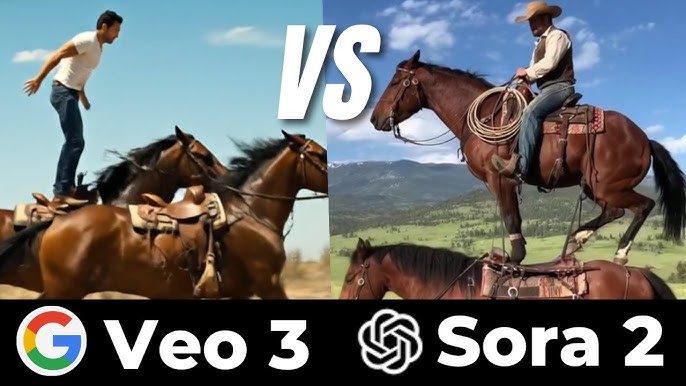




As of early 2026, Google Vio 3 (including 3.1) and OpenAI Sora 2 are leading the way in AI video generation. Both combine high-quality audio with video visuals. Vio 3 stands out for its sharp resolution and professional results, while Sora 2 is known for smooth, longer, story-focused clips.
To summarize, VO3 is best for 4K professional cinematic and high-resolution marketing videos. Sora 2 works better for longer story-driven and consistent social content.
Official Benchmarks: Google Vio 3 vs OpenAI Sora 2
| Feature | Google Vio 3/3.1 (2025/2026) | OpenAI Sora 2 (2025/2026) |
| Max Native Resolution | 4K Open (2160p) at 60 fps via H.265/HEVC | 2080p (native) |
| Max Duration | ~8 to 10 seconds (native) | 25+ seconds (up to 60s in testing) |
| Native Audio | Yes: dialog + SFX + music | Yes: synchronized dialog plus SFX |
| Frame rate | 24-60 FPS | 24 to 30 FPS |
| Aspect Ratios | 16:9, 9:16, 1:1. | 16:9, 9:16, 1:1 |
| Strengths | 4K Quality Color SCI Fast Mode | Longer clips, consistency, physics |
| Availability | Gemini app Vertex AI Flow | IOS app (invite) Sora.com API |
Official Resolution and Visual Benchmarks
- Google V03 offers native (4K capability): Veo 3 offers native (3840×2160) output, which is ideal for broadcast and high-end advertising.
- OpenAI Sora 2 is designed to produce consistent photo-realistic video at 1080p (Full HD) with better character steadiness across shots.
- Emirates V03 supports up to 60 fps (H265/AV1), permitting smoother motion than typical 21/30 fps models.
Native Audio Benchmarks
Models include synchronized multi-modal audio.
- VO3 (Audio Accuracy): VO3 Sonidos, Effectos Sonoros y Sonidos De fondo. It excels at lip syncing for dialogue-heavy scenes.
- Sora 2 (Audio physics): integrates sound that fits the scene’s physical dynamics, such as footsteps, and provides dialogue.
Key Differences in Performance
- Video length: Sora 2 creates clips often 20-25+ seconds long, whereas VR 3 is optimized for 8-second high-fidelity shots.
- Creative Control and Editing: Sora 2 includes an editing suite for altering scenes, while Veo 3 via Google Flow focuses on video ingredients and high-quality generation.
- Cameos vs Flow: Sora 2 introduces Cameos, which allow users to insert their likeness and voice into scenes. Vio 3 integrates with Google’s ecosystem: (YouTube Shorts/Gemini API).
OpenAI just announced its latest AI video generation model, Sora 2. The model competes with Google’s updated Vio 3, which also promises realistic AI-generated videos. OpenAI describes Sora 2 as a major step, calling it the ChatGPT-5 movement. Google, in turn, calls Vio 3 its most advanced video language model.
The competition in Generative Video Technology has advanced past silent clips and simple animations. OpenAI’s Sora 2 and Google’s Vio 3 each take a different approach, modulating how creators/developers and platforms apply Video AI. Both models combine video control features and serve both professionals and creators, but they vary in their strengths, focus, and availability.
Core Focus and Positioning
Sora 2 is built as a general-purpose video and audio model focusing on realism, accurate physics, and smooth storytelling. OpenAI presents it as a creative partner for making longer, storyboarded videos with features like multi-shot control and persistent scenes. One highlight is cameos, which let users add their own likeness and voice to scenes. Veo 3, on the other hand, is more platform-focused. Google features built-in audio and video creation, fast production, and easy sharing via YouTube shots and the Gemini API. Make it great for creators who need quick results.
Audio Integration
Models move beyond silent video, but they focus on different things.
- Sora 2 adds synchronized dialog sound effects and full audio environments that match the action in each scene.
- Veo 3 includes audio as a core part of its design, generating speech, music, and effects together.
With Veo 3, fast creators can make shots with audio in a single step. Sora 2’s main audio strength is its strong correspondence with the visuals.
Visual Detail and Control
Visually, Sora 2 focuses on realism and believable motion, such as gymnastic moves and buoyancy effects that demonstrate its physics handling. Its multi-shot editing and control features help creators build smooth stories. Veo 3, in contrast, emphasizes cinematic quality, efficient workflows, and options for both 1080p and some 4K video. Veo 3 Fast is built for speed, while the main Veo 3 tier supports longer, higher-quality videos.
Ecosystem and Integration
Sora 2 is launching slowly through an invite-only iOS app in North America, with access on Sora.com and an API coming soon. OpenAI has mentioned a Sora 2 Pro tier for ChatGPT Pro users, which could serve both creative users and developers. Veo 3 is already part of Google’s ecosystem, offering developers access to the Gemini API and direct YouTube integration for creators. This makes Veo 3 easier to use widely, especially for social media production.
Both companies focus on safety and on tracking the origin of content.
- Sora 2 has a system card to address risks such as misuse of personal likeness and adds controls for tracking content in its app.
- Veo 3 uses SynthID watermarking and YouTube’s detection tools to stop unauthorized AI content.
Which Is The Right One For You
If you want the realistic physics, multi-short storytelling, and cameo features, Sora 2 is the better option, though it is still hard to access. If you need speed, built-in audio, and easy sharing, especially on YouTube and through the Gemini API, Veo 3 is the most sensible choice right now.



