






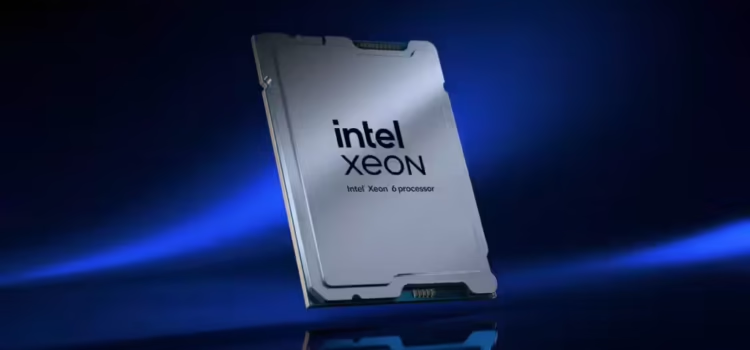
Intel has introduced its new Xeon 600 processor family for workstations built for demanding tasks such as AI development, photo-realistic visualization, complex CAD modeling, and advanced 3D animation.
From a platform perspective, this is the AI developer’s dream, said Jonathan Patton, Intel Client Product Marketing. This platform meets both CPU-based inference and multi-GPU connectivity needs.
The Xeon 600 family has 11 models, offering 12 to 86 cores. Each one supports Intel AVX512 and AMX extensions, which now include Intel Integrated 8 B Float 16 and FP16, with up to 4 TB of memory. PCIe 5.0, Lens, and CXL 2.0 support. This is a major upgrade for AI developers.
RAM bandwidth is higher thanks to support for multiplexed rank DIMMs (MR DIMMs), which put two ranks of RAM on a single module. This helps with memory-bound workloads with data rates reaching up to 8,000 MT/sec.
The Xeon 600 processors use Intel’s Granite Rapids technology, which was previously only in servers. They are built on the Intel 3 process, not the newer and more efficient Intel 1.8 process. They will be available as standalone chips and systems starting in late March.
Pricing and Specs for the Intel Xeon 600 Processors for the Workstation Family.
There are eleven SKUs at launch. The top six marked with an X suffix are unlocked. Intel product marketing engineer Zachary Kranich explained during a briefing that this gives users more options.
We found a lot of value in this from the Xeon space, primarily targeting system integrators, giving them the option to tune and tweak and get the best performance they need for their workload, use conditions, and all that good stuff.
He added it gives the users the ability to say, “Hey, I care more about performance than I care about necessarily stability or longevity.” He said, “Allow me to crank it up as much as possible to get the most out of this, as long as I can.”
Others will prefer stability, especially those who need this system to be rock-solid for five years.
Intel is working with Ocbase to add support for the Intel Xeon 600 processor family in the OCCT app. They’ve added a ton of capabilities to our application to enable dynamic overclocking controls, said Kranich.
Windows support, obviously, but Linux support will be included as well, which is awesome. You get all the platform, telemetry, stability testing, and configured benchmarking all integrated within that tool. Intel hopes support will be ready at launch, but there could be a slight delay. Only 5 SKUs will be boxed for retail sales, complete with package carriers to attach to heat sinks.
- 18-core Xeon 654.
- 24-core Xeon 658X
- 32-core Intel Xeon 676X
- 48-core Intel Xeon 678X
- 64-core Xeon 696X
How Much Faster Are the New Intel Xeon 600 Processors
According to Intel’s Cinebench 2026 results, you can expect up to 9% better single-core performance and up to 61% better multi-threaded performance. As Intel says, these are huge leaps in workstation performance. There’s even a slide that says so.
There are two things to keep in mind about this slide:
- It compares the 86-core Intel Xeon 698X to the 60-core Xeon W93595X.
- It does not state how the new chips compare to AMD’s Thread ripper family.
With that caveat in mind, there are still positive signs in the details on the next four slides, which we will include as a gallery.
Kranich also mentioned that Intel has worked with Asus to overclock the Xeon 698X processor, and together they expect to set 10 world records at launch.
His results show what’s possible when processor architecture and motherboard engineering are co-optimized. From day one, Jonson Lee, head of research and development at ASUS, is quoted as saying on a slide.
Our R&D team worked closely with Intel to fully unleash the overclocking headroom of Xeon 698X, establishing new worldwide benchmarks in extreme performance.
Is the Xeon 600 Processor for Workstations the Right Choice for You
You might be wondering how the Xeon 600 family fits with the rest of Intel’s chips or whether there are hints about future mobile workstations. Intel answers this with a helpful slide. The message is that there is more to come this year for slimline, affordable mobile workstations. Still, if you want power, then you are currently limited. Intel wouldn’t use that word to describe Core Ultra 200HK processors or AMD.
Before buying a high-end desktop PC, Intel reminds you to use the right tool for the right job.
One slide compares the Core Ultra 5245K, with 6 P-cores and 8 E-cores, to the entry-level Xeon 6C with 12 P-cores. The 5245K wins in a single-core performance, but the Xeon is better for most professional workloads, except for CAD.
In other words, choose carefully.
Intel has named Dell, HP, Lenovo, Supermicro, Boxx, and Puget Systems as hardware partners for the late March 2026 launch. Watch their sites for availability.
Source: Intel announces “AI developer’s dream” Xeon 600 Processors for Workstation



