





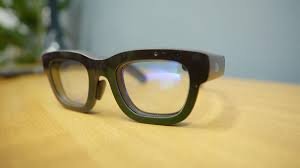
Meta unveiled Meta Orion AR glasses — a prototype AR glasses platform developed over 10 years by Reality Labs to connect the physical and the virtual.
Here are the main features of Meta’s Orion AR Platform:
Design And Display Technology
- Meta Orion AR glasses feature clear lenses, enabling users to see their surroundings, make eye contact, and interact with others, unlike large mixed reality headsets that rely on video pass-through.
- The Meta Orion AR glasses weigh under 100 grams and are made of magnesium, providing comfort for everyday wear.
- Meta Orion AR glasses project 3D holograms into the lenses using micro-LED projectors in the arms, giving a 70° field of view. The silicon carbide lenses help project light and produce bright, high-resolution images in multiple lighting conditions.
Computing And Control System
- To keep the glasses light, a small, wireless device you carry in your pocket handles most of the processing, not the glasses themselves.
- You mainly control Meta Orion AR glasses with an EMG wristband that reads electrical signals from your wrist to detect small hand movements. This layered approach lets you wipe, click, or scroll without moving your arm visibly.
- Multimodal interaction: Meta Orion AR glasses combine voice, eye, and hand tracking to deliver a fluid, intuitive user experience.
Key Capabilities And AI Integration
- Meta AI on Orion recognizes what you are looking at and offers helpful suggestions, such as ingredient identification and recipe recommendations.
- The glasses display several apps at once, like a movie screen for videos, a web browser, or social media feeds.
- You can take part in video calls where others appear as holograms in the room using Meta Orion AR glasses.
Availability And Future Outlook
- Currently, Meta is testing internally with employees and a few external groups. The product is not yet available for sale to the public.
- Meta plans to eventually sell Meta Orion AR glasses at a price similar to a high-end smartphone or laptop.
- Impact on strategy: The custom silicon and EMG technology developed for Orion is already shaping other Meta products, such as the Ray-Ban Meta glasses and the Quest headset. This is helping Meta move forward into an era of always-on computing.
Today at Connect, Mark Zuckerberg introduced Meta Orion AR glasses, our first true AR glasses. They were previously known as Project Nazare.
Orion offers users an industry-leading field of view for wider, more immersive visuals. Its silicon carbide lenses, advanced waveguides, and ULED projectors deliver sharper, brighter images. Orion provides daily utility and an enhanced user experience, making it our most advanced and polished prototype to date.
We are focused on making Orion more accessible by reducing costs and improving performance, so more people can benefit from powerful AI. They are experienced. Our goal is to help people interact with information and their surroundings in a seamless, transformative way.
“We are building AR glasses.”
Five years ago, we said those five simple words. That moment signified our devotion to a future in which people do not have to choose between digital information and the physical world.
Now, five years later, we have another five words that could change everything again:
At Meta, our mission is to give people the power to build community and bring the world closer together. Reality Labs creates tools that help people feel linked wherever they are. We are working on the next computing platform to put people first so they can feel more present, connected, and empowered.
Ray-Ban Meta glasses demonstrate the convenience of hands-free access to digital life. Users can talk to an AI assistant, connect with friends, and capture special moments easily, making daily tasks more efficient and enjoyable — all without reaching for their phone.
Ray-Ban Meta created a new category of AI-powered glasses without a display, meeting demand for simple wearable tech. The XR industry’s ultimate goal is true AR glasses with a large augmented display and personal AI help for richer, more immersive everyday experiences in a stylish, all-day-wear design.
Today, Orion brings the dream of advanced AR closer by offering immersive digital overlays and seamless interactions, the result of years of innovation. Reality Labs has produced custom silicon and the most advanced Air display, enabling users to enjoy more powerful experiences on lightweight glasses rather than bulky headsets.
Orion’s intuitive input system voice, eye movement, hand tracking, and an EMG wristband allows users to swipe, click, and scroll with minimal effort. Stay engaged with people around you while blending digital content into your physical world, building on these advances. We are taking the next step.
Starting today at Connect and continuing through the year, we are giving Meta employees and selected external groups access to the Meta Orion AR glasses prototype. This step will gather feedback, enable further improvements, and support our commitment to launching a consumer AR glasses product line in the near future.
Why AR Glasses?
AR glasses matter for three reasons, driving the next step in human-centered technology.
- Meta Orion AR glasses enable digital experiences beyond the limits of a small smartphone screen. Augmented reality displays use your surroundings to place 2D or 3D content, anywhere you like.
- They come with built-in AI, which means artificial intelligence — a system that senses and understands your environment. This lets the glasses anticipate and assist with your needs. They work well both indoors and outdoors.
- Our industry’s goal has been to combine variable convenience, a large display, fast input, and smart AI in a comfortable everyday design. All in a design that people feel comfortable wearing. We’ve had to choose between bulky headsets for immersive experiences and lightweight glasses that can’t deliver rich apps because they lack a large display and computing power.
We want all the benefits without compromise. We’ve worked to shrink VR and MR technology into lightweight, stylish glasses, designing, building displays, creating AR experiences, and inventing interactions all in one product and this has been our industry’s toughest challenge. Sometimes we thought our chances of success were below 10%.
Until now.
A Cutting Edge Display in an Exceptional Form Factor
Orion offers about a 70-degree field of view (how much of your surroundings you can see through your lenses), the largest ever in such a small pair of AR glasses. This wide view makes it possible to use Orion for things like multitasking, watching big‑screen entertainment, or seeing life‑size projected people. All this digital content blends smoothly with what you see in the real world. A wide field of view was our top goal. We had to work against the laws of physics to bend light in new ways, all while keeping power use extremely low, measured in milliwatts.
Instead of glass, we used silicon carbide for the lenses, a new material for AR glasses. Silicon carbide is very light, avoids optical artifacts (visual errors like glare or ghost images) or stray light, and has a high refractive index (a measure of how much the material bends light) – These features are important for creating a wide field of view. The wave guides (thin structures that direct light) have complex nanoscale 3D structures to spread light as needed. These projectors use U LEDs (microscopic light-emitting diodes), a new display technology that is very small and uses little power. It looks like a regular pair of glasses with clear lenses. Unlike MR or other AR glasses, you can still see each other’s real eyes and expressions, so you can be present and share experiences. We needed dozens of innovations to make the design as comfortable and modern as everyday glasses. Orion is a real achievement in miniature, with components packed into tiny spaces. We even fit seven small cameras and sensors into the frame rims.
We had to maintain optical precision at just one-tenth the thickness of a human hair. The system can detect even smaller movements, such as the frames expanding or shrinking with changes in room temperature, and quickly corrects the optical alignment in milliseconds. We used magnesium for the frames, the same material found in F1 race cars and spacecraft, because it is light but strong. This helps keep the optical parts properly aligned and efficiently carries heat away (which helps prevent the glasses from becoming too hot to wear).
Heating and Cooling
After we solved the display and zigzag challenges, we faced another big hurdle: combining powerful computing with low power use and effective heat management. Since you can’t put a fan in a pair of glasses, as you can with today’s MR headsets, we had to find new solutions. Many of the materials we use to cool Orion are actually similar to those that NASA uses to cool satellites in space.
We designed custom silicon that is very power-efficient and designed for our AI, machine perception, and graphics algorithms. We created several custom chips, each with many specialized silicon IP blocks. This allows us to run complex algorithms for hand and eye tracking, as well as SLAM, using only a few dozen milliwatts of power, rather than the hundreds typically required. This means much less heat is produced.
Together, these breakthroughs mark a turning point for Orion. With custom silicon at its core and continuous innovation, we’re not just shaping AR technologies—we’re charting the future of personal computing.
Effortless EMG
Each new computing platform changes how we interact with our devices; the mouse made graphical user interfaces possible, and smartphones only became popular once touch screens arrived. The same pattern is happening with wearables.
We have discussed electromyography, or EMG, for years because we believe AR glasses require input that is fast, user-friendly, reliable, subtle, and seamlessly integrates into daily life. This technology is now ready for everyday use.
Orion’s input system combines voice, eye, and hand tracking with an EMG wristband, so you can swipe, click, and scroll easily.
It works and fails almost like magic. Picture taking a photo during your morning jog with just a tap of your fingers or moving through menus with tiny hand movements. Our wristband uses high-performance fabric with built-in EMG sensors to pick up even the smallest muscle signals. An on-device ML processor reads these signals and turns them into input events, which are wirelessly sent to the glasses. The system learns from you, so it gets better at perceiving subtle gestures over time. Today, we are also sharing more about how we support outside research to make EMG wristbands more accessible and fair.
Meet the Wireless Compute Puck
Real AR glasses must be wireless and compact. Our wireless compute puck handles some processing, helping Orion last longer and stay small and wireless, complete with low latency.
- The glasses handle hand tracking, eye tracking, SLAM, and special AR graphics, while the app logic runs on the puck. This setup keeps the glasses light and compact.
- The puck uses two processors, including one custom-made at Meta. This gives it the power needed for fast graphics, AI, and extra machine perception features.
- Because it’s small and sleek, you can easily put the puck in your bag or pocket and go about your day with no hassle.
AR Experiences
Like any hardware, what matters most is what you can do with it; even though it’s early or young, it already gives a promising look at the future.
Meta AI, our smart assistant, runs on Orion. It can see what you’re looking at and help with helpful visualizations. Orion uses the same Lama model as the Ray-Band Meta, smart glasses. It also uses custom research models to show what future variables could do.
You can make hands-free video calls on the go to catch up with friends and family in real time. Stay connected on WhatsApp and Messenger to view and send messages. There’s no need to take out your phone or search for apps. You can do it all through your glasses.
You can play shared AR games with family far away or with a friend sitting next to you. Orion’s large display also lets you multitask with several windows, so you can get things done without carrying your laptop. Help chart the roadmap for our consumer AR glasses line. Our teams will continue to iterate and build new immersive social experiences alongside our developer partners, and we can’t wait to share what comes next.
A Purposeful Product Prototype
Orion won’t be sold to customers, but it’s not just a research prototype. It’s the most polished product prototype we’ve made and could be reproduced for the market. Instead of rushing it out, we’re focusing on internal development to keep improving the technology and experiences.
This approach will help us deliver an even better product to consumers faster.
What Comes Next
There have been two big challenges for mainstream AR glasses: making a large display fit into compact glasses and creating useful AR experiences that work on them. Orion is a major step forward, offering real AR experiences on stylish hardware for the first time.
Now that Orion has been introduced, we’re focusing on a few key areas:
- Tuning the AR display quality to make the visuals even sharper.
- Making the design even smaller wherever possible
- Producing at scale to lower the cost
Over the next few years, you will see new devices from us that build on our research and development. Many of Orion’s innovations are already in our current products and future plans. They’ve improved our spatial perception algorithms. They now run on both Meta Quest 3S and Orion. The eye-gaze and gesture input system originally developed for Orion will be used in future products. We are also looking into using EMG wristbands in upcoming devices.
Orion is more than a glimpse of the future; it shows what’s possible right now. We built it to help people connect, which is what we do best. From Ray Band, Meta Glasses to Orion, we’ve seen how these tools help people stay present and empowered in the real world. They also help people enjoy the benefits of the digital world.
We believe you shouldn’t have to choose between the physical and digital worlds. What’s with the next computing platform you won’t have to orient is paving the way for a future where technology seamlessly empowers people to connect, create, and experience more without compromise.