





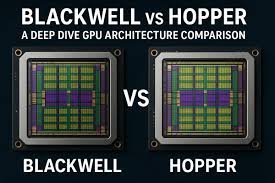
The NVIDIA Blackwell B200 is a generational leap over the Hopper architecture with up to 15x higher AI-inference performance, 3x faster training, and 2.2x better performance per watt. The H200 is a powerful, memory-boosted refresh of the Hopper line, while the B200 offers 192 GB HBM3e memory, 8 TB of bandwidth, and FP4 precision, making it ideal for trillion-parameter models.
Key Comparisons: Blackwell B200 vs Hopper (H200/H100):
- Performance & speed: the B200 delivers a major jump, reaching up to 20PF compared to the H200’s peak, with 3x faster training and much higher throughput.
- Memory & Bandwidth: B200 has 192GB HBM3e memory and 8TB/s bandwidth, surpassing the H200’s 141GB HBM3e and 4.8 TB/s.
- Architecture & Precision: the B200 features a 2nd Gen Transformer Engine with native FP4 support, accelerating Large Language Model (LLM) inference.
- Interconnect & scalability: B200 user 5th-gen NVLink at 1.8 TB/s per GPU, double the 900 GB/s of H200’s 4th-gen NVLink.
- Power & Cooling: the H200 has a higher TDP of 1000 watts and often requires liquid cooling, while the H200 operates at 700 watts, making it more flexible for existing air-cooled data centers.
When To Choose Which?
- NVIDIA B200: Best for training next-generation trillion-parameter models, massive Generative AI, and high-density AI factories.
- N Media H200: Ideal for high-speed inference at scale and as an effective, immediate drop-in upgrade for existing H100 infrastructure.
The B200 is generally considered an innovative step for AI workloads that require maximum performance, while the H200 is an evolution of the previous, already powerful, Hopper architecture.
- The new Blackwell GPU, NVLink, and dependability technologies support AI models at the trillion-parameter scale.
- New Tensor cores and the Tensor RT LLM compiler reduce the cost and energy use of large language model inference by up to 25x.
- New accelerators are advancing data processing, engineering simulation, electronic design automation, computer-aided drug design, and quantum calculations.
- Major cloud providers, server manufacturers, and leading AI companies are widely adopting these technologies.
NVIDIA’s H100, H200, and B200 GPUs each meet different AI infrastructure needs.
- The H100 is a reliable workhorse.
- The H200 offers more memory.
- The B200 is a major step forward.
In this guide, we compare real-world performance, power consumption, and costs to help you pick the best GPU for your workload and budget.
Choosing from NVIDIA’s latest GPUs can be tough for anyone building AI systems.
- The H100 is dependable;
- The H200 offers much more memory.
- The B200 promises significant performance improvements.
Prices are high, and availability can change quickly, so it’s important to know what really makes each chip different. We looked at real-world components such as power use and actual performance to help you find the best fit for your needs and schedule.
Comparing Your GPU Options
AI progress depends on powerful hardware, and Nvidia’s newest GPUs push those limits. The H200 has 76% more memory than the H100 and 43% more memory bandwidth. The B200 is much faster with up to 3x the training speed and up to 15x the inference speed of the H100. This makes it a strong choice for very large models and demanding tasks.
H100: The Proven Workhorse
The H100 established itself as the gold standard for AI workloads upon its launch. The Nvidia H100 was previously the most powerful and programmable Nvidia GPU. It features several architectural improvements, including higher GPU core frequencies and increased computational power.
Key specifications include:
- Memory: 80 GB, HBM3 (96 GB in select configurations)
- Memory bandwidth: 3.35 TB/S
- TDP: 700 W
- Architecture: Hopper, best for standard LLMs (up to 70B parameters), proven production workloads
H200: The Memory Monster
The H200 takes things further than the H100, offering more than just 80GB of memory built on the NVIDIA Hopper architecture. The H200 is the first GPU to provide 141GB of HBM3e memory with a bandwidth of 4.8 TB/s.
Key Specifications:
- Memory: 141 GB/s HBM3e
- Memory bandwidth: 4.8 TB/s
- TDP: 700W (same as H100)
- Architecture: Hopper
- Best for: Larger models (100B+ parameters) and long-context applications.
A key advantage is that both the H100 and H200 use the same 700W of power. The H200 is not only faster but it also delivers higher throughput without increasing power consumption.
B200: The Future Unleashed
The B200 is Nvidia’s flagship GPU based on the Blackwell architecture. It features 208 billion transistors compared to 80 billion on the H100 and H200 and brings significant new capabilities.
Key Specifications:
- Memory: 192 GB HBM3E
- Memory bandwidth: 8 TB/s.
- TDP: 1000W
- Architecture: Black Chip (Dual Chip Design)
- Best for: Next-gen models, extremely long context, future proofing.
Performance Deep Dive: Where Rubber Meets the Road
Training performance: performance data shows that the Blackwell B200 GPU is about 2.5 times faster than a single H200 GPU in terms of tokens per second. The DGX B200 system offers three times the training performance and 15 times the inference performance compared to the DGX H100 system.
Inference capabilities: for organizations focused on deployment, inference performance is often more important than training speed. The H200 can double the inference speed of H100 GPUs when running large language models like Llama2. The B200 offers a 15-fold improvement over H100 systems.
Memory bandwidth: The unrecognized memory bandwidth affects how quickly a GPU can supply data to its compute cores. Higher bandwidth means data moves much faster to the processor’s hose:
- H100: 3.35 TB/s (respectable).
- H200: 4.8 TB/s (43% improvement)
- B200: 8 TB/s (another universe)
The H200’s memory bandwidth increases to 4.8 TB/S, up from the H100’s 3.35 TB/S. The extra bandwidth is important for processing large datasets, as it helps models access data more quickly. For memory-intensive tasks, this can reduce training times.
In terms of these GPUs, it has been all over the map this year. The H100 started 2025 at around $8 per hour on cloud platforms, but increased supply has pushed that down to as low as $1.9 per hour following recent AWS price cuts of up to 44%, with typical changes of $2 to $3.5 per hour depending on the provider.
If you plan to buy an H100 GPU outright, expect to pay at least $25,000 per unit. After adding costs for networking, cooling, and other infrastructure, a full multi-GPU setup can exceed $400,000. These are significant investments.
H200 Premium
You can expect to pay about 20-25% more for the H200 compared to the H100, whether you buy it or rent it in the cloud. For some workloads, the extra memory makes the higher price worthwhile.
B200 Investment
The B200 will cost at least 25% more than the H200 at first and will be hard to get in early 2025. However, it offers excellent long-term effectiveness and efficiency. Early adopters are paying for the latest technology.
Deployment Considerations For Infrastructure Teams
TDP is just one factor to consider:
- H100 and H200 GPUs use 700W, so that most present setups can support them.
- The B200 uses 1000W compared to 700W for the H100. While B200 systems can still use air-cooling, NVIDIA expects more users will need to switch to liquid cooling.
Drop-in Compatibility
If your team already uses H100 hardware, the H200 is an easy upgrade. HGX B100 boards are designed to fit right into HGX H100 setups and use the same 700W per GPU power limit. The B100 gives you Blackwell features without requiring you to change your entire infrastructure.
Availability Timeline
- H100: Readily available, improving supply.
- H200 GPUs came out in mid-2024 and are now easy to find.
- You can get the B200 now from some cloud providers, but only a few are available for enterprise customers.
Real-World Decision Matrix
Choose H100 when:
- You have a tight budget and need something reliable.
- Workloads use models that your present setup can easily handle. You need something available right now. Immediate availability matters.
Choose H200 when:
- Memory bottlenecks limit your current performance.
- Most of your workloads are long-context applications.
- Power budget can’t support the B200.
- You want to get the most value from easy drop-in upgrades.
Choose B200 when:
- You care more about future-proofing than about current costs.
- Do you plan to use extremely large models with over 200 billion parameters?
- You are updating your infrastructure alongside your GPUs.
- Performance per watt isn’t negotiable.
The Introl Advantage.
Setting up these powerful systems is not something you should tackle alone, whether you have just a few GPUs or thousands. The right infrastructure makes all the difference in performance. Professional deployment teams know the details from the best rack setups to the fiber optic connections that keep everything operating smoothly.
Bottom Line: Making The Smart Choice
The H100 is still a dependable choice for most AI tasks. The H200 offers strong memory upgrades while keeping power use comparable to what you know. The B200 is designed for the future in which AI models become much more complex.
Your decision boils down to three things:
- What you need right now
- How much do you plan to grow?
- Whether your infrastructure is ready
Choosing a GPU that fits your model’s complexity, context length, and scaling plans will help you launch your project smoothly and grow as needed.
The race to build better AI infrastructure is only speeding up. No matter if you pick the reliable H100, the well-rounded H200, or the advanced B200, one thing is clear: NVIDIA GPUs will power the future of AI, and your choice today shapes your advantage tomorrow.
Are you prepared to set up your next-generation AI infrastructure? Choosing the right GPU is just the start. Having professionals handle the deployment is what turns potential into real results.
Sources: NVIDIA Blackwell Platform Arrives to Power a New Era of Computing