



NVIDIA has introduced several new technologies to accelerate the development of humanoid robots. This includes NVIDIA ISAAC GR00T-N1, described as the world’s first open and fully customizable foundation model. It is a large artificial intelligence system trained on diverse data that can be adapted for many tasks, in this case, general humanoid reasoning and skills.
Other technologies in the lineup include simulation frameworks and blueprints, such as the NVIDIA ISAAC-GR00T blueprint. A simulation framework is a set of software tools for testing and training robots. In a virtual environment, the blueprint helps generate synthetic training data. There is also Newton, an open-source physics engine developed with Google Brain and Disney Research, designed specifically to simulate real-world physical interactions for building robots.
Building on these releases, GR00T-N1 is now available. It is the first in a series of customizable models that NVIDIA will share globally to support industries facing workforce shortages.
The Age of Generalist Robotics is Here, said Jensen Wong, founder and CEO of NVIDIA, with NVIDIA ISAAC GR00T N1 and new data-generation and robot-learning frameworks. Robotics developers everywhere will open the next frontier in the age of AI.
GR00T-N1 Advances Humanoid Developer Community
The GR00T N1 Foundation Model uses a dual system design inspired by how people think. It features System-1, which acts quickly and automatically, like human reflexes or intuition, and System-2, which takes a slower, more careful approach to decision making. Dual-system design refers to splitting cognitive processes into fast and slow systems, similar to theories in human psychology.
System 2 is powered by a vision-language model, a type of AI that understands images and written or spoken commands, reasons about its environment, and the instructions it has received to plan actions. System 1 then translates these actions into precise, continuous robot movements. System 1 is trained with data from both human demonstrations and a large volume of synthetic data generated by the NVIDIA Omniverse platform. The vision-language model enables the robot to interpret both visual and linguistic inputs.
GR00T-N1 can handle a variety of common tasks, including grasping and moving objects with one or both arms and passing items between arms. It can also perform more complex multi-step tasks that need a longer context and a mix of general scales. These abilities are useful for tasks such as material handling, packaging, and inspection.
Developers and researchers can further train GR00T-N1 with real or synthetic data to fit their own humanoid robots or tasks.
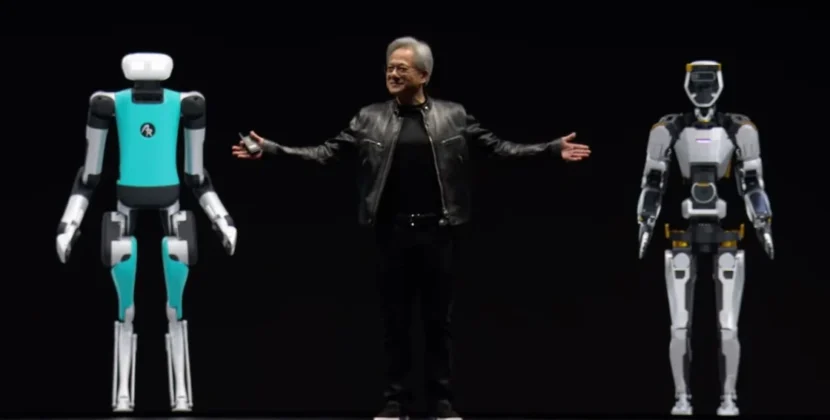
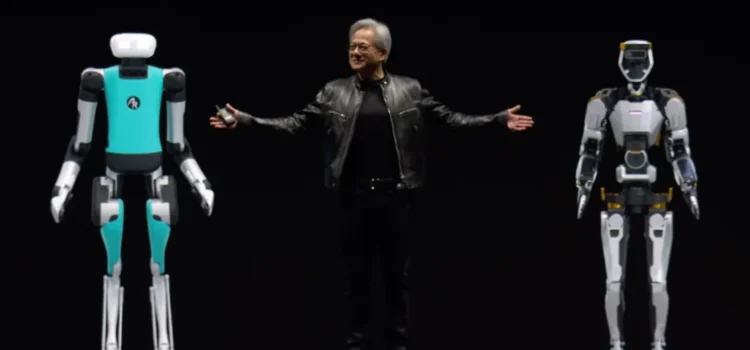
During his GTC keynote, Goan showed 1X’s humanoid robot performing household tidying tasks on its own using a policy trained with GR00T-N1. This autonomous ability comes from an AI training partnership between 1X and NVIDIA.
The future of human arts is concerning adaptability and learning, said Brent Bonich, CEO of One-X Technologies. While we develop our own models and media, GR00T-N1 provides a significant boost to robot reasoning and skills with minimal post-training data. We fully deploy on Neo-Gamma, promoting our mission of creating robots that are more than tools, yet companions capable of assisting humans in valuable, immeasurable ways.
Other top humanoid developers with early access to GR00T-N1 include Agility Robotics, Boston Dynamics, Mentee Robotics, and Neura Robotics.
NVIDIA, Google DeepMind, and Disney Research focus on physics.
NVIDIA is working with Google DeepMind and Disney Research to develop Newton, an open-source physics engine. In this partnership, NVIDIA leads the development, with Google DeepMind and Disney Research contributing expertise, to help robots learn to perform complex tasks more accurately.
Newton, built on the N-Media Warp Framework, will be optimized for robot learning when compatible with simulation frameworks such as MuJoCo and Isaac Sim. It will also utilize Disney’s physics engine.
Google DeepMind and NVIDIA are also co-developing MuJoCo-Warp, aiming to accelerate robotics machine learning tasks by over 70 times. Developers will access it via Google DeepMind’s MJX open-source library and the Newton engine, co-developed with NVIDIA.
Disney Research, as a partner in the Newton project, will be among the first to use the engine to improve its robotic character platform. This platform powers next-generation entertainment robots like the expressive Star Wars-inspired BDH droids that appeared with Huang during his GTC keynote.
The BDH droids are just the beginning. We’re committed to bringing more characters alive in ways the world hasn’t seen before. This cooperation with Disney Research and Video and Google is a key part of that vision, said Kyle Laughlin, Sr. Vice President of Walt Disney Imagineering Research and Development. This alliance will allow us to create a new generation of robotic characters that are more expressive and engaging than ever before and connect with our guests in ways that Disney can.
Continuing their collaboration, NVIDIA, Disney Research, and Intrinsic have announced a new partnership. Each organization will collaborate to develop OpenUSD pipelines and best practices for robotics data workflows, with NVIDIA overseeing the technical architecture and Disney and Intrinsic contributing their expertise in robotics and data management.
NVIDIA has also announced the BGX Spark Personal AI supercomputer at GTC. It gives developers a ready-to-use system to expand GR00T and N1’s capabilities for new robots’ tasks and environments without requiring much custom programming.
The Newton physics engine will be released later this year.
Source: NVIDIA Announces Isaac GR00T N1 — the World’s First Open Humanoid Robot Foundation Model