






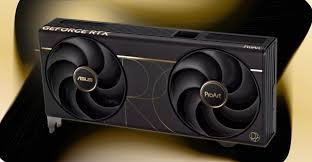
The ProArt RTX 5090 is a professional graphics card based on NVIDIA’s Blackwell architecture. It delivers advanced AI performance and creator-oriented features in a compact 2.5-slot form factor. The card features efficient cooling with a vapor chamber, liquid metal, thermal compound, and a USB-C port for professional workflows, making it ideal for small-form-factor PCs and multi-GPU systems. It features 32GB of GDDR7 VRAM, 3352 TOPS of AI performance, and supports DLSS and Multi-Encoder acceleration for 4K and 8K video production.
Asus RTX 5090: Key Features and Design
Compact Size: The 2.5-slot design offers a unique blend of high performance in a small footprint, boosting airflow and enabling multi-GPU configurations in limited-space cases. Ideal for creators with space or expansion needs.
High Performance Cooling:
- Vapor chamber and liquid metal thermal compound
- Large axial tech fans
- Double-vented backplate
Ensure optimal heat removal.
The ProArt RTX 5090 features a minimalist design with wood-patterned accents, offering a distinctive professional look for creative studios.
Creators-focused ports: The inclusion of a USB Type-C port enables flexible, high-performance video output to professional monitors, supporting modern creator workflows that standard gaming cards don’t.
Performance for Creators
With 3,352 TOPS, the card supports advanced AI work, such as generative art and LLM tasks, on an optimized platform.
32 GB of GDDR7 VRAM supports demanding visuals and complex 3D scenes.
Video editing acceleration supports multiple encoders and decoders for smooth 10-bit, 4:2:2 video workflows, enables multi-track 4K and 8K playback, and faster exports.
NVIDIA Blackwell drivers and DLSS 4 power AI rendering and frame generation.
Target Audience (creators, workstations)
Made for demanding creators needing top-tier performance in compact or multi-GPU workstations, prioritizing efficiency and professional features over gaming looks.
The ProArt RTX 5090 provides premium performance in a slim form factor, prioritizing efficiency and practicality for professionals over aesthetics.
AI Performance Is The Primary Focus
AI acceleration is prioritized, with 32GB GDDR7, 21,760 CUDA cores, and up to 8,352 AI TOPS. Designed for inference, small model training, and hybrid workloads needing memory and cooling in multi-GPU workstations.
Blackwell DLSS4 And Calculated Positioning
Built on NVIDIA’s Blackwell architecture as part of the GeForce RTX 50 series, the card provides access to all current RTX technologies, including DLSS for improved ray tracing, advanced super resolution, and NVIDIA Reflex 2. While these features benefit gaming, they are secondary for professional use. Blackwell further narrows the gap between consumer GPUs and workstation accelerators. The ProArt RTX 5090, though officially a GeForce card, is in situations previously reserved for the Quadro or RTX A series, highlighting its strategic value.
2.5 Slot Design Is A Deliberate Choice
A key feature of the ProArt RTX 5090 is its 2.5-slot design, while 3.5- or 4-slot coolers are now common. This unusual audio jack inclusion in this slimmer profile is essential for professionals. Users running multiple GPUs in a single system often encounter space limitations with wider cards, ASUS, Target’s multi-GPU setups, small-form-factor workstations, and systems with additional Creator graphics cards. The reduced height allows more hardware to fit in the same footprint and eliminates the need for dedicated cases. Compatibility with compact cases is a deliberate design feature. The crucial question is inevitability: how do you cool an RTX 5090 in this format without castrating it? Asus answers this with a combination of known, consistently implemented technologies: Liquid metal as a heat-conducting material on the GPU die delivers significantly better heat transfer than traditional pastes. This is not a marketing promise but a physically verifiable claim, though it requires exact, controlled manufacturing. The whole thing is complemented by a vapor chamber that evenly distributes heat across the base, as well as a double-ventilated backplate with flow-through zones at both ends of the card. The design is familiar from NVIDIA’s Founder’s Edition, but Asus has adapted it to a dual-fan layout with two large 115 mm axial tech fans. According to the manufacturer, this results in around 11% better cooling performance with a 25.7% smaller physical dimensions vs. traditional flow-through designs. This approach is efficient, not revolutionary. Asus avoids extremes and focuses on solid execution.
Connectivity And Practical Versatility
USB Type-C integration simplifies setups for creators with multi-monitor needs, reducing reliance on the motherboard in compact workstations.
Design Focused On Professionalism
Usually, the ProArt RTX 5090 remains true to its line: black, understated, functional. The striking yet subtle wood-laminate accents are less a fashionable gimmick and more a conscious distinction from the gaming market. Not only is a minor role or accent present, but it is also implemented in a minimalist way; the card does not seek to dominate but rather to integrate.
Classification
The ProArt GE Force RTX 5090 is not intended for the general market, as noted in the CES 2026 announcement. It is designed for users who have specific requirements for this card. For these professionals, the 2.5 slot design is a decisive advantage rather than a compromise. ASUS demonstrates that High-End specs and AI TOPS claims do not require maximum size in a market that frequently equates size with progress. This approach is a clear statement.



