




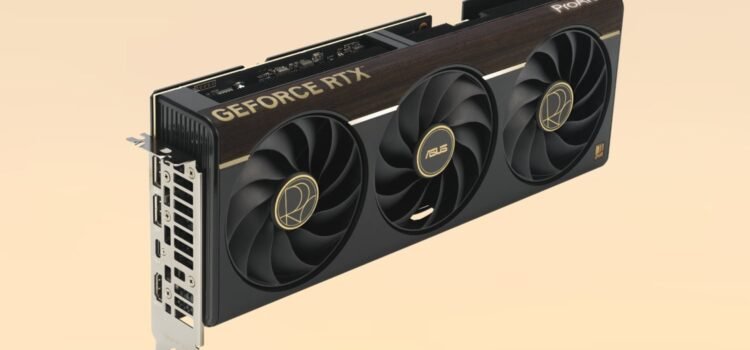
Asus will remove the faux wood trim and integrated M2 SSD slot from the upcoming ProArt RTX 5090 design graphics card, from the Asus ProArt GPU, both of which were included in the previous RTX 5080 model.
The ProArt RTX 5080 featured a wood-grain pattern, laminate trim, and an integrated M.2 SSD slot, resulting in a premium price nearly $500 above that of standard cards. The new RTX 5090 will have an all-metal industrial design. The new RTX 5090 is expected to be the most expensive product on the market and will continue to target creative professionals, offering a compact form factor, an audio jack, and a USB-C port for video output.
For users, these changes mean:
A shift away from distinctive aesthetic features, such as the faux wood trim.
The removal of integrated SSD expansion directly on the graphics card.
This modification indicates a shift in the ProArt line’s design philosophy, prioritizing functional features for creators rather than integrating storage into the GPU.
The Asus ProArt RTX 5090 Is Designed For Creators, Featuring A Compact Design And An Audio Jack
The Compact RTX 5090 is designed for creator response and positioning who require high AI performance in smaller systems.
A rare headphone jack and USB-C port distinguish it from other flagship GPUs.
The ProArt RTX 5090 does not include the wood trim or SSD integration from the earlier RTX 5080.
Asus has launched the ProArt GeForce RTX 5090, a compact version of Nvidia’s flagship GPU designed for creators and workstation users.
The card delivers high AI performance while maintaining a slim profile for small-form-factor systems and multi-card setups.
It offers 32GB of GDDR7 memory, 21760 CUDA cores, and A-coated 3352 AITO PS, placing it at the top of Nvidia’s current line-up.
Notably, The Card Features A Headphone Jack
ProArt RTX 5090 uses the Blackwell architecture and supports DLSS 4, including multi-frame generation and updated ray reconstruction features.
Like many large flagship cards, it uses a 2.5-slot design, leaving room for additional PCIe cards or a second GPU in compatible systems.
The cooling system follows the Founders Edition layout, with a vapor chamber heat pipe and two 115mm axial fans that direct air through a double-flow-through backplate.
Asus uses liquid metal between the GPU die and heat sink, a method typically reserved for premium designs due to its handling requirements.
This approach reportedly improves thermal efficiency and reduces overall card size compared to larger triple-fan designs.
The most notable feature is the built-in 2.5 mm headphone jack, which is rare on modern graphics cards.
Audio output sits alongside DisplayPort and HDMI connections and is paired with a USB Type-C port for displays and peripherals.
What Was Removed Vs. Prior Model?
The USB-C port replaces one standard DisplayPort output and is intended for creators who use portable or daisy-chained monitors.
Visually, the card maintains a restrained industrial appearance without RGB lighting or decorative elements, marking a clear shift from the earlier ProArt RTX 5080, which featured wood-effect trim and an integrated M.2 SSD slot.
These features are not present in the new model. Pricing and availability are unannounced, neither are the reasons for design change. For reference, the ProArt RTX 5080 with an AFV wooden frame was priced at US$1,469, roughly US$500 more than the standard RTX 5080.
Due to its target market and the costs associated with its compact design and custom cooling, expect the RTX 5090 to be priced higher than previous models.



