





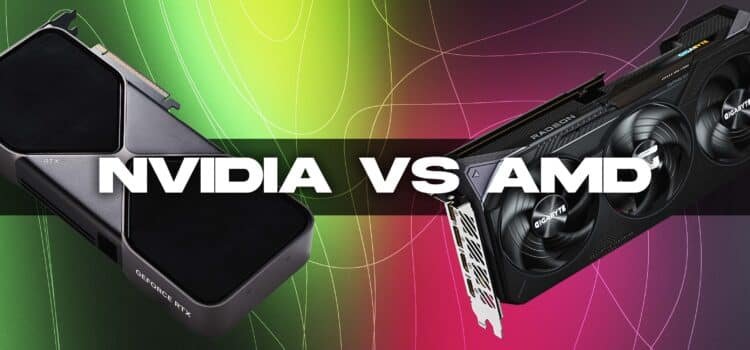
NVIDIA RTX 50 series vs AMD Radeon RX 9000 series: official launch specifications compared
NVIDIA’s GeForce RTX 50 Series (Blackwell) is built for top-level performance using GDDR7 memory and advanced ray tracing and DLSS 4. In contrast, AMD’s Radeon RX 900 series (RDNA 4) aims to deliver strong value for mainstream and high-end gamers, focusing on efficiency and better price-to-frame performance. The RTX 5090 is designed for maximum performance with 32GB VRAM, while the RX 9000 series performs well in the mid-range, offering better value for the price.
NVIDIA GeForce RTX 50 Series (Blackwell)
- Performance leadership: Built for high-quality graphics, advanced ray tracing, and path tracing.
- Key Features: Uses GDDR7 memory, DLSS4, and Advanced AI-powered Neural Shaders.
- Top model: The RTX 5090 comes with 32GB of GDDR7 memory and is made for 4K and 8K gaming as well as AI tasks.
- Efficiency: The Blackwell architecture is designed to keep top performance while using less power thanks to TSMC 4N technology.
AMD Radeon RX 9000 Series (RDNA 4)
- Value and capability: Delivers about 85% to 95% of Nvidia’s performance, but at a much lower price, especially for 1440p and entry-level 4K gaming.
- Architecture: boosts instructions per clock (IPC) for both rasterization and ray tracing.
- Key Features: Adds FSR4 for AI-powered upscaling, aiming for high frame rates and better energy efficiency as seen in the RX 9060 XT.
- Market standpoint: aims at competitive gaming with powerful cards that usually run cooler.
Comparison Summary
- Ray tracing, N-media still leads in demanding ray and path tracing, but AMD has made big improvements.
- Price/Value: AMD usually gives better value. High-end cards like the RX 9070 XT can match or even beat mid-range RTX 50-series cards in rasterization, often at a lower price.
- Best for Cologne. Pick the RTX 50 if you want the latest AI and visual features. Go with the RX 9000 if you want strong performance and better value for your money.
AMD’s RX 9000 series, with models like the RX 9070 XT, is making the market more competitive. It sets up a clear choice among Nvidia’s high-performance, AI-focused cards and AMD’s efficient, high-fps gaming at a lower price.
If you are building or upgrading a gaming or content-creation PC in 2025, you are probably asking yourself the classic question: Radeon or GeForce, with Nvidia’s RTX 50 series or AMD’s new Radeon? The Radeon RX 9000 series is now available. The competition is closer and more exciting than ever. Each brand has its own strengths. Knowing the differences may help you choose what’s best for your needs and budget.
Performance and Compute Power
The NVIDIA RTX 50 series, with cards like the RTX 5090 and RTX 5080, continues NVIDIA’s tradition of leading high-end gaming and professional workloads. These GPUs use the Blackwell architecture, offering better ray tracing, AI-powered rendering, and improved power efficiency. The RTX 5090 stands out for its impressive 4K and even 8K performance, making it a prime option for devotees and creators who want the best.
Meanwhile, AMD’s Radeon RX 9000 series, built on its latest RDNA 4 architecture, delivers strong rasterization performance, improved ray tracing, and more VRAM at each level. The RX 9900 XTX is AMD’s top card and offers great 4K gaming performance at a lower price than Nvidia’s highest-end options. If you care most about high-end, high-resolution gaming and don’t need advanced AI features, Radeon GPUs are a good value.
When it comes to computing power for tasks such as 3D rendering, AI, and simulation, Nvidia still has the advantage thanks to its CUDA cores and strong software support. However, AMD has improved its OpenCL and HIP support, making its cards more useful for demanding compute tasks.
DLSS 4 vs FSR 3.1: AI and Upscaling
One of the main differences between Radeon and GeForce is upscaling and AI-based frame generation. NVIDIA’s DLSS, or deep learning super-sampling, uses cutting-edge neural networks to upscale lower-resolution frames with impressive quality. The latest frame-generation feature also delivers enhanced motion and better responsiveness.
AMD responds with FidelityFX Super Resolution 3.1, boosting visual quality and adding Fluid Motion Frames to compete with DLSS frame generation. FSR works with more GPUs, including some older Nvidia cards, but DLSS still offers better image quality and consistency, especially with ray tracing.
G-Sync vs FreeSync: Adaptive Sync Technologies
Adaptive sync is another important factor when choosing between Radeon and GeForce. NVIDIA’s G-SYNC delivers great performance and quality, but it usually requires pricier monitors. AMD’s FreeSync is available on many budget and premium displays and works smoothly with Radeon GPUs.
The good news is that NVIDIA GPUs now support many FreeSync monitors, though only through G-Sync-compatible certification, so you have more options than before. However, Radeon still gives you more flexibility with adaptive sync.
Radeon vs GeForce Cologne Software Drivers and Ecosystem
NVIDIA’s GeForce Experience still provides an easy-to-use interface for automatic driver updates, game optimizations, and simple streaming and recording. AMD’s Adrenaline Edition software has also improved, giving users detailed performance tuning in driver recording. And features like Radeon Chill and Boost.
AMD’s driver stability has gotten better, but Nvidia is still known for more reliable day-one support, especially for big game launches and professional apps.
Final verdict: Radeon vs GeForce in 2025
So, which GPU should you pick in the Radeon vs GeForce comparison?
- Go with the Nvidia RTX 50 series if you want the best ray tracing, advanced AI features like DLSS 4, and top performance, even if it means paying more.
- Pick the AMD Radeon RX 9000 series if you want strong gaming performance, more VRAM for your money, and a wider selection of FreeSync-compatible monitors, especially for 1440p and 4K gaming.
Source: Radeon vs GeForce: RTX 50 Series vs Radeon RX 9000 GPUs