





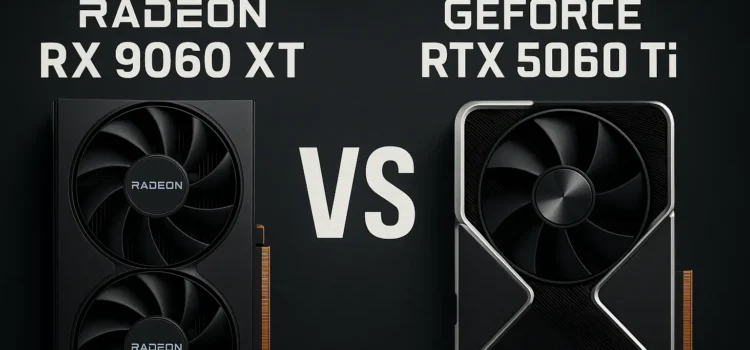
The AMD Radeon RX 9060 XT, especially the 16 GB version, is usually faster in standard gaming performance by about 5 to 10%. It also gives better value for high refreshing 1080p and 1440p gaming. The NVIDIA RTX 5060 stands out for ray tracing AI tasks and DLSS features, making it a better choice for creators or games that use a lot of ray tracing, but it only has 8 GB of VRAM.
Key Comparisons (February 2026)
- Performance: The RX 9060 XT is usually faster in standard rendering, with about a 6% lead at 1080p and a larger advantage at 1440p.
- VRAM: The RX9060XT comes in a 16GB version, which means it will last longer and perform better with higher resolutions than the RTX 5060, which is limited to 8GB.
- Features: The RTX 5060 is better at ray tracing and supports DLSS 4.
- Efficiency: The RX9060XT uses less power, with a 150 W rating, compared to other 50 series cards.
- Price/Value: The RX 9060 XT usually costs less than the 5060 and performs better, making it a great choice for gamers on a budget.
Which one should you choose?
- Pick the RX 9060 XT (16 GB) if you want the best standard gaming performance, high frame rates, 1440p gaming, and good value for your money.
- Go with the RTX 5060 (8 GB) if you mostly play games with heavy ray tracing, need DLSS, or do content creation like 3D modeling or AI work.
This generation, AMD finally has a strong mainstream option with the RX 9060 XT. While it isn’t perfect and doesn’t match the speed of the pricier RX 9070 XT, it’s the first time in years that AMD offers a real alternative to NVIDIA.
This is partly because the RTX 5060 didn’t impress, particularly due to its small frame buffer and lackluster improvements over the previous generation. We tested both GPUs side by side, and one was clearly better.
Two specs are important for the RTX 5060 and RX 9060 XT:
- VRAM capacity
- Power draw
Power Draw is the easier of the two. NVIDIA took a massive lead in efficiency with its ADA-loveless GPUs in the previous generation, and the latest Blackwell cards stall out on the efficiency gains. The RX9060XT and RTX 5060 are in lock step in terms of power draw, which is surprising given their performance over the past few years. It’s even more surprising considering the RX9060XT, despite its issues, is clearly faster than the RTX 5060.
Most people care most about VRAM capacity. The RTX 5060 only comes with 8GB of VRAM. The RX 9060 XT is available with 8GB or 16GB of memory. NVIDIA’s RTX 5060 Ti also comes in 8GB and 16GB versions, but the 16GB model costs over $500. We don’t love that AMD splits VRAM options across the same chip, but it’s clear that AMD offers a cheaper way to get 16GB of VRAM than NVIDIA.
The extra capacity is important, too, though 8GB is enough for most games at 1080p. Our testing shows it becomes a limiting factor even at 1440p, especially in games that aren’t known for stressing VRAM. The RX 9060 may be available in two capacities, but for most people, the 16GB version is the only option.
Both the RTX 5060 and RX 9060 XT target mainstream gamers who play at 1080p, and both have a $300 MSRP, but there’s more to it than just the price tag right now. Both AMD and NVIDIA have cards available at least price, and we found both for $300 with no extra fees. That’s good news, but AMD’s lineup is more complicated.
The RX 9060 XT comes in 8- and 16-GB versions, and while the 8-GB model is at least priced, the 16-GB one isn’t. To justify an extra $50 for the RX 9060 XT over the RTX 5060, given AMD’s better performance and larger frame buffer at $390, however, we are talking about a 30% price increase for a 10% boost in performance, plus extra VRAM for higher resolutions. The 16GB RX 9060 XT is undoubtedly the better buy over the 6GB model, but it’s lost in limbo. It’s clearly more expensive than the RTX 5060, but it’s not as expensive as even the cheapest 8GB models of the RTX 5060 Ti.
If you have a strict $300 budget, you’ll have better luck with the RTX 5060. Although AMD has models at list price, the split between 16GB and 8GB versions means the cheapest ones at MSRP will sell out first. The RTX 5060 has been out for a few weeks, and the prices are still at MSRP. Hopefully, the RTX 9060 XT will keep the MSRP for the 8GB model, but we don’t expect the 16GB model to.
The RX9060 XT is faster than the RTX 5060, which makes sense given its higher price at 1080p. The other RX9060 XT leads by about 6%. This includes all tested games, even those with ray tracing. AMD has made significant improvements to ray tracing with RDNA 4, but the RX 9060 XT only matches the RTX 5060 in this area, which lowers its average performance. If you ignore ray tracing, which is tough now with games like DOOM, the dark ages, AMD’s lead is even bigger.
At 1080P, the extra frame buffer from the RX9060 XT 16GB is not a significant factor. There are a few exceptions, like Indiana Jones and The Great Circle, where 8GB can still struggle even at 1080P. Performance between the 8GB and 16GB RX9060 XT is mostly similar at $300. AMD has about a 5% to 10% advantage over the RTX 5060, depending on the game.
You can see this at 1440p. The RX 9060 XT jumps to a 10% average lead, and in games like Horizon Zero Dawn Remastered and Forza Motorsport, the gap widens. This clearly shows how 8GB graphics cards can’t keep up with 1080p. The RTX 5060 does not hit the extreme VRAM bottlenecks seen with 8GB cards at 4K, but the averages show it gives up some performance at greater resolutions simply because it does not have enough VRAM.
The performance advantages of the RX 9060 XT alone are not enough to justify extra spending over the RTX 5060, even if AMD wins when both GPUs are $300. The main reason for choosing the 16 GB RX 9060 XT is that NVIDIA does not offer a 16 GB RTX 5060. You would need to upgrade to the RTX 5060 Ti, with the 16 GB version costing around $500, spending an extra $50. The 16 GB RX 9060 XT over the RTX 5060 may be steep, but it is your best option right now.
Even if you are not limited by VRAM at 1080p, the RX9060 XT is better equipped for modern games with a 16GB frame buffer. The extra capacity lets it scale up to 1440p and makes it easier to enable features like frame generation. The RTX 5060 may have an edge with DLSS 4 and multi-frame generation (MFG), but MFG uses more VRAM, which is hard to allocate when 8GB cards are already short on capacity.
It is hard to justify the RTX 5060 over the RX 9060 XT. That’s true for both the 8GB and 16GB models. For the 8GB models, the RTX 5060 and RX 9060 XT have the same MSRP. It is hard to justify the RTX 5060 over the RX 9060 XT. That’s true for both the 8GB and 16GB models. For the 8GB models, the RTX 5060 and RX 9060 XT have the same MSRP of $300. They are both available at that price, and the RX 9060 XT is faster, pure, and simple. Sure, the RTX 5060 has access to MFG, but that’s a much less useful feature on an 8GB graphics card that already struggles to scale up to greater resolutions and graphics settings.
For the 16GB model, it’s a bit trickier. The RX 9060 XT with 16GB is faster, and it comes with more VRAM to scale to higher resolutions and fully leverage frame generation. It’s also around 30% more expensive. If you can find the RX 9060 XT at $350, you should buy it. Once prices pass $400, though, it’s time to start looking at alternatives.
Source: Nvidia’s RTX 5060 is embarrassing against the RX 9060 XT



