






Samsung is a major force in South Korea’s economy as one of the country’s largest conglomerates. It spans insurance, mobile services, pharmaceuticals, and construction.
Samsung Electronics stands out within the conglomerate and is the first South Korean company to approach a valuation of $700 billion in today’s exchange rates, based on current market organization capitalization. This achievement underscores the group’s significance on both a national and international scale.
This strong market position has made Samsung Electronics an attractive investment.
Over the past year, strong shareholder interest has driven Samsung Electronics’ stock to record highs. For example, the stock briefly exceeded 160,000 won yesterday at about $110 at current rates pushing the company’s market capitalization above 1,000 trillion won (approximately $700 billion as of now), building on earlier momentum.
This marks the first time a South Korean company has reached this level of worth, despite the presence of other major conglomerates such as LG, Hyundai, and Lotte. Publicly traded companies in South Korea are frequently undervalued due to limitations in the capital market, making Samsung Electronics’ recent performance all the more notable.
The company’s stock has tripled in the past year, driven by investors forecast of its ability to capitalize on the memory super-cycle. This increased demand has resulted in higher share value and prices.
Samsung Electronics’ stock is increasingly popular among young investors in South Korea. A recent report indicated that over 400,000 investors under 20 now hold shares in the company.
Samsung Electronics, a top domestic semiconductor company, showed strong early trading on the 22nd. Its share price surpassed 160,000 won intraday, including preferred shares. Its total market capitalization exceeded 1,000 trillion won for the first time among Korean corporations.
At 10:02 am, Samsung Electronics traded at 154,300 won, up 4,800 won (3.21%) from the previous session. The stock reached 160,000 won intraday, marking a one-year high.
Alongside the rise in common shares, Samsung Electronics’ preferred shares also gained 1.9% to 112,500 won, bringing the company’s total market capitalization to 1,052 trillion won.
Last year, Samsung Electronics’ shares traded in the low 50,000 won range. However, they began to rise significantly with the onset of the semiconductor Supercycle in the fourth quarter of the year. The company declared an operating profit of 20 trillion won, its highest ever.
Analysts in the securities industry expect Samsung Electronics’ strong earnings to continue. Kim Dong-won, AKB Securities researcher, said, “As memory rises to the center of the artificial intelligence (AI) industry structure and as a structural transition to a memory-centric era combines system design capabilities, Samsung Electronics, which has both memory and foundry businesses, will benefit even more significantly.”
The Korean Tech Giant Achieves a National First, But Can It Challenge Apple’s Ecosystem
As of early 2026, Samsung has experienced significant growth. Despite these advances, the company is still not positioned to surpass Apple in total market capitalization, setting the stage for further comparisons.
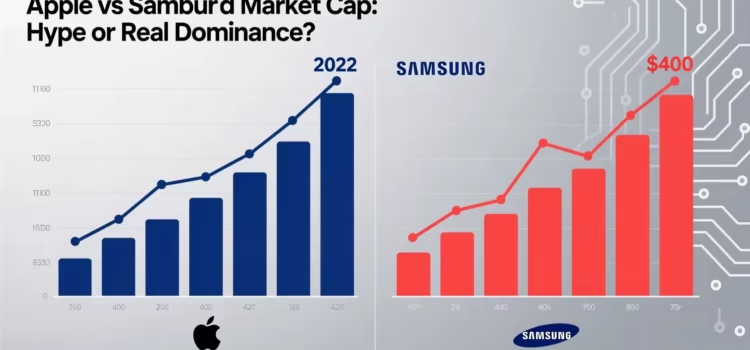
As of January 2026, Apple’s market capitalization remains between $3.6 trillion and $3.8 trillion, securing its status as one of the world’s most valuable companies. Although Samsung Electronics’ market cap has surged to approximately $500 billion to $680 billion. It remains significantly smaller than Apple’s.
Why Samsung Cannot Surpass Apple at This Time
- Significant valuation gap: Apple’s market cap ($3.6 trillion) dwarfs Samsung Electronics ($500B-$680B as of mid-January 2026).
- Profitability vs revenue: Although Samsung frequently competes with Apple for the highest smartphone shipment volumes, Apple consistently achieves greater profitability by focusing on premium margin products and services.
- Market status: Apple, like Samsung, holds a dominant position in the premium smartphone segment.
Samsung’s position
- Growth: Samsung Electronics’ market cap reportedly increased by over 150% in one year, surpassing $500B by late January 2026.
- Strengths: Samsung continues to be a leader in hardware sectors such as DRAM, NAND flash, and OLED displays, and often leads in total smartphone unit sales.
Conclusion
Samsung is the largest electronics maker by volume, but Apple’s premium model, higher profitability, and service ecosystem secure a much higher valuation. Samsung remains strong, but is not positioned to surpass Apple’s $3.6 trillion market cap.



