
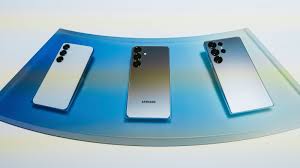




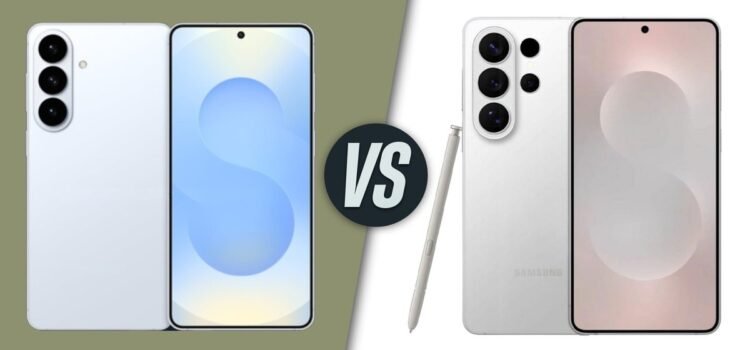
The Samsung Galaxy S26 Ultra and S26 Plus, expected in early 2026, mainly differ in their camera and display features.
The S26 Ultra features a 6.9-inch screen, a 200MP quad-camera, and S Pen support. It will likely use the faster Snapdragon 8 Elite Gen 5 chip. The S26 Plus comes with a 6.7-inch display and a triple 50 MP camera and usually runs on the Exynos 2600 chip in some areas. Both models offer about 2,600 nits of brightness and support 45 W charging.
Key Technical Differences
- Camera System: The S26 Ultra is expected to have a 200MP main camera, a 50MP ultra-wide lens, and a 50MP periscope lens with 5x zoom. The S26+ will likely include a 50MP main camera, a 12MP ultra-wide lens, and a 10MP telephoto lens with 3x zoom.
- Performance: The S26 Ultra will likely use a faster Snapdragon 8 Elite Gen 5 chip reaching up to 4.74GHz. The S26 Plus is expected to use the Exynos 2600 chip in many regions.
- The Ultra has a larger 6.9-inch display with possibly higher peak brightness close to 3000 nits and likely supports the S Pen. Both models will feature Gorilla Glass armor and a privacy display.
- Battery: The S26+ is expected to come with a 4900 mAh battery and 45W charging. The Ultra may have a larger upgraded battery.
- Design: Both phones are expected to be thinner and lighter, with stronger, more refined frames.
Summary Table of Expected Specifications
| Feature | Galaxy S26 Ultra | Galaxy S26 Plus |
| Display | 6.9-inch dynamic AMOLED 2x | 6.7-inch Dynamic AMOLED 2X |
| Processor | Snapdragon 8 Elite Gen 5 | Exynos 2600/Snapdragon |
| Rear Camera | 200 MP + 50 MP + 50 MP + 10 MP | 50 MP + 10 MP + 12 MP |
| Battery | ~5000 Plus MH | 4900 mAh |
| Charging | 45 W Plus | 45 W Plus |
| S. Pen | Yes | No. |
| Protection. | Gorilla Glass Armor | Gorilla Glass Armor |
The Galaxy S26 series is set to arrive in less than 2 weeks. Samsung will release the new flagships on Feb 25, 2026, and they’ll be available in stores starting in March.
This is a little later than expected, but there’s a good reason. Samsung originally planned to launch the Galaxy S26 Pro and Galaxy S26 Edge, but those models were reportedly canceled, so the company returned to its usual lineup.
As a result, we’ll see the familiar lineup: the Galaxy S26, Galaxy S26 Plus, and Galaxy S26 Ultra.
As usual, the Galaxy S26 Plus and Galaxy S26 Ultra will be the larger models. How do they stack up against each other?
Design and Size
Samsung is sticking to a safe approach. Again, this year, neither the Galaxy S26 Plus nor the Galaxy S26 Ultra will have major design changes. All updates will likely be small and won’t affect how the phones feel to use.
The Galaxy S26 Plus will likely retain the design style of the previous Galaxy S Plus models. It should be a compact and slim phone with well-placed buttons. The phone is expected to keep the aluminum flat frame and flat Gorilla Glass Victus 2 2 panels on both the front and the back.
The main difference from the previous generation might be a slightly raised camera island on the back, which will hold all three camera lenses. The Galaxy S25 Plus did not have this kind of unified camera island.
The Galaxy S26 Ultra will likely use aluminum rather than titanium, as Apple did with the iPhone 17 series. Aside from that and a slightly raised camera island on the back, the Galaxy S26 Ultra will look much like the Galaxy S25 Ultra.
The Galaxy S26 Plus will be the more compact option. The Galaxy S26 Ultra will be larger in length, width, and thickness, and likely weight. If you want a phone that’s easier to handle but still has a big screen, the Galaxy Plus is a good choice.
Both phones will have at least IP68 water- and dust-resistance. Some high-end Chinese flagships now offer IP69 and IP69K ratings, which are better than IP68, but it’s not clear whether Samsung will do the same this year.
The Galaxy S26 Ultra will include the built-in S Pen.
There is no information yet about color options, but we expect a good selection, including some explosive colors, on samsung.com.
Display Differences
The Galaxy S26 Plus will have the same 6.7-inch Dynamic AMOLED 2X screen as last year, offering a refresh rate of up to 120 Hz, HDR support, and a peak brightness of over 2,600 nits.
The Galaxy S26 Ultra will also feature a 6.9-inch Dynamic AMOLED 2X display with a 120 Hz refresh rate, HDR, and brightness close to 3000 nits.
The prominent new display feature in the Galaxy S26 series is the privacy display. This uses AI software and Samsung’s Flex Window OLED panel to stop people next to you from seeing your screen while everything still looks normal to you. It’s similar to privacy screen protectors but built into the phone’s software.
Both the Galaxy S26 Ultra and S26 Plus will come with Gorilla Glass Armor for strong scratch and drop resistance.
Recent reports claim this feature won’t be exclusive to the Galaxy S26 Ultra, but will be supported by both the Galaxy S26+ and the Galaxy S26. However, since it requires the new OLED panel, it’s highly unlikely to arrive on older galaxies via a software update.
Both phones will feature under-display fingerprint scanners, expected to be fast and accurate.
Performance and Software
Samsung is once again splitting its chip choices for the Galaxy S26 and S26 Ultra, and this time it might be a permanent change.
In the USA, Canada, and China, the Galaxy S26 Plus will use the Qualcomm Snapdragon 8 Elite Gen5, the best high-profile 3nm chipset available for most Android makers.
In other markets, the S26 Plus will use Samsung’s Exynos 2600 chip built on a 2nm process. Samsung says the chip is about five percent faster and 8% more efficient than the previous Exynos 2500.
This doesn’t apply to the Galaxy S26 Ultra. The Ultra will use Qualcomm chips worldwide, with no Exynos version for the main flagship.
It’s still unclear whether Samsung will offer 16GB of RAM in its flagships, as many Chinese brands do, or stick with 12GB. The latter seems more likely.
Camera
There are no major camera changes this year either.
The Galaxy S26 Plus will have a 50MP main camera, likely with an upgraded sensor, a 12MP ultra-wide, and a 10MP telephoto with 3x optical zoom. It will retain its latest setup: A200MP main camera, A50MP 5x periscope, A50MP ultra-wide, and A10MP 3x telephoto. The change here could be either a larger sensor for the main camera (a 1/1.1-inch Sony sensor has been floated as a possibility) or a faster f/1.4 aperture.
Both phones will keep their 12MP selfie cameras, but the lens might be wider to capture more background. This would be a nice upgrade.
Battery Life and Charging
Samsung might finally step away from the 5,000 mAh battery it has been using for the past five or six years on its Galaxy Ultra phones, but the change might not be as big as hoped. Samsung may move on from the 5,000 mAh battery it has used in Galaxy Ultra phones for years; however, the change may be small, with rumors pointing to a 5,200 mAh battery in the Galaxy S26 Ultra. The battery size is around 4,900 mAh, the same as last year’s S25 Plus.
The Galaxy S26 Ultra will likely get a charging upgrade from 45 W to 60 W, enabling faster charging. The S26 Plus will likely keep its 45 W charging, which is now standard.
There’s a high chance we’ll see full Qi2 implementations across the Galaxy S26 range, meaning both the Galaxy S26 Ultra and the Galaxy S26 Plus will be joining the party. This means wireless charging speeds potentially up to 25 W, but the bigger thing could be the use of Qi2 magnets in the rear. These could allow you to easily snap on compatible Qi2 Mag Safe or Pixel Snap accessories.
Summary
Samsung is playing it safe with its flagships again. There are no new product names, categories, or major changes in performance or design. It is a very familiar pair of devices that will retain their major selling points and key differentiators.
The Galaxy S26 Ultra will likely be the top choice for power users, as it should be the most powerful Android phone in the US for some time. With the best camera and most features, it will be expensive but offer no compromises in early 2026. It will continue to be that weirdly positioned device that feels slightly off. It’s a flagship but not quite, and it’s compact but not as much as the Galaxy S26. It’s been nearly half a decade since the Galaxy S Plus phones, and they don’t have a valid reason for existence.
Source: Samsung Galaxy S26 Plus vs Galaxy S26 Ultra: Main differences to expect



