



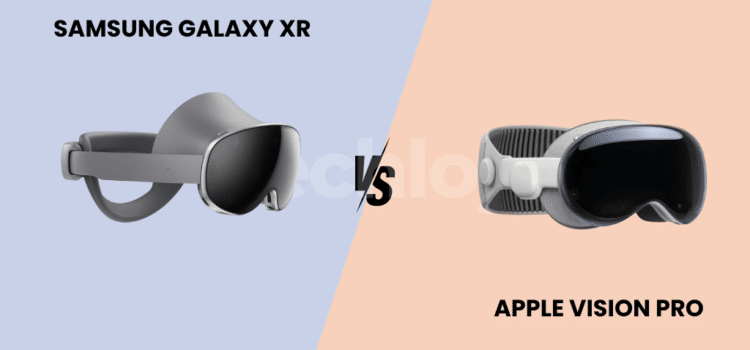
The Samsung Galaxy XR ($1799) and Apple Vision Pro ($3499) are competing mixed reality headsets. Samsung focuses on value and AI features through Android XR, while Apple highlights luxury, performance, and a polished ecosystem.
Both headsets have high-resolution 4K Micro OLED pass-through. The Vision Pro creates more immersive environments and offers better spatial precision. The Galaxy XR is lighter, more comfortable, and lets you choose optional controllers.
- OS & apps: the Galaxy XR runs Android XR, so it supports most Android apps, offers strong Google Gemini AI features, and provides direct access to the Play Store. The Vision Pro runs Vision OS, offering polished spatial apps, great iPadOS and iOS app support, and realistic digital personas.
- Performance & Design: The Apple Vision Pro features the advanced M5 chip, which delivers a 120Hz refresh rate and strong spatial awareness. Galaxy XR uses the Snapdragon XR2+ Gen 2 chip and is much lighter (545 grams compared to 800 grams), making it more comfortable for longer use, even though it uses more plastic.
- Interaction & Controllers: Both headsets use eye and hand tracking. The Vision Pro’s tracking is more precise, but the Galaxy XR also supports physical controllers, which many people prefer for gaming.
- Ecosystem depth: Apple stands out in spatial computing, offering smooth integration with Macs and iPhones and exclusive apps like Disney+ environments. Samsung’s Hex headset serves as a hub for the Galaxy ecosystem and may support smart glasses in the future.
- Battery: Both headsets use external battery packs that last about 2-2.5 hours.
The Apple Vision Pro is a premium spatial computer with top-quality visuals for professional and entertainment use. The Samsung Galaxy XR is a comfortable, flexible, AI-powered headset that works well with familiar apps and costs about half as much.
Soon, one pair of smart glasses could serve as your personal movie theater. Might guide you through a new city, let you check group texts during meetings, or help you translate a menu while traveling. You could ask an AI assistant for movie suggestions or view 3D photos and videos that bring memories to life. You might even set up a virtual workspace with displays that look almost as clear as real monitors.
However, the future isn’t here yet. In 2025, people still have to choose. Option A is sleek, lightweight smart glasses like the Ray-Ban Meta Glasses. These can take photos and videos and let you use an AI assistant. You can wear them in public and still look like everyone else.
Option B is immersive mixed-reality headsets such as Meta Quest, Apple’s Vision Pro, and the new Galaxy XR from Samsung and Google. These devices are effectively computers you wear on your face, and they look like they are.
These headsets aren’t selling quickly. Apple CEO Tim Cook has admitted the Vision Pro is not a mass market product, mostly because it costs $3,499. The Quest 3 is much cheaper at $500, but it isn’t as advanced. Samsung’s $1,800 Galaxy XR aims to be a middle ground.
All these XR headsets are still impressive from a technological standpoint. However, their bulky shapes, high prices, and some compromises have limited their popularity. We are beginning to see hints of what future glasses might do, but for now, Apple and Samsung’s latest headsets are the best options if you want to enter a virtual world or mix it with the real one.
Samsung’s Headset is the first to use Android XR, a new version of Google’s mobile system made for mixed-reality devices. It highlights Google’s Gemini AI Assistant and offers improved immersive versions of YouTube, Google Photos, and Google Maps. The Galaxy XR also matches some of the Vision Pro’s top hardware features at about half the price.
After a week of using the Galaxy XR and Apple’s new Vision Pro (now with a much-improved headband and a faster M5 chip), the adage proved true: “You get what you pay for.” Apple’s head start on Vision OS has led to a more thought-out user experience, while Samsung’s headset is slightly cheaper. Both devices are niche luxury items, and very few customers/consumers will buy them. Still, they are an important stepping stone and a base for exploring ideas before mainstream AR glasses inevitably take hold.
Hardware
While the Vision Pro has long been widely criticized for being rather heavy, Samsung favored a lightweight design for the Galaxy XR. It has a hard plastic headband that tightens via a knob on the back, and the company threw in several forehead spacers to help people find the right fit.
However, that fixed rigid design brings a different set of trade-offs. The rear-mounted adjustment dial can make using the Galaxy XR uncomfortable when lying in bed or on the couch. By contrast, Apple’s updated strap includes thick, adjustable padding for both the back and the top of your head, allowing me to comfortably use the Vision Pro for long stretches, including an entire movie. Still, the headset becomes tiring after extended use.
To its credit, the Vision Pro looks and feels like a more premium device, and several of its components (like the head strap and light seal) are user-replaceable. If anything on the Galaxy XR breaks, the whole unit will need to be repaired.
I do appreciate that by default, the Galaxy XR lets you maintain some peripheral vision below the lenses and at your sides. You can add magnetic inserts to fully envelope yourself in the virtual realm, but I preferred to leave them off. It’s convenient to look down and clearly see a phone or a connected Bluetooth keyboard.
Both headsets use sharp, high-resolution micro OLED displays for each eye, but the Vision Pro runs at a smoother 120Hz refresh rate. The Galaxy XR, meanwhile, is limited to 72Hz by default. That difference matters more in pass-through mode, when you are looking around your environment, and any delay or blur can cause discomfort. It’s less of an issue when focusing on apps or watching videos, and neither headset ever caused me any motion sickness.
The Vision Pro’s built-in speakers also offer fuller sound than the Galaxy XR, but I recommend wireless earbuds either way for the best possible audio.
Controls
The physical controls vary slightly between the two headsets. Still, each provides an easy way to bring up the home screen, adjust the volume, and quickly switch between pass-through and virtual environments, making it easy to master the basics.
Both headsets have an external battery pack that must remain connected for the device to function and be recharged via USB-C. It takes time to get accustomed to this tethered setup, and during my first few days using the Vision Pro and Galaxy XR, both batteries took their share of tumbles, as did the headsets whenever I forgot to remove a battery pack from my pocket. Fortunately, there are no worse-for-wear.
By default, the two headsets differ in their user experience. Apple’s Vision Pro uses sophisticated eye tracking: you look at what you want to select and then pinch with your thumb and index finger. The Galaxy XR relies more on hand tracking, so it works wherever you point. A small screen cursor appears, and you do the same pinching gesture to confirm a selection or grab an on-screen window you want to move. It’s possible to enable eye-only tracking in the XR’s settings if you’d rather mimic the Vision Pro’s approach, but because Samsung’s Eye Tracking isn’t as precise, the result is markedly worse. I stuck with the Hand Tracking system.
However, even as Samsung works through growing pains, the Vision Pro occasionally misses a pinch gesture here and there; it’s a recurring frustration on the Galaxy XR, which frequently struggles to recognize hand-tracking pinches in dimmer settings. The company can remedy this with future software updates. In brighter conditions, I rarely encountered issues. Typing on the virtual keyboard is another area where Apple’s headset proved more intuitive and more reliable across lighting conditions.
Software
Power both devices on, and it’s clear that Android XR has taken many cues from Vision OS. The hovering app grids are similar. The gestures for resizing app windows are identical, and so is the shortcut for bringing up the home screen: look at your palm and pinch your thumb and index finger together.
With both headsets, you can open apps and position them wherever you’d like in 3D space or even in different rooms. Want a movie to fill an entire hall? You can make it so. Multiple browser windows can be strewn about for easy reference as you work on a presentation or spreadsheet. Revisiting your photos is more compelling at this life-sized scale than scrolling through them on a phone. Both headsets let you spatialize images, giving them greater depth and briefly making it seem like you are right back in a special moment.
However, Vision OS shows that Apple has put a lot of thought into spatial computing. It’s elegant, requires less effort, and is just nicer to look at. Translucency is used across the system, with Windows accurately showing the lighting in your room. Everything comes off as more real and does a better job of tricking your brain into accepting that these apps are something you can work up to and actually touch.
Apple’s M5 chip vastly outperforms the Qualcomm Inc. Snapdragon XR2+ Gen 2 processor inside the Galaxy XR, which might explain why Samsung’s headset lacks some of the same graphical niceties. Samsung’s virtual environments are also less detailed than the realistic backdrops you can surround yourself with using the Vision Pro.
Apple is also better at understanding physical space. The Vision Pro lets you place virtual widgets throughout your home: a clock, a photo frame, a music player, or the weather forecast, and remembers exactly where you left them even after powering the headset off or taking it to another location. Come back, and you will find those widgets anchored on the same wall.
On the Galaxy XR, meanwhile, the windows occasionally drift from where you originally put them (especially in low light). It’s not as easy to push apps to a spot farther away in the room without literally standing up and dragging them there. Widgets aren’t yet available on the platform either.
Samsung’s persona avatars aren’t much better: They look cartoonish and elementary compared with the ultra-realistic personas that the Vision Pro can create with a few facial scans. Samsung has indicated that increasingly lifelike avatars are coming at some point in the future.
Multimedia
What the Galaxy XR lacks in polish, it makes up for with apps. Samsung’s headset includes some features you won’t find on Vision OS, such as YouTube, YouTube TV, Google Maps, and Netflix. The Android XR version of YouTube has a dedicated section for 1080- and 360-degree videos. Google Maps’ immersive overhead view makes it feel like you’re flying through cities, and you can tour many indoor locations with ground-level walk-throughs.
Unfortunately, Netflix on Android XR is merely a blown-up version of the Tablet App that isn’t particularly optimized for mixed reality, but it’s still better than nothing. These services can all be accessed through a web browser on the Vision Pro. That’s a fine workaround. But it means sacrificing features like offline downloads for YouTube and Netflix.
Watching movies is a terrific experience on either headset. Cologne’s displays are plenty bright, colors are vivid, and the image clarity is notably superior to what you’d get on something like the 6.5″ Xreal one pro. Those glasses are much smaller and easy to take anywhere, but they can’t produce the same illusion of a private movie theater on your face.
One glaring issue is that Samsung’s Vision Pro headset currently doesn’t include a travel mode. Activating this feature keeps virtual windows in place in front of you, even on a fast-moving train or airplane. The XR’s lack of an equivalent setting means windows will keep whizzing by as you move, making it impossible to do much of anything. This is something the company needs to rectify in a hurry.
AI
The Galaxy XR’s main highlight is its compatibility with Google Gemini on the Vision Pro. Apple’s Siri can open apps and change settings, and Apple Intelligence adds some AI features like writing tools, but Gemini stands out because it can actually see what’s around you. You can seek more details about what’s in front of you or even circle something with your finger, like a book or a food item, to get more specific information.
Gemini also knows what’s on your screen while you are using the headset. If you are browsing a streaming app, you can ask what reviews say about the movie you’ve selected. When using Google Maps, you can ask about any landmark you see. If your virtual windows get messy, you can ask Gemini to organize them.
The experience is impressive, but some basic design issues limit it. Most people won’t wear the tattered Galaxy XR in public or take it outside. So, Gemini’s ability to see the real world is mostly limited to your home. Still, Google’s AI seems ready for smaller, lighter glasses. Now the hardware needs to catch up.
Productivity
Both companies promote these mixed reality devices as tools to improve your home workspace. With the Vision Pro, you can connect the headset to any modern Mac and pick the size of your virtual display (standard, wide, or ultra-wide). The resolution was good enough for me to write checks and use Slack without straining my eyes. The only downside was that the headset became heavy after a few hours.
Samsung has a similar productivity feature, but it only works with Galaxy Book laptops. If the Galaxy XR could work on all Windows PCs, it would be much more useful. For now, if you don’t have a Galaxy Book, you’ll need third-party software to connect the Galaxy XR to a computer. Alternatively, you can use the Android versions of Google and Microsoft productivity apps inside the headset.
The Takeaway
At about half the price of the Vision Pro, Samsung’s Galaxy XR works well as a personal cinema. Apps like Google Maps and Photos have a fun new feature on Android XR, and Gemini looks very promising. However, the hardware feels sturdy, and some parts of the experience aren’t fully developed yet. Samsung should fix these issues with future software updates, so it might be best to wait for improvements.
On the other hand, Apple’s headset gives a much better overall experience. Vision OS also feels like a more exciting look at what’scoming next. Still, the Vision Pro doesn’t have many apps yet. According to Bloomberg, Apple has put plans for a cheaper, lighter version on hold until 2027 to work on smart glasses. At the current price, it’s a really good choice for serious gadget fans who can afford it.
In any case, most people should wait until Apple and Samsung make their headsets smaller and less awkward before buying one.
Source: Apple and Samsung’s New XR Headsets Fights for a tiny market