





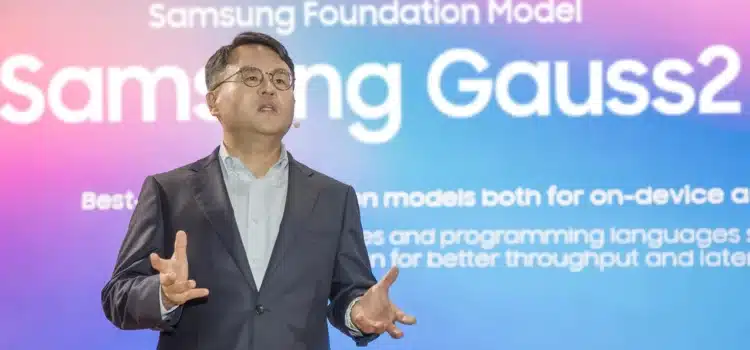
These tiers show Samsung’s goal to improve code, language, and image workloads across settings. Early adoption has led to noticeable productivity gains. Developer use of its assistant grew by 4x after switching to Gauss 2. Many technical details remain undisclosed. Analysts await independent proof.
This article unpacks Gauss 2’s specifications, strategy benefits, and unanswered questions for enterprise buyers. To set the context, it first situates Samsung’s Live within the wider enterprise Gen.AI model landscape shaping 2025. With this perspective, readers gain concrete data points and applicable considerations for future AI roadmaps. Professionals may also explore certification paths to guide successful project deployment. Let us explore the core developments powering Samsung’s latest AI statement.
Samsung Gauss 2 Model Overview.
Building on the introduction, Gauss 2 is Samsung’s second internal formation model following Gauss. This project highlights Samsung researchers’ growth in AI. The enterprise GenAI model comes in three versions: Compact, Balanced, and Supreme, each for different tasks. Compact runs directly on devices for offline help with Galaxy phones and appliances. Balanced operates in Samsung data centers to enable broader consumer services, balancing speed and scale.
Supreme uses a mixture of experts for complex inference and training. Samsung includes a custom tokenizer that supports 9 to 14 languages, depending on the setup, enabling faster multilingual processing than top open-source options. All versions support multimodal input — text, code, and images making Gauss 2 a flexible corporate content platform. In short, Samsung offers a range of options within a single enterprise Gen AI model family, informing enterprise adoption strategies.
Strategic Enterprise Gen AI Move
Samsung’s shift aligns with the world’s goal to use AI across 90% of its business areas. Leaders see Gauss 2 as the main engine for this change. By building its own platform, Samsung can control data location, privacy, and how the model works. It also saves on ongoing API costs to outside providers. Experts note that Samsung’s chip expertise helps it improve both the model and the hardware. It runs on. Competitors rely on third-party hardware and unclear messages. Gauss 2 also gives Samsung more power when working with telecom and cloud partners. These benefits support the company’s investments. Still, keeping funding and top talent is key to achieving long-term success. This context leads to a closer look at multimodal features.
Multimodal Capabilities in Depth
Multimodality refers to the ability to use multiple input types (text, code, images, and language translation) within a single system. For example, users can upload screenshots or design drafts and receive code suggestions tailored to the context. Developers can have the model update old scripts while viewing visual layouts. Call center agents get quick language summaries from recorded calls. Samsung says response crafting is now three times faster with those tools. The supreme version also improves knowledge in graphs, meaning it connects answers to real product facts. This reduces errors and improves productivity for support teams. Most open models require separate tools for each input type, but Gauss-2 combines them. These features set the stage for performance analysis.
Performance And Adoption Data
HUD numbers remain limited, yet Samsung shared several adoption metrics. According to the firm, usage of the coding assistant increased within months of Gauss 2 integration. Moreover, about 60% of Device-experience developers access the assistant weekly. The enterprise Gen AI model backs these gains by delivering 1.5 to 3 times faster processing. Samsung compared Balanced and Supreme against unnamed open-source baselines on internal benchmarks. However, the company has not released full datasets, tasks, or details on statistical significance as independent topics. Therefore, treat the figures as marketing claims awaiting third-party validation.
Analysis of these performance data would not be complete without considering transparency and validation. This natural progression leads to broader consideration of benefits and challenges for stakeholders evaluating the platform.
Benefits For The Samsung Ecosystem.
The Gauss 2 rollout benefits more than just developers. On-device processing means tasks run directly on devices, reducing cloud latency and improving privacy. Galaxy phones with the compact version can transcribe or capture images offline, offering faster language translation and keeping data on the device. The balance-term and supreme versions help service teams by summarizing information and routing tickets efficiently, reducing support costs. Samsung fine-tunes the enterprise Gen AI model for business needs using its own data (instead of third-party data), which is harder to do on generic platforms. Organizations considering Gauss 2 should keep these key benefits in mind:
- Cost control through reduced external API calls.
- Unified handling of software, language, and image data.
- On-device experiences boosted buyer interest.
- Scalable architecture matching workload size.
Together, these benefits make a strong case for Samsung’s AI platform. However, to provide a balanced view, before adopting Gauss 2, organizations should consider potential challenges and questions.
Challenges And Open Questions.
Like any proprietary platform, Gauss 2 comes with some risks. Samsung has not shared specifics such as parameter counts (number of model settings) or training sources (datasets used for learning), making it hard for analysts to compare it to models like GPT-4 or Gemini. There is also limited information on safety testing (risk evaluation), bias controls (methods to reduce bias in outputs), and governance (policies overseeing AI use). The Enterprise Gen AI model does not yet have a public API, meaning external developers cannot easily access its features, and there is no pricing information for planning integrations. By contrast, open-source models on Hugging Face are easier to try out right away. Ongoing maintenance, especially for on-device updates, is another concern. Though Samsung’s hardware expertise may help reduce some costs, professionals can improve oversight by earning the AI Project Manager certification. These problems show there are still important unknowns, so reviewing the roadmap is essential.
Roadmap and Industry Impact
Samsung plans to add GALF to most of its products over the coming years. The supreme version targets cloud systems while the compact one powers wearables and home devices. Adding knowledge graphs will make information more precise and customized. Experts, Apple, Google, and Xiaomi are expected to respond with updates. Samsung’s move may also drive demand for better mobile AI chips and push job providers to reveal more about costs and performance. Companies will need to balance vendor independence with ecosystem benefits. The choice of a foundation model will depend on openness, transparency, and cost-effectiveness. Those tools’ roadmap could reset buyer expectations for AI. These points lead us to our final thoughts.
Gauss 2 shows that Samsung wants to shape its own AI features. The platform brings together software, language, and image processing into a single system. Early results point to real productivity gains and faster service. However, the lack of technical transparency means buyers need to do careful research. Companies should ask for clear benchmarks, safety information, and governance policies. As for the competition, Samsung will likely disclose more details soon. Professionals can help guide these decisions by earning the AI Project Manager certification. Now is the time to align your strategy with the fast-changing world of enterprise Gen.AI.
Source: Samsung Gauss2 Enterprise GenAI Model for Multimodal Workflows



