





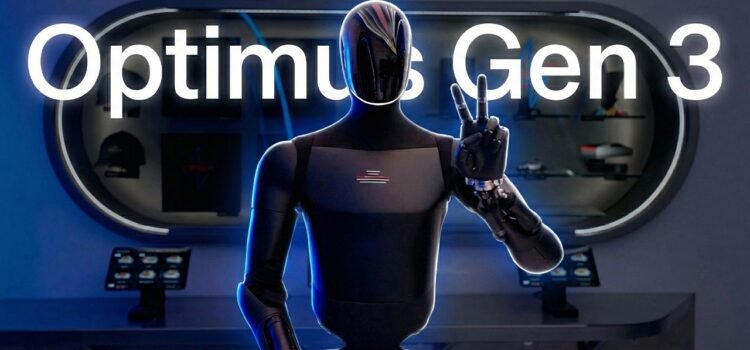
Optimus Gen 3 or V3 may look so real, you’ll need to poke it, says Musk. Wall Street is revising its models for possible major revenues. Meanwhile, roboticists warn that dexterity, safety, and cost remain big challenges.
To set the context, this article breaks down the timeline, production plans, market outlook, and engineering challenges ahead of the upcoming reveal. We also look at what investors expect and the new career opportunities created by Tesla’s latest AI project. Let’s begin by reviewing the confirmed timeline milestones for Optimus.
Confirmed Optimus Timeline Milestone
Tesla’s October 22 statements give the most detailed schedule yet. Musk said, “We look forward to unveiling Optimus V3 probably in Q1,” hinting at a February showcase. Analysts expect a major public test of Tesla’s robotics plans in early spring 2026.
First-generation production lines are already being installed at Freeman and Giga in Texas. According to the investor deck, internal pilots will deploy 7,000 robots across Tesla shops in 2025. Those points set the stage for later aspirations for one end production capacity
The timeline now seems solid, but there are still risks to actually making it happen. To understand the scale of Tesla’s ambitions and operational steps ahead, let’s take a closer look at the company’s production plans.
Tesla Scale Ambitions Stated
Musk confirmed a goal of 1 million units in a few years. He called it key to global factory automation and management and set a long-term price target of $30,000 per robot.
To hit the $30,000 price target, Tesla will cut costs and simplify supply chains. Its vehicle expertise will standardize parts and lower the cost of electronics. Executors believe costs could fall to $20,000 per robot, protecting margins.
Suppliers warn that 10,000 parts per robot will make it hard to make the 1 million unique gold. Tesla believes in-house production will reduce delays and sets its unique mix of AI hardware and manufacturing skills.
Big goals alone won’t solve the technical problems or main safety standards. Building reliable human-health robots depends on thorough management of parts and logistics with an eye on critical engineering challenges. Let’s identify the obstacles that make slow progress.
Critical Manufacturing Hurdles Ahead
Making a working robot is easier than scaling to millions. Rodney Brooks calls it a humanoid robot bubble and says dexterity remains unsolved. Touch sensors and joints are still in research, not mass production.
Every Optimus contains roughly 10,000 K components, many of which are custom-designed for Tesla. Subsequently, a single late supply can halt an entire factory automation cell. Therefore, Musk conceded the ramp will be limited by the slowest part during Q&A.
Battery performance, heat management, and the robots’ ability to withstand faults or need thorough testing before unit robots are ready for use. The next prototype should help identify the remaining problems to solve. These technical issues are important to consider as we turn to market demand and revenue forecasts.
Global Market Forecast Variances
Market researchers cannot agree on potential demand. Grandview Research banks humanoid robot sales at $4.04 billion by 2030, a conservative trajectory. In contrast, ABI Research models multi-value and revenue earlier, and RGB’s rapid adoption of factory automation.
- Q3 2025 Revenue column $28.095 Billion up 20% YOY
- Free Cash Flow: $3.99 Billion.
- Cash and Investments: $41 Billion.
- Vehicle Deliveries: 497,099 units
Tesla’s goal of producing 1 million robots is well above either forecast. Management also promotes a long-term price target of $30,000 per robot, which could translate into $30 billion in annual hardware revenue. Because of this, some investors believe optimists could eventually surpass Tesla’s car business.
Doubters argue that price, production volume, and regulations will slow down adoption. Still, even cautious estimates suggest that companies making human-like art robots would see strong double-digit growth. Next, to assess whether these ambitions are plausible, we examine how experts view the path forward.
Independent Expert Skepticism Mounts
Rodney Brooks argues hands remain the Achilles’ heel. He notes that decades of research have not produced affordable, reliable manipulation for 10k-component systems. Additionally, Brooks questions whether Musk’s $30,000 price target covers warranty costs and liability.
Other experts note that no approval systems yet exist for robots in surgery or public places. Officials must test for false emergency stops, and cybersecurity testing of robots outside Tesla factories could take years.
Expert warnings have made people more cautious about humanoid problems, yet their potential remains. Next, we’ll look at how success in this area could change other industries.
Wider Strategic Industry Impact
If successful, optimists could change work across the car, logistics, and electronics factories, enabling people and robots to collaborate on production lines. Consultants estimate that 1 million robots would boost productivity 20-40%.
A $30,000 price could make Optimus cheaper than many traditional systems. Startups like Figure AI and Apptronik seek partnerships before Tesla scales. Older robotics firms target specialized markets rather than high-volume production.
Government agencies will likely draft new guidelines for the development of humanoid robots in shared spaces. Nevertheless, clear economic incentives would accelerate regulatory harmonization across areas. Upskilling imperatives emerge, examined next.
Essential Upskilling for Engineers
Robotics engineers and operations managers must refresh their skills ahead of the mass adoption of humanoid robots. Additionally, cross-disciplinary competence in AI safety and mechanics will drive career mobility. Professionals can enhance their expertise through the AI Robotics certification endorsed by industry groups.
Moreover, maintenance technicians will need fluency with 10K components, diagnostics, and predictive analytics. Training programs are surfacing at partner colleges and within Tesla’s own academies. Consequently, early adopters may secure leadership roles in factory automation rollouts.
- AI, Model, Tuning.
- Safety, Certification, Protocols.
- Actuator maintenance.
- Supply Chain Analytics
Training programs need to grow as technology advances. To wrap up, here is a summary of the current situation and what comes next for Optimus and the sector.
Tesla’s Optimus Gen 3 timeline crystallizes a key year for the development of humanoid robotics. The company targets 1M in production capacity, a $30K price target, and seamless integration with factory automation. However, the 10K components, complexity, safety certifications, and uncertainty remain challenges. If Tesla succeeds, the way manufacturing works around the world could change a lot. Professionals should watch for prototype demos and look for ways to keep learning. Getting certified now can help you prepare for the intelligent production lines of the future.
Source: Tesla Optimus Gen 3 Spurs Humanoid Robotics Development Leap



