





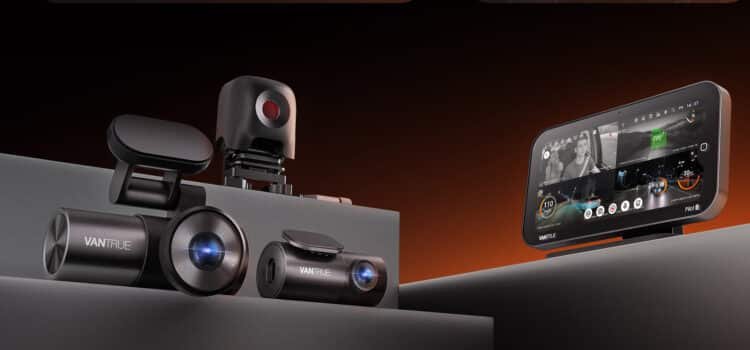
At the busy Las Vegas Convention Center, Vantrue introduced a new thermal dash cam package that it calls its smartest to date.
Called the pilot 2, this package stands out by offering one of the widest fields of view available in aftermarket in-car camera systems, thanks to its combination of front-, rear-, and thermal-imaging cameras.
The front camera of the Vantrue Dash Cam uses Sony’s Starvis sensors. Two lenses record inside the cabin at 1080p and provide clear evidence for professionals needing passenger records.
A second front-facing 2K thermal imaging car camera records through the front windshield at 1440p, and a rear camera captures footage from the back at the same resolution. The distinctive feature of this package is its compact thermal imaging camera, which mounts on the outside of the vehicle.
A small IP67 waterproof unit resembles a matchbox. Drivers can mount it on the hood just below the windshield or tuck it into the front grille. Vantrue offers several ways to let you position it perfectly.
The thermal camera streams a live feed to a 6.25-inch touchscreen on the dashboard. This screen serves as a media hub for all camera views and recordings.
Low-light or bad-weather drivers can set the display of the night vision dash cam to show only the thermal imaging camera feed, an unusual feature for dash cams. This camera, unlike visual cameras, can detect heat from people, animals, and other vehicles, improving visibility in situations where regular cameras may struggle.
The Thermal Smart Module uses Vantrue’s advanced detection algorithms to identify and highlight potential road hazards.
Yi Mei Vantrue’s marketing manager explained at the CES booth that the system detects heat signatures up to 200 feet away.
Using its proprietary software, the display highlights potential hazards. It tracks their movements and issues audible warnings if immediate braking is needed.
Do you think Vantrue is introducing a magical feature to the market that you must have, since you’re wondering how thermal dash cams work? If so, let us explain the working of dash cams with thermal imaging to give you a clearer understanding of what you are about to witness.
The Operation of Thermal Dash Cams
Thermal dashcams operate by detecting infrared (heat) energy rather than visible light. They use a special lens to focus this heat onto a sensor, creating a thermogram, or heat map. The camera then turns temperature differences into visible colors: hotter areas appear red or white, while cooler areas appear blue or black. This gives drivers a clear view in darkness, fog, or rain, making it easier to spot people and animals by their heat patterns, something standard dashcams cannot do.
Here’s How It Works Step-By-Step
- Infrared emission: Every object emits infrared (IR) radiation, depending on its temperature. Hotter objects give off more heat.
- A special lens in the thermal dash cam focuses this invisible heat energy onto a sensor.
- Detection and conversion:
- The sensor measures the amount of infrared energy present.
- It converts this energy into electrical impulses.
- A processor then converts these signals into a visual image.
- Color mapping (ThermoGram): The system uses different colors for different temperatures, creating a heatmap. Warmer objects, such as people, animals, or running engines, appear in bright colors, such as red, yellow, or white, while cooler backgrounds appear blue or black.
- Alerts: Some advanced tools use AI to spot heat sources, such as pedestrians or deer, and give audible beeps or on-screen alerts. They can do this even in fog, smoke, or complete darkness, where regular cameras do not work well.
- Night vision: These cameras detect heat rather than light, providing a clear view even in total darkness.
- They perform better than regular cameras in fog, rain, and smoke.
- They quickly spot living creatures and hot engine parts, helping prevent incidents.
This information should give you a sense of the real-world benefits of the Vantrue Thermal Imaging Dash Cam.
When driving in fog, at night, or in heavy rain, seeing ahead can be nearly impossible. However, a thermal imaging camera works in any conditions,Yi explains:
Although Vantrue did not confirm the availability of the thermal imaging dash cams, a company spokesman said the Pilot 2 will cost about $600 at launch later this year. He added that a Kickstarter is coming soon, letting early adopters get it for about $450.
Although the price is high, Vantrue adds value by offering a 6.2-inch touchscreen as an aftermarket option for wireless Apple CarPlay and Android Auto.
This is helpful for older cars lacking modern infotainment. The display also has a built-in speaker and an auxiliary slot, so you can connect it to your current sound system.
Vantrue plans to bring thermal imaging to motorcyclists. Yi says that in a similar system, the Falcon 2 will feature ultra-impact-resistant, ultra-compact, 2K-resolution front- and rear-facing cameras to fit motorcycle bodywork.
The company is finalizing a digital cockpit for handlebars. It includes a separate remote control for easy use with gloves.
System supports Wi-Fi and Bluetooth, so riders can use wireless headphones and voice commands on the move.
The Falcon 2 price has not been announced, but it will launch in the third quarter. Vantrue will also offer a wireless tire pressure monitoring system compatible with the Falcon 2 and the Pilot 2, and usable on any vehicle.



