






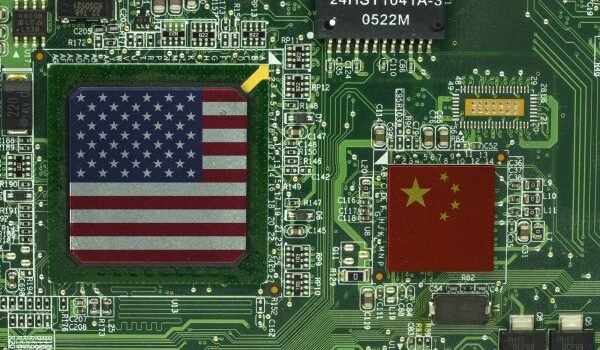
Backfire Effect: How US Export Controls on AI Chips Accelerated China’s Leap into Quantum Computing in 2026.
The US restrictions from 2022 to 2025 on exporting NVIDIA 100 and A100 chips to China were meant to slow China’s AI progress. Instead, these measures triggered a domestic hardware push that moved China from relying on Silicon Valley to building its own capable AI ecosystem.
This situation, known as the paradox, turned the sanctions into a major government-supported boost to research and development. It led to rapid progress in local chip-design software improvements and a reported 40% jump in chip-making efficiency, especially in packaging and interconnect technology.
The Turning Point, The Paradox of Sanctions
The US aimed to limit China’s ability to train large language models by blocking access to advanced GPUs.
- Forced to adapt after losing 90% of their AI chip market share, Chinese tech companies like Baidu, Alibaba, and Tencent, along with hardware makers such as Huawei and SMIC, turned to homegrown chip solutions.
- Without access to top-level computing power, Chinese developers worked to improve software and develop efficient, specialized chips. As a result, their models could run well even on less powerful hardware.
- Although Chinese chips usually do not match the top H100 in raw power, the need to innovate in chip packaging, networking, and interconnects has led to a significant increase in system efficiency. For example, Huawei’s Ascend 910B is designed to work well on older 7nm technology and still offers performance similar to older Nvidia chips.
The Domestic Revolution: Key Players and Techniques
- Huawei and SMIC have become the main alternatives. Huawei’s Ascend 910C and the newer 910D and 950 chips are now central to China’s AI efforts, using 7nm technology and moving toward 5nm processors.
- The strategy has shifted from trying to match H100 performance to making chips that are simply good enough and can be produced at scale. For example, a cluster of 384 HUAWEI ATLAS 900 A3 SuperPod chips can deliver enough computing power to compete with Western AI training systems.
- Chinese factories have been dismantling and re-packaging gaming chips, such as the NVIDIA RTX 4090, on a large scale to make improvised server-grade accelerators. This shows how determined and resourceful they have been in finding workarounds.
The New Landscape: 2025-2026
- By 2025, major Chinese companies started moving away from NVIDIA, replacing its products with locally made AI chips.
- This change is motivated by geopolitics, as Beijing is now emphasizing domestic AI chips and has even encouraged some sectors to boycott Nvidia products.
- Although the US still leads in 3nm and 2nm technology, China has shown that, with sufficient investment, it can build a working, independent, high-performance computing system.
The sanctions, therefore, did not destroy Chinese AI capability; they forced a rapid maturation of a parallel indigenous good-enough technology stack.
The competition for semiconductors has become a modern arms race. The country with the most advanced chips will determine the future of artificial intelligence, economic growth, and national security. In 2022, the U.S. sought to block China’s gains by imposing strict export controls on advanced processors and manufacturing equipment. However, two years later, these restrictions may accelerate rather than slow China’s progress.
Why The US Chose Export Controls
U.S. policymakers-imposed export controls on semiconductors due to national security concerns about Chinese companies like Huawei, supply chain disruptions during the COVID-19 pandemic, and a desire to keep the U.S. ahead in chip technology.
Huawei’s growing role in 5G networks and the U.S.’s dependence on Chinese technology have raised concerns about China’s influence over critical infrastructure. Shortages during the pandemic showed how much the U.S. relies on Taiwan’s TSMC, which is close to China. Both countries know that advanced chips will affect the future balance of power and drive new developments in AI, advanced weapons, and high-performance computing, such as quantum technology.
On October 7, 2022, the U.S. Bureau of Industry and Security (BIS) announced the toughest restrictions in decades. The new rules focused on four areas:
- Advanced AI processors
- Semiconductor design
- Manufacturing abilities
- Access to equipment
NVIDIA’s top A100 and H100 graphics processing units (GPUs) could no longer be exported to China. Other U.S. companies, including Applied Materials, Lam Research, and KLA Corporation, were also blocked from selling their most advanced tools to Chinese firms. GPUs accelerate graphics by performing the complex math required for visual output.
The BIS announcement caused immediate disruption. Projects around the world were delayed, costs went up, and companies had to adjust quickly. Over time, it became clear that loopholes, workarounds, and unexpected outcomes might diminish the strategy’s long-term impact.
Loopholes and Workarounds
Even though the US controls set by BIS were broad, they had technical, legal, and enforcement gaps. Regulators mainly focused on chip specifications, such as interconnect speeds and performance limits, which allowed companies to find ways around the rules and still offer nearly advanced products.
Legal strategies also weakened the impact of BIS restrictions. Some foreign companies built up chip supplies before the rules started, giving themselves time to adjust. Others made deals that technically followed the rules but took advantage of unclear language. Some used unauthorized channels, which raised serious concerns. For instance, smuggling networks and third-party agents helped restricted GPUs reach China. Reports showed that NVIDIA’s A100 and H100 GPUs, which were meant to be blocked by US policy, were still being sold on Chinese e-commerce sites months after the ban.
These gaps emphasize the ongoing difficulty of blocking technology and a global economy. History shows that export controls, from Cold War supercomputer bans to sanctions on Russia, can slow down determined competition but rarely stop it completely. China’s size, resources, and strong government coordination have helped it adjust to and get around US export restrictions.
China’s Counter-Move: A National Drive for Self-Sufficiency
Instead of stopping Chinese innovation, US export controls encouraged China to work harder towards technological independence. This impact could be seen in several areas:
- Artificial Intelligence Adaptation: Chinese companies started creating models that work well with the processes they can get locally. DeepSeek, a growing AI company, launched a massive language model that runs on Nvidia’s top GPUs, while U.S. companies like OpenAI. The latest hardware from DeepSeek showed that smart software design can overcome hardware limitations.
- Breakthroughs in Chip Making. In 2023, Huawei launched the Mate 60 Pro smartphone, which uses a 7-nanometer A7 chip manufactured in China by Semiconductor Manufacturing International Corporation (SMIC). This surprised many people, including U.S. officials, who thought China was still years away from making such advanced chips at this scale.
- Talent Investment: Recognizing the need for skilled workers, China’s Ministry of Education made semiconductor sciences a top focus in schools. Peking University opened its schools of integrated circuits to train engineers since the country may need up to 600,000 experts in this field. Many universities across China also grew their programs, showing a long-term plan to build.
- Manufacturing equipment development. Chinese companies also started making their own chip-making tools. Shanghai Microelectronics Equipment (SMEE) announced it would build its first 28 nm lithography machine by 2024. While this is still behind the Dutch company ASML, it is an important step forward, reducing reliance on foreign suppliers.
- Massive Government Funding. One of the biggest changes was China’s large government investment. In May 2024, Beijing launched a $47.5B semiconductor fund, more than twice the size of its last major effort in 2014. This fund supports Xi Jinping’s goal of making China self-reliant and a technology leader.
Overall, efforts to limit China’s access to advanced technology have gone hand in hand with China’s own push to develop technology at home.
The Global Stakes
China’s rapid progress has important consequences for the US and its allies. If Chinese chips become more competitive, countries in Asia, Africa, and parts of Europe might rely less on US technology, potentially reducing US dominance in semiconductor markets.
From a geopolitical perspective, countries like Russia could benefit from China’s rise, even as Western sanctions limit its options. Russia might look to China for advanced processes to help modernize its military. Iran, North Korea, and others could also gain from China’s readiness to provide restricted technology.
U.S. allies also face tough decisions. Japan will meet South Korea, and the European Union is economically connected to China but shares strategic interests with the U.S. It has been hard to coordinate export controls among these countries, and any lack of unity might weaken their joint efforts. TSMC in Taiwan is a key part of global supply chains and plays a major role in US-China relations.
Another important factor is the development of new technologies. The US and its allies might lead in one area, while China and its partners create a separate system. This split could slow innovation, increase costs, and divide markets, but it might also make global alliances clearer as technology competition grows.
Policy Options and Dilemmas
The US faces a tough challenge. Export controls are among the main non-military ways to slow competitors’ access to important technologies; however, they have limited impact and can lead to unintended consequences.
US policymakers have a few options to consider:
- One option is to tighten enforcement. Regulators could:
- Close technical loopholes
- Monitor third-party transfers more closely.
- Increase penalties for violations.
- Another option is to work more closely with allies. Export controls work best when countries act together. Proactively coordinating strategies with partners in Europe and Asia will help reduce enforcement gaps.
In the end, export controls should be seen as just one part of a larger strategy. Their main value lies in giving the US more time to slow knowledge loss, accelerate innovation, and strengthen supply lines.
Conclusion
The semiconductor export controls that the US put in place in 2022 were meant to shape global tech competition. At first, they disrupted Chinese companies and strengthened US leadership. However, over time, these controls might help China build a stronger and more independent semiconductor industry, which could lead to the very changes the controls were meant to prevent.
This is an example of how efforts to slow China’s progress helped it advance. The U.S. government now needs to review its policies, fix enforcement problems, and support innovation at home. In the semiconductor industry, keeping things as they are is not an option.