





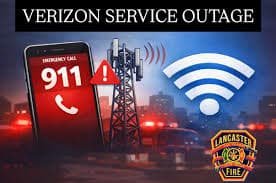
Verizon customers across the United States began reporting cellular outages around noon ET on Wednesday, including Verizon Outage 911, citing issues completing calls or accessing mobile data. Verizon broadband internet users also reported issues. AT&T and T-Mobile customers experienced service outages during the same period, though these may be related to the Verizon outage.
Verizon spokesperson Kristina Moon Ashraf told Wired in a statement, “We are aware of an issue impacting wireless voice and data services for some customers. Our engineers are engaged and working to identify and resolve the issue, including emergency calls, Verizon, quickly.”
A T-Mobile spokesperson told Wired in a statement that its service is operating normally and as expected but added that T-Mobile customers may not be able to reach Verizon customer service at this time. An AT&T spokesperson similarly said its network is operating normally at this time and added that service issues are due to a separate carrier.
The outage tracking site Down Detector reported an increase in service disruption reports across all three major US mobile carriers.
Many customers using iOS devices reported their phones were in SOS satellite mode, allowing only emergency calls. However, some reports indicated that even 911 calls could not be completed.
Washington D.C.’s official emergency alert channel posted at 12:57 p.m. Eastern Time that DC’s Office of Unified Communications is aware of a nationwide Verizon wireless outage that may be affecting some users’ ability to connect to 911. They also provided instructions for emergencies, stating, “If you have an emergency and cannot connect using your Verizon wireless service, please connect using a device from another carrier, a landline, or go to a police district or fire station to report the emergency.”
Verizon’s Network was down for much of Wednesday, with service restored at 10:20 p.m. Eastern Time. Most users were left unable to make even emergency calls despite being in SOS mode.
Although emergency calls can usually connect to any available tower, reports indicated that some users could not reach 911 during the outage.
Some Verizon users were unable to call 911, and emergency services advised using alternative methods to seek help.
This light sparked today, and my family was unable to call 911 because of @Verizon’s incompetence. Ex-user @OmarMKAhmad allegedly shared a photograph of a burnt and melted ceiling light. Thankfully, our cleaners happened to be at the house. We had to be at the house (who has a @T-Mobile) and called 911.
The Office of Unified Communications acknowledged the then-ongoing Verizon outage on Wednesday evening via X, warning that it was affecting some individuals attempting to reach emergency services. The OUC also issued a message through Alert DC, the District of Columbia’s official emergency notification system. The carrier appears to involve multiple telecoms because of collateral impacts when a down telecom can’t route calls and data to other providers.
Syed Rafael Hassan, a mobile network security researcher at Purdue University, speculated that the outage could have been caused by a server configuration issue in Verizon’s core network. It is unlikely a coordinated attack against the Verizon network, he told Wired.
How 911 Routing Works
911 Routing uses your phone’s location to direct calls to the appropriate public safety answering point (PSAP), which is the local emergency dispatch center. The system has evolved from relying on cell tower locations, which could miss out calls, to next-generation 911 systems that use GPS and device data for faster, more accurate dispatch.
Dial 911: Initiate a call to the emergency number from your device.
- Location identification:
- Wireline (landline): The system uses your phone number, known as Automatic Number Identification (ANI), to retrieve your registered address from the Automatic Location Identification (ALI) database, which stores address details for landline phones.
- Mobile calls previously routed to the PSAP nearest to the cell tower (legacy 911). Now uses GPS, Wi-Fi, and other device data to provide more accurate location information.
- Routing to PSAP.
- A central router, the APA Selective Router, uses location data to identify the emergency service number for the correct PSAP. This process references the Master Street Address Guide (MSAG), a database of street addresses.
- Call transfer: The call is routed to the appropriate PSAP, which then dispatches emergency services.
Satellite SOS Explained.
After traditional and mobile 911 systems, an additional safety feature is Satellite SOS, which servers use in remote areas where cellular or Wi-Fi coverage is unavailable. This function allows users to text emergency services via satellite using on-screen instructions to send vital information, such as location and situation details, available on select devices, including iOS 14 and later, and some Google Pixels. It requires a clear view of the sky and serves as a last resort when off grid.
How it works.
- No signal: When you dial your local emergency number (such as 911 or 112), and there is no cellular or Wi-Fi coverage, your phone detects a lack of signal.
- Connect to Satellite: An option to use satellite SOS appears. Tap it to begin the connection process.
- Find a satellite: Follow the on-screen instructions to align your phone with a clear view of the sky and establish a satellite connection.
- Answer the questionnaire: Complete a brief questionnaire about your emergency, including injury type, location, and the number of people involved, to quickly send essential information.
- Relay to emergency services: Transmit your message from your device to the satellite via a ground station and then to emergency responders.
- Emergency Contacts: Alert your un-designated contacts with your location and emergency details.



