





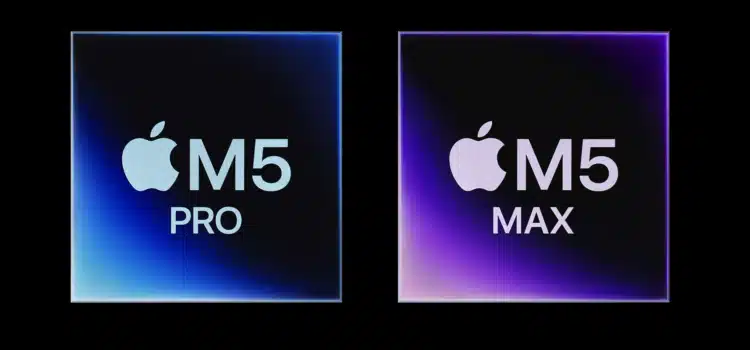
Apple has launched the M5 Pro and M5 Max chips for the new MacBook Pro, featuring a new fusion architecture that combines two dies in a single SOC. Each chip includes a powerful CPU, a scalable GPU, a media engine, a unified memory controller, a neural engine, and support for Thunderbolt 5. Both chips offer an 18-core CPU with 6 high-performance cores for first‑class professional performance and 12 efficiency cores for efficient multi-threaded workloads, enabling up to a 30% performance increase. The GPU scales up to 40 cores and includes a neural accelerator in each core, providing over four times the AI compute and up to 35% better ray-tracing performance than previous models. The MacBook Pro with these chips is available for pre-order tomorrow and in stores on March 11.
M5 Pro and M5 Max mark an exhilarating leap for Apple Silicon. With our remarkable new fusion architecture, we’re expanding what Apple Silicon can achieve all while maintaining our trademark focus on performance, power efficiency, and unified memory,” exclaimed Johny Srouji, Apple’s senior vice president of hardware technologies. “These chips are a testament to Apple’s relentless innovation, bringing together the world’s fastest CPU cores, a next-generation GPU supercharged with neural accelerators, a lightning-fast neural engine, and ultra-high-bandwidth, high-capacity memory. Together they create an unprecedented fusion of power efficiency, oil, and awe-inspiring on-device AI for MacBook Pro.”
All New Fusion Architecture
M5 Pro and M5 Max use Apple’s new Fusion architecture, which combines two chips into a single system-on-a-chip. This design combines third-generation 3‑nanometer chips with high-bandwidth, low-latency capabilities enabled by advanced packaging. Each chip includes a powerful CPU, a scalable GPU, a Media Engine, a Unified Memory Controller, a Neural Engine, and support for Thunderbolt 5.
Apple’s Fastest, Most Advanced CPU Cores
The M5 Pro and M5 Max come with a new 18-core CPU with 6 Super cores and 12 performance cores. The Super core, first introduced in M5, is now used across all M5-based products, including MacBook Air, MacBook Pro, iPad Pro, and Apple Vision Pro. It offers the world’s highest single-core performance, with more bandwidth, a new cache system, and improved branch prediction. These new cores deliver up to 2.5× the multi-threaded performance of M1 Pro and M1 Max.
M5 Pro: Designed To Handle Demanding Workflows.
M5 Pro is engineered for professionals such as data modelers, post-production sound engineers, and STEM students who require high processing power, advanced graphics, and unified memory to handle complex projects.
Building on the M5 chip, the M5 Pro combines an 18‑core CPU with a next‑generation GPU featuring up to 20 cores, each with neural accelerators. Compared to M4 Pro, it adds four more CPU cores and uses a new architecture that boosts multi‑threaded performance by up to 30%. The M5 Pro supports up to 64 GB of unified memory and higher bandwidth, with four times the peak GPU compute of M4 Pro and more than six times that of M1 Pro for AI performance.
The M5 Pro features an improved shader core with second-generation dynamic caching and hardware-accelerated mesh shading. Its graphics performance is up to 20% faster than the M4 Pro and 2.2 times that of the M1 Pro. With Apple’s third-generation ray tracing engine, the M5 Pro delivers up to 35% higher graphics performance in RayTrace apps than the M4 Pro.
M5 Max: Unmatched Capabilities
The M5 Max is targeted at professionals, including 3D animators, app developers, and AI researchers, who demand leading GPU power and maximum memory bandwidth for the most demanding workloads.
The M5 Max uses the same advanced GPU architecture as the M5 Pro but doubles the number of GPU cores, pairing an 18-core CPU with a GPU that can reach up to 40 cores. Its new CPU design delivers up to 15% better multi-threaded performance than the M4 Max. The M5 Max supports up to 128 GB of unified memory and delivers up to 614 GB/s of memory bandwidth. This extra bandwidth helps users handle sophisticated scenes, substantial datasets, and higher token generation for LLMs with ease. The M5 Max provides over four times the GPU compute of the previous generation and more than six times that of the M1 Max for AI tasks.
M5 Max delivers up to 20% better graphics than M4 Max and 2.2× better than M1 Max in ray tracing. It offers up to 30% better graphics performance over M4 Max.
Advanced Technologies Across M5 Pro and M5 Max
Both M5 Pro and M5 Max have these technologies on-chip:
- A faster 16-core neural engine with higher memory bandwidth accelerates on-device AI and Apple intelligence.
- The media engine supports hardware-accelerated H.264 and HEVC decoding, AV1 decoding, and ProRes encode/decode.
- Memory-integrated enforcement offers always-on memory safety with no performance penalty.
- Thunderbolt 5 ports, each with an on-chip custom controller, deliver top Thunderbolt 5 performance.
Apple Silicon and the Environment
Apple’s 2030 targets carbon neutrality across its operations by the end of the decade and focuses on material, electricity, and transportation emissions. The energy efficiency of the M5 Pro and M5 Max supports MacBook Pro standards and reduces life-cycle energy use.
Source: Apple debuts M5 Pro and M5 Max to supercharge the most demanding pro workflows


