





Introduction
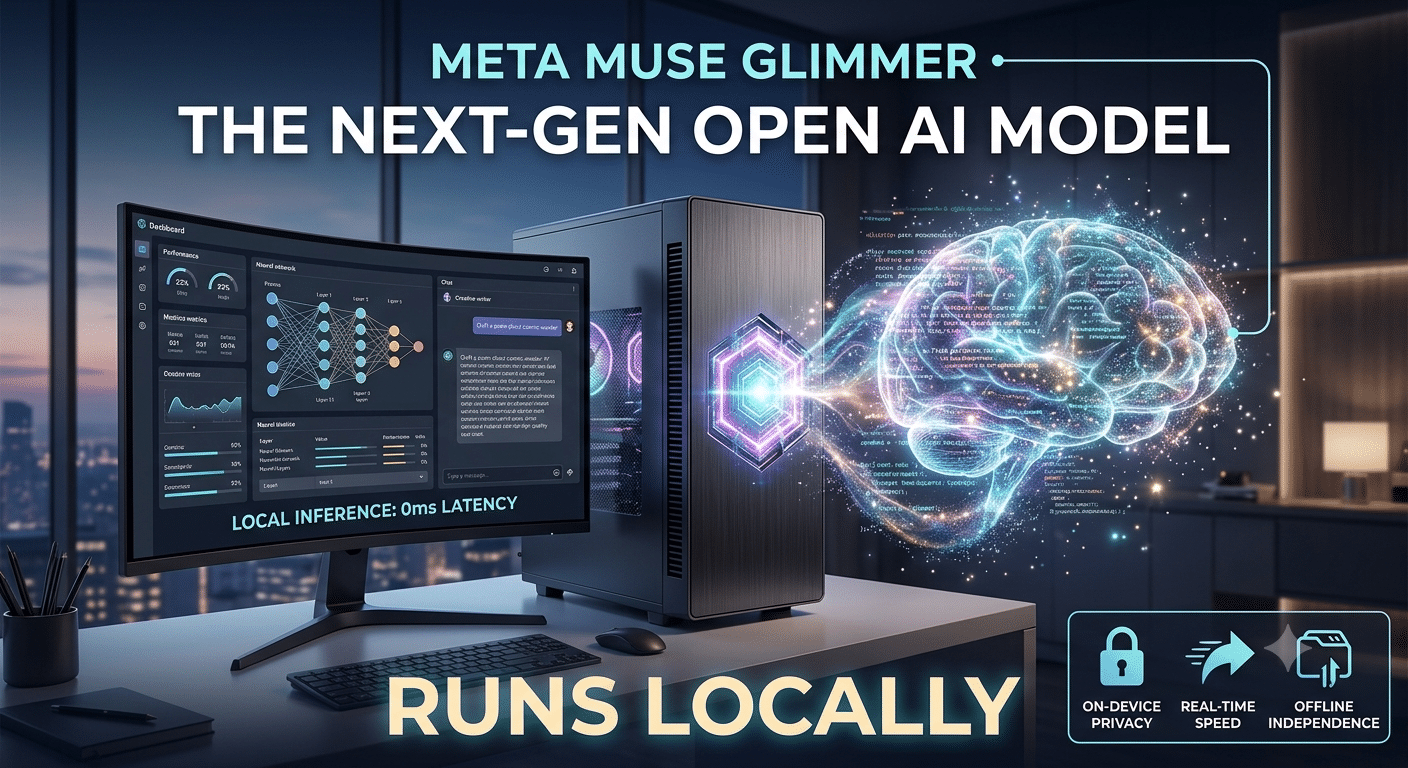
Meta has unveiled Muse Glimmer, a groundbreaking 30-billion-parameter open-weight AI model that can run entirely on a consumer laptop with a single GPU. Released by Meta Superintelligence Labs on August 10, 2026, Muse Glimmer represents a major leap forward in the democratization of artificial intelligence, allowing developers, researchers, and everyday users to run powerful AI models without relying on expensive cloud infrastructure.
The model features a 120,000-plus token context window and is designed specifically for agentic AI workloads — tasks that require the model to reason, plan, and execute multi-step workflows using external tools. Unlike Meta’s proprietary Muse Spark model, Muse Glimmer’s weights are freely available on HuggingFace, meaning anyone can download, modify, and deploy it on their own hardware.
What Makes Muse Glimmer Special
Muse Glimmer is Meta’s most powerful open-weight model to date, and it stands out for several key reasons. First, its 30-billion-parameter architecture strikes a balance between performance and accessibility. While larger models like Muse Spark offer raw computational power, they require server-grade hardware. Muse Glimmer, by contrast, is optimized to run on a single NVIDIA RTX 4060 or equivalent consumer GPU with just 16 gigabytes of VRAM.
The model’s 120K context window is particularly impressive for its size. This allows it to process and reason about extremely long documents, codebases, and conversations without losing important context. For comparison, many competing open-weight models in the same parameter range offer context windows of only 8K to 32K tokens.
Mark Zuckerberg announced the model in a post on Instagram, positioning it as part of Meta’s broader strategy to lead the open-source AI movement. ‘We believe that the most powerful AI should be accessible to everyone, not locked behind corporate walls,’ Zuckerberg wrote. ‘Muse Glimmer is our commitment to that vision.’
Agentic AI Capabilities
The most significant innovation in Muse Glimmer is its agentic capabilities. Unlike traditional language models that simply generate text responses, Muse Glimmer is designed to autonomously execute multi-step tasks using external tools and APIs.
In practice, this means Muse Glimmer can browse the web, write and execute code, manage files, interact with databases, and chain together complex workflows without human intervention. The model has been trained on a proprietary dataset of agent workflows that teaches it to plan ahead, recover from errors, and optimize its approach based on feedback.
NVIDIA has published a detailed guide on running Muse Glimmer locally using its developer tools. According to NVIDIA’s blog post, the model can execute agentic workflows at speeds comparable to cloud-based models while keeping all data on the user’s local machine — a critical advantage for privacy-sensitive applications.
Performance Benchmarks
Early benchmarks have shown that Muse Glimmer performs remarkably well against both open-weight and proprietary competitors. On the SWE-bench coding benchmark, the model achieved a 42.3 percent pass rate, outperforming several models with significantly larger parameter counts. On the GAIA general AI assistant benchmark, it scored within two percentage points of OpenAI’s GPT-4o.
AlphaMatch AI, which conducted an independent evaluation, described Muse Glimmer as ‘the most capable open-weight model that can realistically run on consumer hardware.’ The evaluation highlighted the model’s ability to maintain coherence over extremely long conversations and its strong performance on tasks requiring multi-step reasoning.
However, the model is not without limitations. Independent testers have noted that it can struggle with highly specialized domain knowledge, and its performance on some math benchmarks trails behind larger proprietary models. Meta has acknowledged these limitations and has indicated that future updates will address them.
How to Run Muse Glimmer Locally
Getting started with Muse Glimmer is relatively straightforward for anyone with basic technical knowledge. The model weights are available for free download from HuggingFace, and several popular inference frameworks support it out of the box.
Ollama, one of the most popular tools for running local AI models, has already added support for Muse Glimmer. Users can download and run the model with a single command. For more advanced users, vLLM provides optimized serving capabilities that can handle higher throughput and support for multiple simultaneous requests.
The minimum hardware requirements include a GPU with at least 16 gigabytes of VRAM, 32 gigabytes of system RAM, and a modern multi-core processor. Users with NVIDIA RTX 4060 or newer GPUs will experience the best performance, though AMD and Intel GPU support is expected in upcoming releases.
The Open AI Race Heats Up
Muse Glimmer’s release intensifies the ongoing competition between Meta, OpenAI, Google, and Anthropic in the open-weight AI space. Google released its Gemma 3 model family earlier this year, and Mistral has been steadily improving its Mixtral line of models. However, none of these competitors offer the same combination of agentic capabilities, large context window, and consumer-friendly hardware requirements.
The strategic implications are significant. By releasing Muse Glimmer as open-weight, Meta is betting that the value of AI lies not in the models themselves, but in the ecosystem built around them. If developers and companies build on Meta’s open models, they become more dependent on Meta’s infrastructure and services, creating a flywheel effect that benefits the company’s broader business.
For consumers and businesses, the release of Muse Glimmer represents a new era of AI accessibility. Tasks that previously required expensive cloud subscriptions or enterprise contracts can now be performed on a laptop sitting on a desk. The implications for privacy, cost, and creative freedom are profound.
Sources
· https://research.meta.ai/blog/introducing-muse-glimmer-open-agentic-model
· https://www.cnbc.com/2026/08/10/meta-muse-glimmer-open-weight-ai.html
· https://developer.nvidia.com/blog/run-local-agentic-ai-workflows-with-metas-muse-glimmer-on-nvidia/
· https://www.alphamatch.ai/blog/meta-muse-glimmer-open-weight-local-ai-2026
Privacy and Data Security Advantages
One of the most compelling arguments for running Muse Glimmer locally is data privacy. When users interact with cloud-based AI services like ChatGPT or Claude, their data is transmitted to remote servers where it may be processed, stored, or used for training purposes. This raises significant concerns for businesses handling sensitive information, healthcare providers subject to HIPAA regulations, and individuals who simply value their privacy.
With Muse Glimmer running entirely on local hardware, all data remains on the user’s machine. No prompts, responses, or file contents are ever transmitted to external servers. This makes the model particularly attractive for use cases involving confidential business documents, personal medical information, legal documents, and proprietary source code.
The privacy advantage extends to intellectual property as well. Companies using cloud-based AI services often have concerns about their proprietary data being used to train future models. With a local model like Muse Glimmer, these concerns are eliminated entirely, as the model operates in a completely isolated environment.