




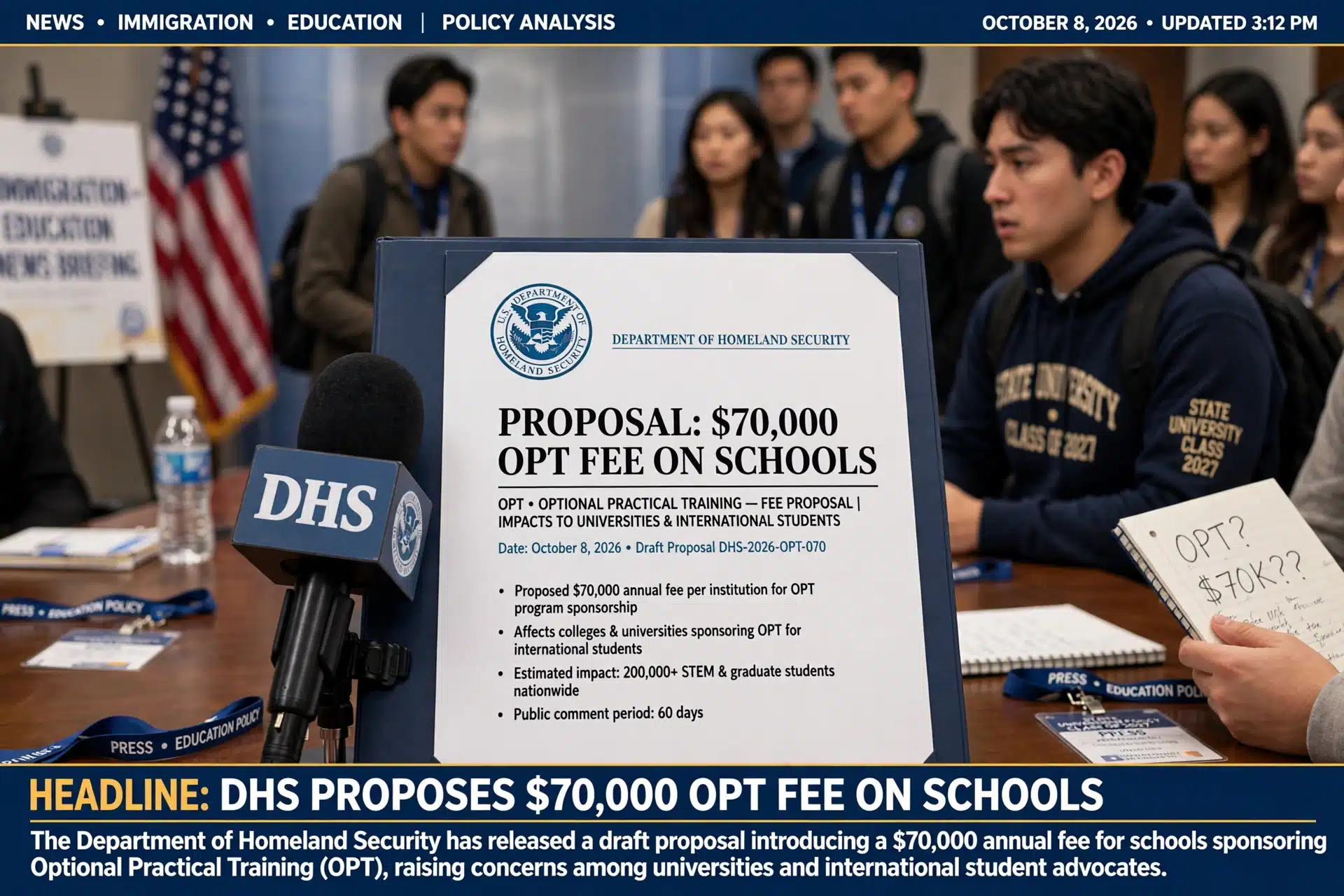
DHS Wants a $70,000 Fee on Every International Student’s OPT: What the Proposal Says
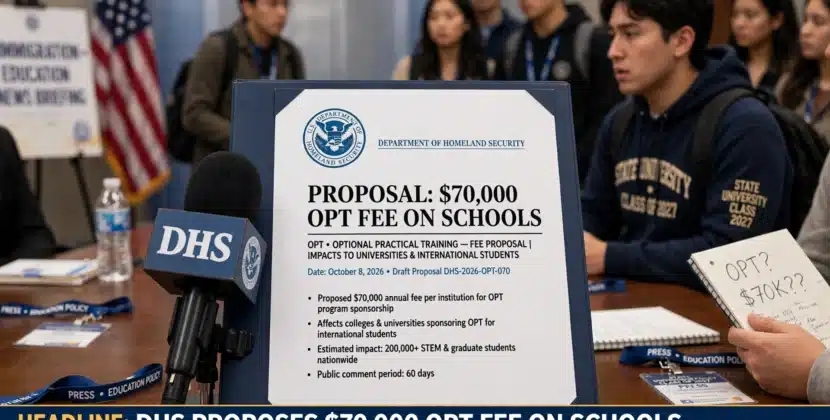
The Trump administration wants American colleges to write a five-figure check every time one of their international students gets permission to work after graduation. On October 7, 2026, the Department of Homeland Security announced a proposed rule that would charge schools certified by the Student and Exchange Visitor Program $70,000 for a student’s initial period of Optional Practical Training and $30,000 for every subsequent one. It would be the first time the OPT recommendation itself, the document that opens the door to a year of American work experience for roughly hundreds of thousands of graduates, has ever carried a price.
The proposal lands on October 8 in the Federal Register, and public comments open the same day, running through November 9. Nothing changes overnight. Students remain eligible for 12 months of OPT at each degree level and STEM graduates still qualify for the 24-month extension, and no fee takes effect until DHS reviews the comments and finalizes the rule with an implementation date. But for international students, designated school officials and the universities that employ them, the message is unmistakable: the most popular work program in the American immigration system is about to get a lot more expensive for somebody.
What the Proposed Rule Actually Says
Under the draft regulation, a SEVP-certified school would have to pay $70,000 the first time its designated school official recommends a student for OPT after the rule takes effect, and $30,000 for each later recommendation. The fee attaches to the timing of the request rather than its type, which means the first OPT request after implementation costs $70,000 whether it is pre-completion OPT during the degree, post-completion OPT after graduation, or the STEM OPT extension. Every recommendation after that starts at $30,000.
The payment has to clear before the school official can recommend the student in the Student and Exchange Visitor Information System, and USCIS would refuse to grant employment authorization if the fee has not been paid. The money goes straight to the United States Treasury, because current law does not allow ICE, which runs the OPT oversight program and is promulgating the rule, to keep the receipts. The proposal also builds in two protections: the fees apply only to recommendations made after the effective date, so OPT already approved and in progress is untouched, and schools may seek a refund if USCIS denies the student’s application for a work card.
Who Pays When the School Holds the Bill
The design is deliberate. The fee is levied on institutions rather than on students, which puts the checkbook in the university’s hands while leaving open the question of who ultimately absorbs the cost. The proposed rule explicitly permits schools to pass the fee to the individual student, to spread it across the entire student body, or to charge OPT employers. Immigration lawyers at Fragomen, who reviewed the rule within hours of its release, noted that universities would be required to pay before any recommendation is filed, a sequencing that hands administrators a veto over a program they have spent decades expanding.
For students, that transforms the calculus of studying in America. A graduate facing a forwarded $70,000 charge would be priced out of the single benefit that makes the American degree worth the investment for many families, and universities that cover the fee themselves would have to decide how many international recommendations they can afford to make each year. The announcement also arrives as Fortune reported, citing the administration’s own reasoning, that new foreign enrollment has fallen by roughly 17 percent, a drop that critics say this proposal can only deepen.
DHS Says the Program Is Full of Fraud
In its release, DHS framed the fee as an integrity measure. The agency said its Student and Exchange Visitor Program has uncovered schemes involving problematic worksites and so-called pay-to-stay arrangements, where students lean on employment or school programs mainly to keep their immigration status alive rather than to study or train. Officials argued the price would force schools to exercise greater oversight and selectivity before recommending anyone.
A DHS spokesperson drew the line in sharp terms. Optional Practical Training, the spokesperson said, was never meant to be a back door into the American workforce, a subsidy for cheap labor, or a prize for those who game the system, and the department is upskilling OPT to require foreign students to justify their worth to employers. DHS also tied the fee directly to its H-1B agenda: one of the reasons it cited for the $70,000 charge is to stop employers from routing around the new six-figure H-1B fees by hiring foreign graduates on OPT instead.
The Latest Move in a Year of Visa Fee Fights
The OPT proposal is one more front in a broader campaign to raise the cost of employing foreign nationals. It follows the $100,000 fee on certain H-1B petitions, which two federal judges have blocked in recent weeks and which remains tied up in litigation, and a proposed $103,265 filing fee for H-1B cap petitions that is working its way through rulemaking. The administration has also floated a wage-weighted H-1B selection system and a separate rule to eliminate the 60-day grace period that lets fired H-1B holders search for a new sponsor.
Education groups had already been bracing for this one. NAFSA, the Association of International Educators, tracked DHS advancing the OPT fee rulemaking as far back as August 20, and the August notice told universities what was coming before the numbers were public. Each of these policies has survived or stumbled in the courts on its own timetable, and immigration attorneys expect the same here: if the OPT fee is finalized, challenges are considered almost certain.
The Timeline for Students and Schools
The rule publishes October 8, and DHS will accept public comments for 30 days, through November 9, with a separate 60-day comment period for its paperwork section. After that, the agency reviews the submissions, may revise the numbers, and must issue a final rule with a specific effective date before a dollar changes hands. That process alone takes months, and the litigation would run alongside it.
For now, current OPT holders and students with approved recommendations feel nothing. The people who should be watching most closely are the incoming class of graduating international students and the international offices that file their paperwork. Comments can be filed through the Federal Register notice, designated school officials expect broadcast messages through SEVIS with instructions, and universities are already modeling what a $70,000 recommendation line item would do to next year’s budget. The 30-day clock starts now.
Frequently Asked Questions
How much is the proposed OPT fee?
DHS proposes $70,000 for a student’s first OPT recommendation after the rule takes effect and $30,000 for each later one, whether the request is pre-completion, post-completion or the STEM extension.
Who pays the OPT fee under the new rule?
The SEVP-certified school pays before its designated official can file the recommendation, though the proposed rule lets universities pass the cost to the student, to all students, or to the OPT employer.
When does the OPT fee take effect?
It does not take effect yet. Comments are due by November 9, DHS must finalize the rule afterward, and an implementation date would only be set in the final regulation, with court challenges expected.
Does the fee apply to OPT that is already approved?
No. The fee would apply only to recommendations filed after the effective date, not to OPT already in progress, and schools can seek a refund if USCIS denies the student’s work authorization.