



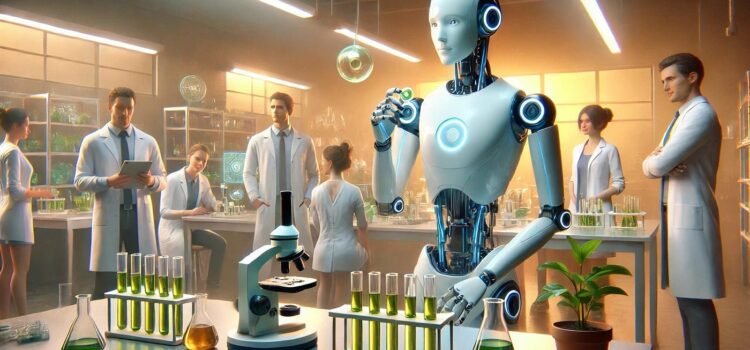
An AI scientist is now capable of independently completing every phase of a research experiment. It can generate ideas, conduct tests, and write and review its own papers, all without human intervention.
A new study in Nature by Rajas from UBC and Computer Science, Sakana, AI, the Vector Institute, and the University of Oxford shows that the entire research process can be automated. This could potentially speed up scientific discovery.
While AI has helped scientists with tasks like predicting protein structures or analyzing medical images, this is the first demonstration of AI independently completing the full scientific research process, says UBC Computer Science Professor Jeff Clune, lead author.
It’s amazing to see what it’s been able to do so far, but even more incredible to consider what lies ahead in the near future.
The AI scientist generates ideas, checks originality, and conducts experiments. It analyzes data, writes papers, and reviews its own work. Built on foundational models like ChatGPT, it handles a variety of research tasks.
To test the AI’s work, the researchers submitted a fully written AI paper to a major machine learning conference workshop, where it passed peer review.
The team also created an automated reviewer for AI-generated papers. Finding it could predict conference acceptance with a score comparable to that of humans, improving the AI model, and further raising paper quality.
One exciting direction is the potential for AI scientists’ self-improvement, said Shengran Wu, PhD, at USB Computer Science and a co-author.
The AI scientist opens doors to reclusive self-improvement, enabling the system not just to discover new knowledge but to use those discoveries to enhance itself and drive further breakthroughs. This is a fundamentally new kind of scientific progress. Says Hu?
When the AI scientists completed every stage of research, the team also found some limitations, such as weak ideas and citation errors. So far, its research is limited to computer science, but it could expand to other fields in the future.
With additional research, this system could be used to create entire scientific communities of AI agents, says Dr. Clune.
Each new discovery could build on the system’s prior discoveries, creating an open-ended process of endless scientific discovery, just as it does in communities of human scientists. That is when we’ll see the next major scientific revolution.