
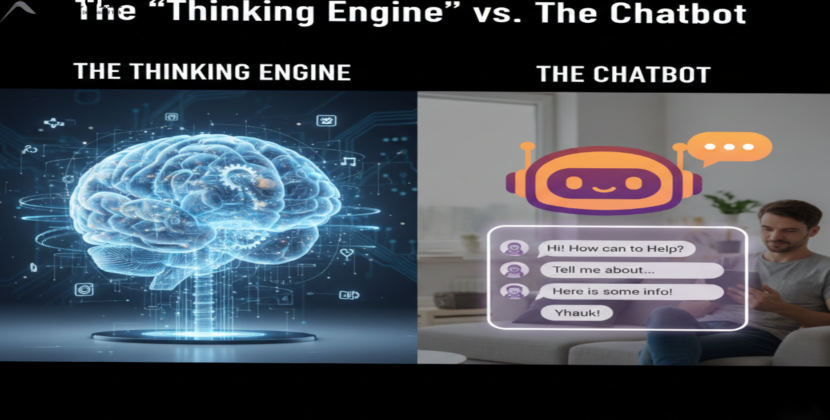





In January 2026, artificial intelligence saw its biggest change since ChatGPT. OpenAI has now launched GPT-5 and its latest version, GPT-5.2, into full introduction after a careful rollout that started in late 2025. This launch shifts AI from simply predicting the next word to what CEO Sam Altman calls a “thinking engine,” a system capable of complex reasoning and carrying out projects on its own.
GPT-5’s launch is a turning point for the tech industry, marking the end of the chatbot era and the start of the agent era. The model is built to align with expert knowledge in fields such as molecular biology and quantum physics, and it is already changing how professionals work. Companies now have to adjust to AI that can solve problems rather than summarize information.
The Technical Core: Moving Past the 520 Trillion Parameter Myth
GPT-5’s development was kept secret under codenames such as Gobi and Arrakis. For a long time, people thought the model would have 520 trillion parameters, but new tech documents for GPT-5.2 show this was a misunderstanding about training compute (TFLOPs). Instead of making the model overly large, OpenAI used a more efficient mixture-of-experts (MOE) architecture. The exact number of parameters is still secret, but experts estimate the total is in the tens of trillions, with 2-5 trillion active per query.
GPT-5 stands out from GPT-4 thanks to its native multi-modality enabled by the Gobi project. Unlike earlier models that combined separate vision and text systems, GPT-5 was trained from the start on text, images, and video together. This lets it see and hear as well as it reads. Project Arrakis also brought efficiency improvements, helping OpenAI fix the inference wall so that the model can reason deeply without slowdowns. As a result, GPT-5 scores over 88% on the GPQA benchmark, beating the average human PhD in complex science questions.
The AI research community has reacted to GPT-5 with both eagerness and prudence. One lead researcher in Stanford’s human-centered AI institute said, “We are seeing the first model that truly ponders a question before answering.”
The late 2025 update added adaptive reasoning, which lets GPT-5 switch between a quick instant mode for easy tasks and a thinking mode for deeper analysis. Experts think this feature is important for making AI more consistent in professional settings.
The Corporate Arms Race: Microsoft and the Competitive Fallout
The release of GPT-5 has greatly influenced financial markets and the strategic management of Silicon Valley firms. Microsoft, as OpenAI’s primary partner, has rapidly benefited through integrating GPT-5 Pro into its Azure AI and 365 Co-Pilot suites. This integration has strengthened Microsoft’s position as the leading enterprise AI provider, permitting businesses to deploy a digital workforce capable of managing in-depth data analysis and software development tasks.
Competitors have reacted quickly. Alphabet Inc. (NASDAQ: GOGL) recently introduced Gemini 3, featuring its 10-million-token context window, while Anthropic, supported by Amazon (NASDAQ: AMZN), has developed its constitutional AI through the Claude 4 Series. A competitive edge now favors organizations capable of delivering agentic autonomy, defined as the ability for AI systems to execute plans across multiple software platforms. This change has increased demand for top-tier hardware, reinforcing NVIDIA’s (NASDAQ: NVDA) position as a core provider since its latest Blackwell series chips are essential for operating GPT-5’s thinking mode at scale.
Start-ups are meeting significant platform risks. Numerous companies that previously offered GPT-4 wrappers have become obsolete with the release of GPT-5. The new model natively supports long-form research, video editing, and sophisticated coding through a process called vibe coding, which interprets visual and practical intent from high-level descriptions. This advancement has lowered the barrier to entry for developing complex software, posing a threat to traditional software-as-a-service (SaaS) business models.
Societal Effects: The Age of Sovereign AI and PhD-Level Agents
The significance of GPT-5 lies in its capacity to democratize advanced expertise by offering doctor-level intelligence to any user with Internet access. OpenAI questions the traditional gatekeeping of specialized knowledge. This change has prompted major debate regarding the future of education and professional certification. If AI systems can pass the Bar CIS exam or medical licensing tests with greater accuracy than most graduates, the value of traditional knowledge-based degrees is more frequently questioned.
The transition to Agentic AI introduces substantial safety and alignment problems in contrast to GPT-4, which required frequent human input. GPT-5 can operate autonomously for extended periods to achieve a single objective. This long-horizon capability heightens the risk of unintended actions while handling complex tasks.
Regulators in the European Union and the United States have expedited the development of frameworks to address agentic responsibility, aiming to clarify liability when autonomous AI agents commit financial errors or legal violations.
The emergence of GPT-5 coincides with the rise of sovereign AI since nations increasingly regard large-scale models as essential national infrastructure. The considerable computational resources required to operate such models have generated a new digital divide between countries with access to extensive GPU arrays and those without, as AI becomes a central driver of economic productivity. The thinking engine is attaining a level of importance for national security comparable to that of energy or telecommunications.
The Road to GPT-6 and AI Hardware
The evolution of GPT-5 continues. OpenAI has announced a partnership with Johnny Ive to develop a screenless, AI-native hardware device, targeted for release in late 2026. This device will leverage GPT-5’s advanced reasoning to deliver an effortless voice-and-vision interface, potentially replacing smartphones. The objective is a persistent companion that understands user context, history, and preferences without manual input.
Reports indicate that Project Garlic, the internal name for GPT-5’s successor, is underway, while GPT-5 emphasized reasoning and multi-modality. Early information suggests that GPT-6 will focus on infinite context and world modeling, enabling AI to simulate physical reality and predict outcomes within complex systems such as climate and markets. Experts note that achieving on-device doctoral-level intelligence, allowing these models to run locally without constant cloud access, will be the next major challenge.
Conclusion: A New Chapter in Global History
The launch and refinement of GPT-5 between late 2025 and early 2026 may mark the point at which the AI revolution became agentic, advancing beyond text generation to doctoral-level reasoning and autonomous action. OpenAI has introduced a fundamentally new tool. The thinking engine is now a reality, changing how we work, learn, and communicate with technology.
In 2026, key trends are emerging:
- The number of parameters is no longer the primary measure of process progress.
- Reasoning is the new focus.
- Integrating AI into hardware is the next major challenge.
Although safety and economic disruption remain concerns, GPT-5’s capacity to address complex issues such as drug discovery and sustainable energy is greater than ever. The pace at which society adapts to this PhD in its pocket will shape the coming months.
This content is intended for informational purposes only and represents an analysis of current AI developments.
Token Ring AI delivers enterprise-grade solutions for multi-agent AI workflow orchestration, AI-powered development tools, and seamless online collaboration platforms. For more information, visit http://www.tokenring.ai/.



