




Major technology companies such as Microsoft, Amazon, Google, and Meta are investing in new power systems. They aim to address the significant power needs of AI data centers. As AI workloads increase and place greater demands on electric grids, these firms pursue an integrated strategy. This strategy combines renewable energy with investments in nuclear power and natural gas to ensure continuous reliability.
Key Investments and Strategies:
- Nuclear Energy (SMRs and Existing Plants): technology companies have invested in small modular nuclear reactors (SMRs) and existing nuclear infrastructure. Infrastructure to deliver carbon-free, high-capacity baseload power.
- Amazon: The company is investing over $500 million in nuclear development, has entered a $650 million agreement for power from a Pennsylvania plant, and is working with Energy Northwest to fund four SMRs.
- Microsoft signed a 20-year agreement in 2024 to restart the decommissioned Three Mile Island nuclear plant and partner with fusion startup Helion.
- Google signed an agreement with Kairos Power to build seven SMRs, with the first expected to be online by 2030.
- Meta: The company is collaborating with utilities to secure new nuclear energy for its data centers, including a reported 20 T contract with Conservation Energy.
In addition, two nuclear energy companies are also turning to natural gas and hybrid energy systems to maintain 24/7 reliability. Tlass’s demand grows.
- Meta: The company is developing a large data center in Louisiana supported by three new gas plants. It announced plans for a gigawatt-scale data center powered by three small modular nuclear reactors.
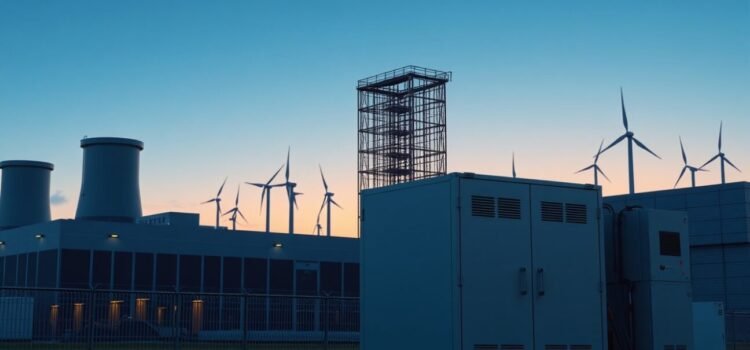
- Combined strategy: Companies are integrating on-site renewable energy sources, such as solar photovoltaic and wind turbines, with battery energy storage systems and natural gas turbines to ensure a continuous electricity supply.
Renewable Energy Expansion
- Microsoft: contracted over 34 GW of carbon-free electricity in 24 countries, including a $6.2 billion agreement in Norway to set the government’s target to 100% renewable energy.
- Amazon: The company met its goal of matching 100% of electricity usage with renewable energy seven years ahead of schedule in 2023 and continues to support new projects. Evolving energy strategies reflect a pivot to new sources. Here is why this shift is underway. The rapid growth of AI is slowly training the electric grid, with data centers expected to consume as much power as 100,000 homes. These initiatives help prevent grid bottlenecks, meet net-zero commitments, and ensure the reliable operation of energy-intensive air training.
The rise of AI poses a unique opportunity to fuel economic growth, increase productivity, and support the community changes needed for the energy transition. At the same time, energy remains a top priority for policymakers and business leaders because it connects economic opportunity, innovation, industrial growth, digital transformation, and environmental impact.
The Asia-Pacific region, with its rapidly growing economies, large urban populations, and dynamic manufacturing labs, is expected to account for two-thirds of global electricity demand by 2030, according to the International Energy Agency (IEA). This increase parallels a spike in digital infrastructure, including data centers, cloud computing, and artificial intelligence (AI).
In 2024, Asia installed over 413 gigawatts (GW) of new renewable power capacity, representing 71% of the world’s total additions. In Southeast Asia, electricity demand is projected to triple by 2050, driven by demographic growth, urbanization, and rising air-conditioning demand. Expanding carbon-free electricity generation, upgrading transmission and distribution networks, and making AI infrastructure more sustainable will support energy security, job creation, and advancement in clean energy and economic development.
Energy and Sustainability Solutions
Across Asia, Microsoft is signing long-term agreements to source carbon-free electricity and deploying technologies such as AI-driven grid forecasting models and circular data center processes to enhance energy system reliability, efficiency, and sustainability. The company is also partnering with governments, utilities, and industry associations to advance policy reform and expedite progress. Initiatives include clean energy development and market facilitation, legislative advocacy, technology innovation, water resilience, and circularity all of which contribute to the energy transition.
- Expand Clean Energy Supply and Market Development: demand for carbon-free electricity is essential to expanding the clean energy supply. Microsoft has contracted over 34 GW of carbon-free electricity across 24 countries, including 19 GW in 2024, and is applying this approach in the Asia Pacific to enable developer financing and create expandable solutions for buyers. Recent agreements include a 20-year virtual PPA with Shizan Energy in Japan for 25 MW of rooftop solar, a portfolio with EDP Renewables in Singapore for up to 200 MW, and a 10-year agreement with Contact Energy for Hookah Unit 3 Geothermal Power Station in Aotearoa, New Zealand. Through our climate innovation fund, we support novel financing models that accelerate the adoption of clean energy in Asia. We have invested in Eversource Capital, which has mobilized $2,000,000,000 and avoided 13.4 million tons of CO2, and in SEACEF, which reduces risk for early-stage renewable projects in Southeast Asia. These investments help unlock private capital and speed up project delivery. Supporting policies and technologies that expand carbon-free electricity and grid infrastructure is also critical. Advocacy matters because government policies and regulations determine the pace of renewable growth, the affordability of clean power, and access for corporate buyers in Korea. Microsoft collaborated with PS suppliers and the Association on the Special Act on Expanding the National Power Grid, passed in February 2025. The act will strengthen Korea’s transmission system, enable greater integration of renewable energy, and create opportunities for corporate buyers. This demonstrates how collaborative advocacy and government leadership can remove barriers. Microsoft is also partnering with energy companies in Asia to use AI for clean power. One developer is building an AI platform on Azure to improve predictions of solar and wind output. Early results show better forecast accuracy, fewer costly errors, and more efficient maintenance of renewable energy even before new power lines are constructed.
- Strengthen Water Resilience: Water stress is a critical sustainability challenge in Asia, ranging from shortages and poor water quality to climate-driven variability. Data centers depend on water for cooling. So we are committed to reducing our water use and supporting community adaptation. Microsoft is investing in solutions that strengthen local water resilience and support our goal to be water-positive in Malaysia by 2030. We partnered with CLEAN International to install rainwater-harvesting and filtration systems in 50 schools, benefiting 20,000 people. In India, collaborations with Flux Gen and Botanical Water Technologies conserve millions of liters annually and provide portable water to underserved communities in Korea. Our partnership with K-Water will create a wetland to restore water flows equal to the daily needs of one million people.
- Advanced Circularity: Microsoft is also reducing data center waste. At the circular center in Singapore, decommissioned servers and cloud computing hardware are reused or recycled. Parts are distributed to schools, training programs, and manufacturers. Microsoft is investing in companies like Cyclic Materials, which recycle rare earth magnets from old equipment. This reduces the need for new mining and improves supply chain sustainability.
AI As a Tool for Decarbonization
AAI’s influence goes beyond the digital group when used effectively. AI can drive decarbonization across entire economies. The IEA estimates that widespread use of existing AI technologies could reduce global emissions. This could be up to three times the indirect emissions generated by data centers worldwide.
Building on this global perspective, it is important to consider Asia’s unique context, where energy-related systems are complex and fast-changing. AI offers three core strengths:
- Measuring, forecasting, and optimizing complex systems such as national electricity grids in real time while balancing fluctuating renewable generation with electricity demand.
- Accelerating progress in materials science, such as new battery chemistries and low-carbon fuels.
- Empowering the workforce and decision makers by transforming fragmented datasets into practical insights that accelerate deployment, strengthen supply chains, and unlock financing.
A strong example is AI’s application in grid management across Asia. Advanced forecasting tools can model renewable output, predict demand increases, and optimize the use of existing transmission assets. This allows more clean energy to connect without waste while new lines are being built.
We are also exploring how AI can accelerate permitting reform, which is still a significant barrier to energy project deployment and development. Microsoft is partnering with organizations such as Idaho National Laboratory in the US and Lloyd’s Register in the UK to simplify energy project development and permitting, thereby reducing costs and time in Asia. We are in early discussions on how AI can support faster approval of renewable projects and grid interconnections.
Policy And What Comes Next
Policy acts as a multiplier when supported by supportive frameworks. Governments can unlock investment, accelerate innovation, and scale solutions more rapidly than any single company. Three imperatives stand out:
- Expand grid infrastructure, address grid bottlenecks, and mitigate risks to digital growth and decarbonization. Governments can fast-track permitting and interconnection timelines and adopt digital solutions, such as AI, to maximize the use of existing assets, shared open, trusted platforms, and RSS. These elements are essential for AI development in energy, enabling utilities, regulators, and innovators to optimize in real time.
- Governments and private-sector partners must coordinate efforts to accelerate clean energy development and access. Key actions include scaling up technology deployment, streamlining and accelerating permitting processes, developing procurement pathways, and targeted investments to ensure all communities benefit from expanded clean energy.
- Utilize AI as an accelerator of innovation. All tools and technologies empower people globally to build and operate clean, efficient, and resilient energy systems by enabling smarter resource use, improving system efficiency, and fostering innovation in carbon-free energy and conservation. The AI economy has the potential to advance both economic growth and environmental stewardship.
The IEA estimates that emerging Asian economies must increase annual clean energy investment fivefold to approximately USD 190 billion by 2035 to meet security, climate, and development goals. Grid modernization alone will require $30 billion per year. This highlights the immediacy of coordinated public-private action.
Microsoft is committed to playing our part as a long-term off-taker of clean energy, a technology partner deploying AI, and a policy collaborator shaping enabling conditions.
The dual transformation of AI and energy is underway. With the right policies, investments, and partnerships, we can drive emissions reduction and encourage inclusive growth, regional resilience, and technological leadership. The time to act decisively and together is now.


