






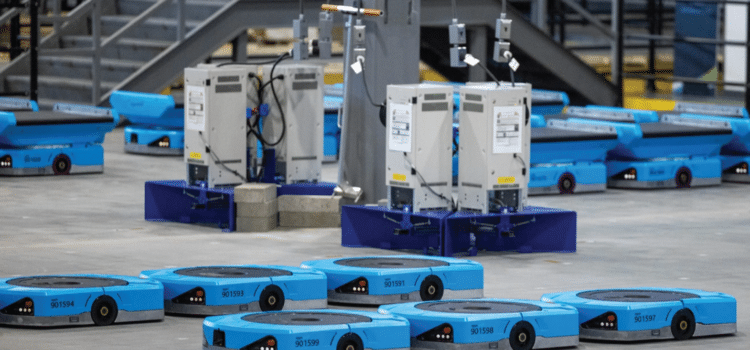
Amazon is spending much more to implement warehouse robots in the United States to gain a competitive advantage by achieving shorter delivery times and building a more resilient supply chain. The firm would increase its business activities by implementing over half a million mobile robotic units to be used alongside human employees to enhance sorting, picking, and packing processes. These advances show that the company is committed to automating its operations as it develops more logistics solutions.
Robotic Integration Across Fulfillment Centers
Amazon has grown to have numerous distribution centers in the United States and beyond, with warehouse robotics programmes that started as small pilot projects and are now full-scale and operational. The system uses autonomous mobile robots (AMRs) to transfer inventory in large facilities, minimising physical load on workers, reducing unnecessary movement, and improving operational performance.
The robots use high-level AI-based routing technology to monitor order volumes, patterns in warehouse traffic, and changes in facility layout and to adjust paths in real time. Optimising the movement will also enable Amazon to achieve a 25% increase in processing speed across its capacity centres, which are already operating at full capacity. The robotics system not only accelerates order processing but also helps human workers focus on crucial tasks, such as quality control, complex packaging, and inventory management, thereby boosting the entire organisation’s productivity.
Robotic systems also help human workers by enabling them to focus on important business activities, such as evaluating product quality, performing complex packaging operations, and providing customer support.
Enhancing Delivery Speeds in the US
Fast delivery services now serve as the most important competitive advantage for online shopping businesses. Amazon expands its robotic systems to meet customer demand for same-day and next-day delivery. The company will achieve faster order processing and delivery operations through its plan to increase warehouse automation.
Amazon operates robotics technology in both its standard urban fulfilment centres and delivery system, a logistics process that transports packages from the final storage location to customers’ doors, enabling rapid movement from storage to delivery vehicles.
AI-Driven Warehouse Management
The central component of Amazon’s robotics operations uses an artificial intelligence-based system that manages its operations. The machine learning algorithms track inventory status, forecast future demand changes, and control robot movements throughout the day.
During peak holiday periods, AI systems dynamically reallocate robots to zones experiencing higher demand. The system also tracks energy usage, robot movement patterns, and maintenance timetables, letting each facility establish its own autonomous management system.
Amazon combines robotics with predictive analytics to achieve faster delivery times, which result in reduced operational costs, fewer mistakes, and safer work environments for its employees.
Sustainability and Efficiency Gains
Amazon uses its automated systems to achieve environmental sustainability goals that extend beyond its current operations. The company achieves cost savings through its robotic systems, which operate at peak efficiency by reducing the walking required of warehouse staff and lowering energy use. The company claims that its robot systems have already improved operational efficiency while decreasing energy consumption throughout its facilities.
The new generation of robots uses lightweight yet durable materials and energy-efficient motors to reduce environmental impact while achieving high operational performance.
Workforce Collaboration and Training
Amazon states that robots serve as tools that enhance human workers’ abilities rather than replace them. The company trains its associates to operate robots using mobile devices and sensors to achieve robotic unit operation.
The company has established training programmes to develop employees’ skills so they can handle every aspect of robotic system operation and maintenance. This partnership creates a workplace sector that promotes safety and efficiency and trains employees to manage more automated tasks.
Implications for US Logistics and E-Commerce
Amazon’s warehouse robotics expansion has multiple impacts on the entire US logistics industry. The competitors face pressure to implement identical systems because the technology delivers faster processing and more reliable performance, which drives e-commerce and third-party logistics to adopt automated systems.
Automated fulfilment meets while also allowing them to develop their own robotic systems. Industry analysts predict that these investments will change how customers expect delivery times, service dependability, and service performance.
Challenges and Considerations
The robotics industry faces technical and operational hurdles that prevent its benefits from being fully realised. The safe operation of warehouse systems requires three components: precise facility mapping, ongoing system oversight, and flexible artificial intelligence systems.
The organisation needs to maintain its numerous units through two essential requirements: strong infrastructure and highly skilled personnel. Amazon works on system improvements to increase production while maintaining operational dependability.
Three main elements need assessment to create automation systems for facility operations: workplace safety requirements, labour relations, and regulatory compliance. The company establishes safety standards governing robot operations in areas requiring continuous operational oversight.
Looking Ahead
Amazon plans to integrate robotic solutions into its current and future distribution centres by 2026. In the future, there will be improved artificial intelligence systems, faster mobile robots, and more efficient systems that can tie delivery operations to drones and self-driving cars.
The application of warehouse robots in Amazon’s operations enables the development of an innovative e-commerce logistics system, thereby reducing delivery times across the United States. The project demonstrates that AI-driven automation systems can be efficient in terms of operational efficiency, safety standards, and customer satisfaction.
Sources: Operations


