





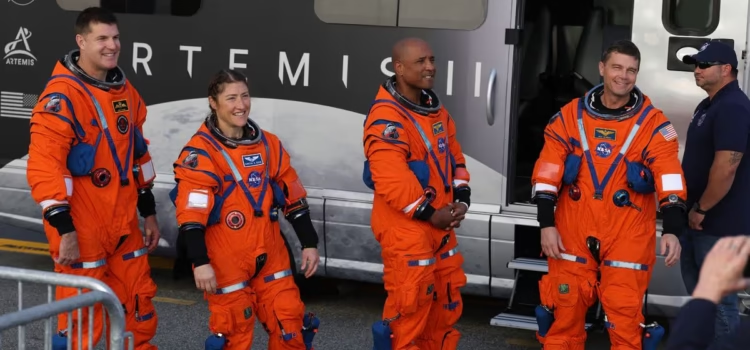
As NASA takes the next necessary steps towards the launch of the Artemis II mission, it is laying the groundwork for recovery operations after its return, a critical element in the US’s preparation for its return to human-led lunar missions.
In the final preparations for recovery plans for the Artemis II mission, which will carry a crew of astronauts around the Moon for the first time in over 50 years, NASA is now completing preparations for its recovery teams, defining naval operations coordination, and developing final safety systems for recovery procedures after splashdown.
NASA has made significant strides towards establishing a permanent human presence on and near the Moon as part of its larger Artemis program by creating Artemis II; however, this emphasizes that we must be prepared for the overall recovery of the astronauts from the current mission, which illustrates how precise and complicated conducting human spaceflight missions to date has been. The three events, the launch of the satellite, the return of the astronauts, and the recovery of the spacecraft, must be executed successfully to facilitate a safe return for the astronauts to Earth.
Preparing for Crew Recovery at Sea
Splashdown operations in the Pacific Ocean provide an opportunity for recovery teams to recover the Orion spacecraft and astronauts after the Artemis II mission. This phase of the mission is one of the most critical, as it requires planning and executing operations that coordinate naval assets, medical teams, and engineering specialists to safely extract astronauts from the capsule and transport them for post-mission evaluation.
Recovery operations are set up to provide a timely response to retrieve the capsule after it reenters and lands in ocean waters. Specialized ships, helicopters, and recovery personnel will be pre-positioned and ready to recover, stabilize, and assist astronauts as they leave the spacecraft.
NASA has stated that the recovery procedures are based on extensive experience gained through a series of simulations and lessons learned from prior missions, especially those of the Apollo program and prior Artemis missions, to refine modern procedures for spacecraft recovery post-splashdown.
Lessons from Artemis I and Apollo Missions
NASA has been developing the recovery plan for Artemis II for a long time, drawing on lessons from previous human spaceflight missions. Apollo laid the foundation for ocean recovery operations, and Artemis I was a modern example of retrieving the Orion without an astronaut on board.
In Artemis I, NASA tested how the heat shield would perform, how it would work during re-entry, and how it would land in water to develop improved recovery planning processes for crewed missions. NASA has incorporated this knowledge into the recovery plan for Artemis II to ensure that astronauts transitioning from space to Earth have a smooth, safe journey.
By leveraging historical knowledge from Apollo missions and the latest technologies, NASA will be able to reduce risk while ensuring the most efficient recovery of astronauts during the mission’s most critical phase.
The Role of the Orion Spacecraft
The Artemis II spacecraft and the missions designed to take humans to explore the universe are being developed using the Orion spacecraft, which was purpose-built to enable people to venture into the depths of space beyond our planet. The Orion spacecraft has life support systems, navigation aids, and measures to protect against heat and stress when it returns to Earth after being launched from a launch pad for many years, thereby providing astronauts with an opportunity to travel beyond Earth into space.
The Orion spacecraft encounters intense thermal conditions and structural strain during re-entry, traveling at high speed through different atmospheric layers before parachute deployment, which leads to a safe descent to Earth for an Atlantic Ocean landing. After the capsule lands, recovery personnel will have specific instructions on how to be ready to respond to the splashdown and to keep the capsule from rolling onto its side or rocking to prevent injury to the astronauts during extraction.
The Orion spacecraft is essential to enabling NASA’s long-term mission to establish a permanent presence on the Moon and pave the way for future manned space expeditions to Mars.
Coordination with Naval and Recovery Teams
NASA Recovery Operations for Artemis II require extensive coordination between NASA and the U.S. Navy. The U.S. Navy provides the primary recovery vessels and the personnel to perform splashdown recovery operations. The recovery team is responsible for locating the capsule, securing the landing site, and performing astronaut recovery procedures.
Training has been conducted under various ocean conditions to simulate actual operations, including rough seas, delayed communication, and emergency and contingency operations. The training is critical to ensuring that recovery personnel are prepared to operate effectively in all potential conditions.
The integration of both military and civilian resources reflects the complexity of current space operations and the need for highly coordinated operations support.
Ensuring Astronaut Safety Post-Splashdown
Once the Orion capsule has been recovered, astronauts will undergo an initial health evaluation immediately after returning from microgravity. The purpose of the initial health evaluations is to determine the astronaut’s health status after exposure to multiple accelerations from microgravity, high-speed reentry, and ocean landing. Medical personnel on recovery vessels will be prepared and capable of providing immediate medical assistance as required.
The transition from the spacecraft to the recovery ship will occur in a controlled, expeditious manner to reduce the risk of the crew encountering environmental hazards. This phase of the recovery process is critical for providing both physical safety and psychological comfort to the astronaut after prolonged exposure to microgravity.
NASA has placed a high priority on these recovery procedures as a demonstration of its firm commitment to the health, safety, and success of the astronauts and their mission.
Advancing Human Space Exploration
Artemis II is a crucial component of NASA’s plan to send people back to the Moon and eventually to Mars on a long-term basis. In contrast to Artemis I, which used robotic crew members to conduct system tests, Artemis II will use trained astronauts who will fly around the Moon. As a result, recovery operations for Artemis II will be much more complicated and time-sensitive than those of Artemis I.
The successful completion of this mission will help to demonstrate the function of critical systems for future exploratory trips into deep space, such as navigation, life support systems, and re-entry procedures. The successful completion of this mission will also mark the first time that humans have returned to deep space to explore beyond Earth’s gravity.
Challenges of Deep Space Mission Recovery
Recovery operations are major challenges for space missions, even when space agencies prepare extensively. This is due to a variety of ever-changing factors, including weather, ocean currents, and communications delays.
NASA is continually refining its contingency planning process to account for these variables and equip recovery teams with the tools they need to adapt to rapidly changing circumstances. In addition, all stages of the recovery operation contain built-in redundancy systems and backup procedures.
Broader Implications for Space Infrastructure
In addition to exploring the moon, the Artemis Program will help build infrastructure that enables long-term human habitation in deep space. Recovery operations will be a necessary component of this ecosystem and will enhance the safety, repeatability, and scalability of all rocket and spacecraft missions.
As NASA’s ambitions for lunar flight grow, the need for efficient recovery systems will increase to support more frequent crewed missions and continued commercial partnerships.
Conclusion: A Step Closer to Lunar Return
By showing how complex and exacting Artemis II recovery operations will be, it has demonstrated the advanced quality of astronauts’ human space flight activities today. Now that NASA is preparing to launch its first manned lunar fly-by in almost 50 years, it is focusing on planning every detail of the mission from launch to splashdown.
The success of these activities will mark an important milestone in mankind’s effort to probe the universe. This sets the foundation for further missions by providing humanity with the tools needed to reach deeper into outer space.
Source: NASA News Release


