
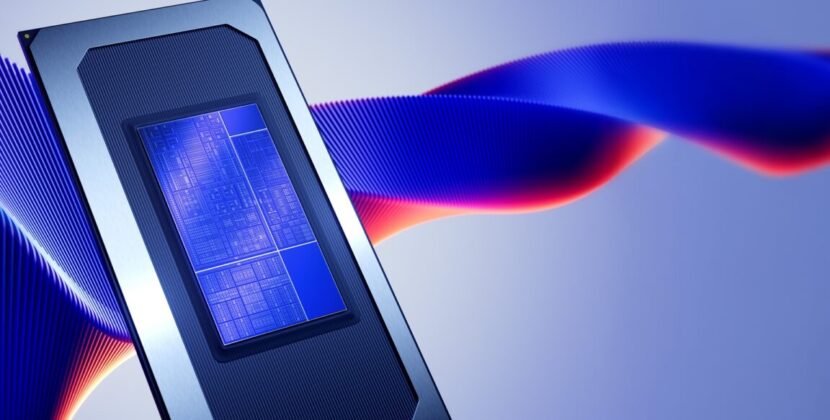





Intel has launched a new phase in semiconductor manufacturing with the introduction of the Intel Core Ultra Series 3 processors. First announced at CES 2026 and coming to global markets this spring, these chips, known as Panther Lake, are the first consumer platform built on the Intel 18A process node. This achievement is the result of years of work to reclaim transistor leadership. Using an advanced ribbon-fit gate-all-around architecture and backside power delivery—by moving the power circuitry to the back of the silicon wafer—Intel has greatly reduced voltage drops and interference. As a result, the Series 3 offers impressive energy efficiency and computing power in a mobile device.
The Architecture of Panther Lake
Building on this momentum, the Ultra Core Series 3 introduces a new architecture that separates different tasks into specialized sections, or tiles. The main compute tile, built on the 18A node, features a hybrid setup with up to 16 cores. These include high-performance Cougar Cove cores for demanding single-threaded tasks, and Darkmont efficiency cores for background operations that use little power. There is also a third group, the SkyMont Low Power Efficiency course, on a separate ID area called the Low Power Island. This handle handles system functions and media streaming, helping laptops achieve up to 27 hours of video playback on a single charge.
This new design is not simply about speed, but about using resources much more efficiently. The Series 3 uses a fast on-chip network to move data quickly between the CPU, GPU, and memory controller, supporting LPDDR5X memory speeds up to 9600 MT/s. The platform offers the fast data connections needed for today’s multitasking. Even in slim laptops, users can see a 60% boost in multi-threaded performance compared to earlier models, bringing workstation-level performance to portable devices.
Advancing Integrated Graphics and Visual Computing
Graphics performance has improved significantly with the new XE3 architecture, also known as Celestial. This integrated GPU features 12 XE cores and delivers a 77% boost in gaming performance over Series 2 by adding features once found only in desktop graphics cards, such as hardware ray tracing and XESS upscaling. The Core Ultra Series 3 lets users enjoy smooth, high-quality gaming at 1,080P without needing a separate graphics chip.
Beyond gaming, the XE3 engine is also great for creative work. Its dedicated media engine can fully handle hardware encoding and decoding for the latest AV1 and VVC video codecs, which are important for 8K streaming and professional video. For creators. This means tasks like 3D rendering or exporting 4K videos are much faster. So there is less waiting and more time to create. Thunderbolt 5 support adds even more flexibility, making it easy to connect several 8K displays and fast external storage with just one cable.
The Dedicated Compute Framework
A key feature of the Series 3 platform is its distributed compute model. Intel’s NPU5 (neural processing unit) delivers up to 50 TOPS (tera operations per second) specifically for AI inference. In conjunction with the x86 CPU and GPU, which offer high-throughput vector and matrix computation, respectively, the platform can reach an aggregate of 180 TOPS. The architecture assigns computational workloads based on processor specialization: the NPU accelerates continuous, low-latency AI workloads such as real-time noise cancellation and background blur during video processing. The GPU executes graphics and parallel-intensive creative tasks.
This cooperation between processors is what makes the platform an AI PC. It allows complex models to run directly on the device, eliminating the need for cloud servers. Processing on the device improves privacy and reduces delays for tasks such as real-time language translation. For professionals, the system appears more reactive and can automatically adjust power and connectivity settings without manual intervention.
Expansion Into Edge and Industrial Sectors
For the first time, Intel is certifying the Core Ultra Series 3 for edge and industrial users, not just for customers. These specialized versions are built for 24/7 dependability in tough environments, from autonomous robots in factories to cutting-edge medical imaging in hospitals. The Edge First chips can handle wider temperature ranges and deliver precise, consistent performance, enabling important tasks to be completed within milliseconds.
Integrated advanced video analytics and vision-based automation into a single system-on-a-chip (SOC), simplifying and reducing the cost of industrial setups with a unified architecture that supports both high-end consumer laptops and rugged industrial controllers. Intel is building an ecosystem that enables software to move easily between environments. This suppleness is central to Intel’s plan to bring its latest technology into every part of the world’s digital infrastructure.
The Crystalline Pulse Of Progress
As these processes enter everyday devices, our relations with technology change. Chips work more closely with us, almost anticipating our needs. Over time, the line between our actions and computer tasks may blur. We will rely on technology’s steady power and shape a future where it supports our ideas with dependable performance.
Source: Client Computing


