




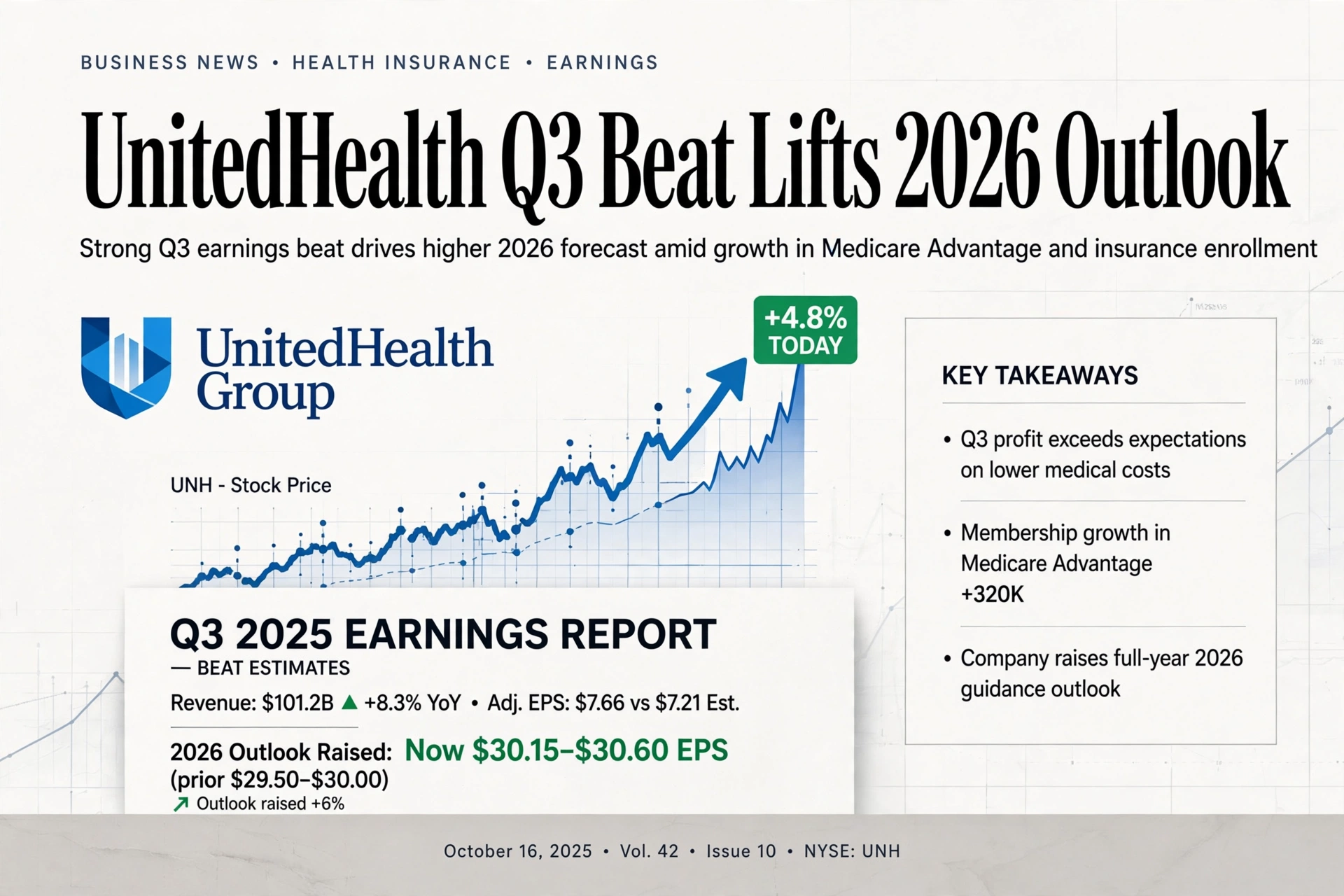
UnitedHealth Beats Q3 Estimates and Raises Its 2026 Outlook as Costs Ease
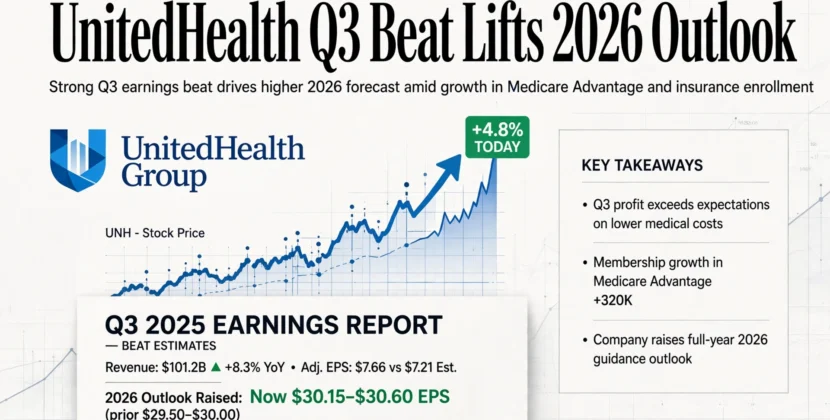
UnitedHealth Group reported third-quarter 2026 results on Monday, October 13, delivering revenue and earnings that topped Wall Street expectations and lifting its full-year profit guidance, a combination that pushed shares higher in premarket trading and offered the largest U.S. health insurer its clearest confirmation yet that the cost pressures that roiled its business over the past year are easing. Consolidated revenues came in at $112.7 billion, roughly flat year over year but ahead of the $111.31 billion consensus, while adjusted earnings reached $4.69 per share against the roughly $4.12 analysts had modeled.
Key Takeaways:
- – UnitedHealth reported Q3 2026 results on October 13: revenue of $112.7 billion, adjusted earnings of $4.69 per share, and earnings from operations of $6.6 billion.
- – Both headline lines beat estimates, with revenue ahead of the $111.31 billion consensus and adjusted EPS far above the roughly $4.12 analysts modeled.
- – The company raised its full-year 2026 adjusted EPS guidance to at least $20.50, up from $19.50 to $20 and above the $19.87 consensus.
- – The medical cost ratio fell to 88.4% from 89.9%, improving margins year over year, while OptumHealth was the only segment to miss expectations.
The Headline Numbers
Behind the top-line beat, the reported figures were equally solid. Earnings from operations were $6.6 billion with a net margin of 3.6%, reported earnings were $4.56 per share, and cash flow from operations totaled $5.1 billion, or 1.2 times net income, with the debt-to-capital ratio at 41.7% as of September 30. The adjusted earnings comparison is the one that moved the stock: $4.69 per share versus $4.12 expected, and up sharply from $2.92 a year earlier, a year-over-year jump that reflects both an easier comparison period and genuine cost discipline.
Chief Executive Stephen Hemsley framed the quarter as proof of direction. Our third quarter results reflect the discipline and execution our teams are bringing to every part of our business, he said in the release, as we continue evolving UnitedHealth Group to deliver a simpler, more supportive experience for patients and the clinicians who care for them. The company now expects full-year 2026 adjusted net earnings of at least $20.50 per share, raised from prior guidance of $19.50 to $20 and above the $19.87 consensus.
Margins Are the Real Story
The most important detail in the report is the direction of the medical cost ratio, the share of premiums spent on patient care. UnitedHealth’s ratio fell to 88.4% from 89.9% a year earlier, better than the 89.9% analysts expected, which means the company kept a larger slice of every premium dollar as claims experience improved. Operating margin widened to 5.8% from 3.8% a year earlier, and the operating cost ratio improved to 12.8% from 13.5%, though it ran slightly above the 12.6% estimate.
Those ratios matter beyond the quarter because the medical cost ratio is the single clearest gauge of whether an insurer’s pricing and care-management decisions from the prior year were set correctly. A falling ratio after a period of elevated medical cost trends signals that premium increases, network strategies and utilization management are catching up to claims, which is the precondition for the company to hold or lower prices, defend membership and restore the earnings profile investors had assumed before the disruption.
How the Segments Performed
UnitedHealthcare, the insurance arm, posted revenue of $86.33 billion, down 0.8% from a year earlier but comfortably above the $84.87 billion estimate, indicating the membership base held up better than models assumed. Optum revenue fell 3.3% to $66.88 billion, still ahead of the $66.48 billion consensus. Within Optum, the pharmacy benefit unit OptumRx reported $39.93 billion, up 0.6% and above the $38.81 billion estimate, OptumInsight delivered $5.47 billion versus a $5.4 billion estimate, and OptumHealth was the one segment that lagged, with $22.91 billion against $23.37 billion expected.
The mix tells a familiar story about the modern health conglomerate: the insurance business provides scale and steady cash, pharmacy is carrying near-term growth, and the care-delivery arm, OptumHealth, is where the pressure sits this quarter. Investors have spent the year debating how much of UnitedHealth’s strategy should remain integrated, and a quarter where insurance and pharmacy beat while care delivery misses feeds that discussion directly.
Wall Street’s Reaction and the Turnaround Context
UnitedHealth shares rose more than 2% in premarket trading after the report, a response tempered by the fact that the stock spent much of the year well below its prior highs while the company worked through its turnaround. The raised guidance is what distinguished this report from a simple beat: moving the full-year target to at least $20.50 from a $19.50 to $20 range tells the market that management sees the improved cost experience persisting through the fourth quarter rather than normalizing.
Analysts on the earnings call focused on the same question from the other direction: whether the better claims experience reflects structural improvements in how the company manages care, or simply a pricing cycle that will eventually reverse as competitors respond. Hemsley’s emphasis on discipline and a simpler experience for patients and clinicians is the company’s answer, positioning the changes as operational rather than actuarial timing. Whether that holds will be settled by the claims experience of the next two quarters, not by any single quarter’s headline.
What It Means for the Industry
UnitedHealth’s results land in a week of consequential news across American health care. The wider industry is absorbing new pressure on multiple fronts, including drug pricing policy, hospital consolidation and the cost of covering expensive new therapies. For a company of UnitedHealth’s scale, serving tens of millions of members across insurance, pharmacy and care delivery, a quarter of improving margins is also a signal about underlying claims costs that the rest of the sector will read carefully.
The competitive backdrop is shifting as well. Payers including UnitedHealth, Cigna, Aetna, Elevance and Humana are partnering through a shared provider-data standard to fix directory accuracy, private capital is moving into senior primary care with BlackRock agreeing to buy a majority stake in Humana’s CenterWell clinics for $2.8 billion, and Medicare Advantage economics remain the industry’s central swing factor heading into the annual enrollment season. In that context, raising guidance while beating on both lines gives UnitedHealth room to compete on price and investment instead of playing defense.
What to Watch Next
The fourth quarter will test whether the medical cost ratio improvement holds as plan pricing for 2027 takes effect and as enrollment seasons for Medicare and commercial coverage reset. Watch OptumHealth’s revenue trajectory, since that segment’s miss was the only blemish in the quarter, and watch management’s commentary on medical cost trends for next year, which will determine whether the raised $20.50 floor is a conservative starting point or the top of the range.
For investors, the calibration is simple: the company has now shown a beat, a raised outlook and a stock that responds positively, the three-part pattern its turnaround narrative needed. For customers and clinicians, the test is slower but more important, whether a quieter cost line shows up as stable premiums, intact networks and the simpler experience Hemsley promised in the company’s own announcement.
Conclusion
UnitedHealth Q3 2026 earnings delivered what the company’s turnaround story needed: a beat on both top and bottom lines, a raised guidance, and a tighter medical cost ratio that signals the cost surge is cooling. The UnitedHealth earnings beat is less a single-quarter event than the first clean evidence that pricing and care management have caught up with claims, which is the condition for stable premiums and more competition in Medicare Advantage and commercial markets.
The proof points now shift to the fourth quarter and to 2027 pricing. Watch whether the medical care ratio holds as seasonal utilization picks up, whether OptumHealth’s revenue trajectory recovers from the quarter’s only miss, and how management sizes next year’s medical cost trend. For providers, partners and members, Wednesday’s report is the first quarter in a while where the industry’s largest insurer can invest rather than retrench, and the difference should become visible in pricing and network decisions through the rest of the year.
Frequently Asked Questions
When did UnitedHealth report third-quarter 2026 earnings?
UnitedHealth Group reported its third quarter 2026 results on October 13, 2026, including revenue of $112.7 billion, earnings from operations of $6.6 billion and adjusted earnings of $4.69 per share.
How much did UnitedHealth beat estimates?
Adjusted earnings of $4.69 per share topped the roughly $4.12 analysts expected, and revenue of $112.7 billion came in ahead of the $111.31 billion consensus estimate.
What is UnitedHealth’s full-year 2026 guidance?
UnitedHealth raised its full-year 2026 outlook to adjusted net earnings of at least $20.50 per share, up from prior guidance of $19.50 to $20 and above the $19.87 consensus.
How did UnitedHealth’s medical costs change?
The medical care ratio, the share of premiums spent on patient care, fell to 88.4% from 89.9% a year earlier, better than expected, while operating margin widened to 5.8% from 3.8%.