




TSMC Posts Record Sixth-Straight Quarter of Profit as AI Chip Demand Defies Doubts
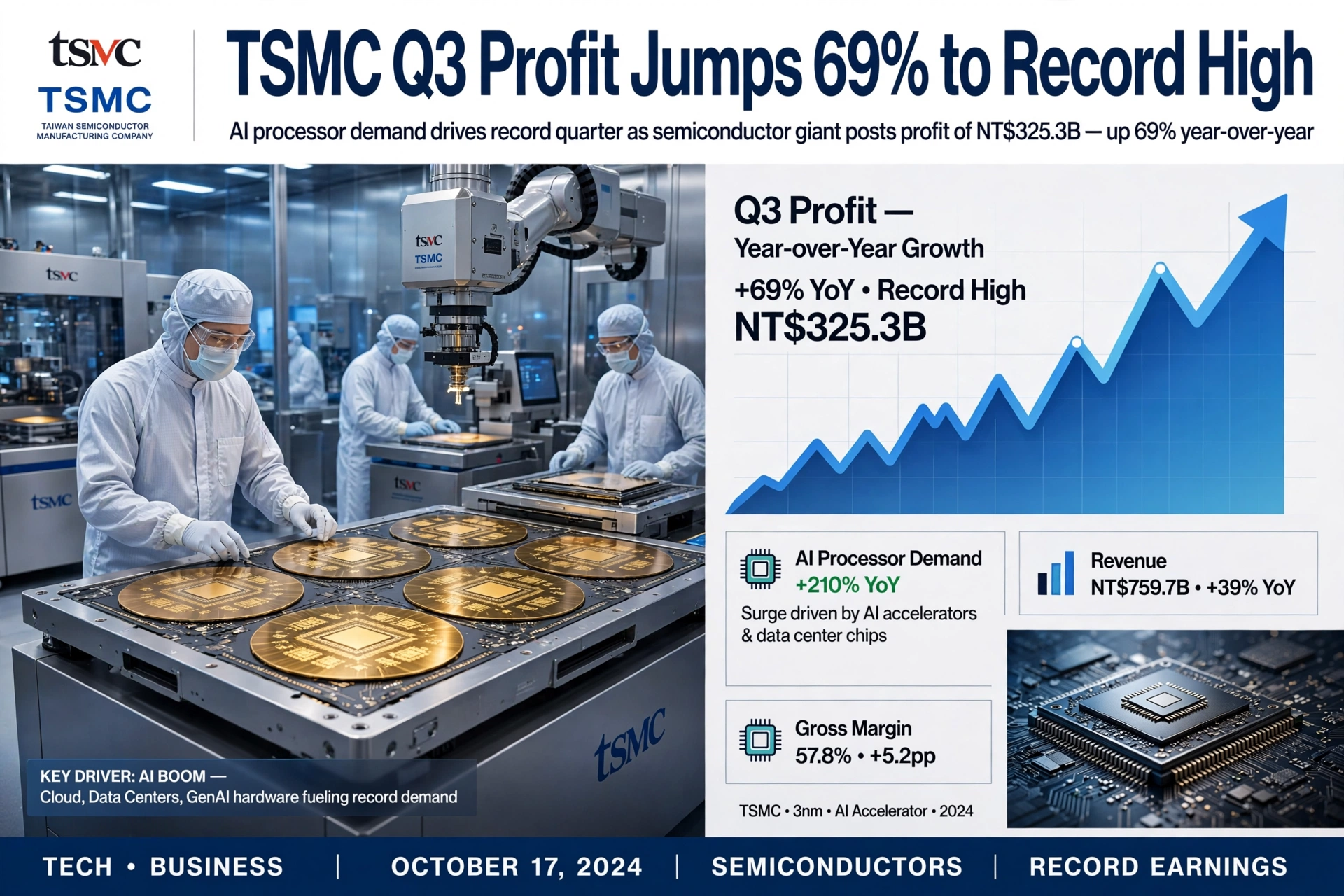
Taiwan Semiconductor Manufacturing Company reported third-quarter 2026 results on Thursday, October 15, posting record net profit for a sixth consecutive quarter and beating analyst estimates as demand for artificial intelligence chips continued to outrun the company’s capacity. Net income reached NT$763.1 billion, about $23.6 billion, a 68.7% surge from a year earlier, while quarterly revenue came in at NT$1.49 trillion, roughly $46.36 billion, ahead of the NT$1.47 trillion that analysts polled by LSEG had expected. It is the clearest quarterly evidence yet that the AI buildout is translating into orders rather than merely announcements.
Key Takeaways:
- – TSMC’s Q3 2026 net profit hit a record NT$763.1 billion, roughly $23.6 billion, up 68.7% year over year, its sixth straight record quarter.
- – Quarterly revenue reached NT$1.49 trillion, about $46.36 billion, ahead of the NT$1.47 trillion analysts expected, and the operating margin of 58.7% beat the top of TSMC’s own guidance range.
- – TSMC completed construction of its second Arizona fab and is installing equipment, with mass production expected to begin in Q3 2027 within a planned $265 billion U.S. investment.
- – For U.S. readers, TSMC’s results function as a real-time gauge of AI infrastructure demand, since the company manufactures the leading AI accelerators behind Nvidia and much of the computing economy.
The Numbers Behind the Beat
Beyond the headline profit, the report cleared expectations across nearly every line investors watch. Net profit of NT$763.1 billion topped the NT$746.34 billion consensus, the operating margin of 58.7% exceeded the upper end of TSMC’s own guidance range of 58%, and free cash flow surged to NT$476.56 billion from NT$139.38 billion a year earlier, a more than threefold expansion that gives the company unusual financing flexibility for its construction plans.
Operating margin above the guidance ceiling is the detail that speaks to pricing power. In a business where the company publicly sets a range for its own profitability each quarter, delivering above the top of that range while volumes are also rising indicates that advanced-chip pricing is holding firm even as customers absorb the cost of the AI infrastructure race. The board also approved a NT$7.00 cash dividend for the quarter, returning a slice of the record result to shareholders.
A Fourth-Quarter Forecast That Implies Acceleration
TSMC guided fourth-quarter revenue to between $52.3 billion and $54.3 billion, a roughly 14% sequential increase and a 58% jump from a year earlier at the midpoint of the range, and it upgraded its full-year revenue outlook along the way. The company expects capital expenditure from 2026 through 2028 to be significantly higher than in the previous three years as it builds to meet demand, a commitment that ripples through construction, equipment suppliers and energy planners on multiple continents.
Analysts read the guidance as confirmation rather than aspiration. Sravan Kundojjala of SemiAnalysis told CNBC that the stronger-than-expected results and upgraded outlook underscore how demand for advanced chips continues to outpace production capacity, and he highlighted TSMC’s careful approach to expansion, noting the company checks whether customers have the financing and supporting components to deploy AI systems before adding capacity. Even after those checks, he said, TSMC reports demand remains well above its supply capacity.
Where the Revenue Comes From
The mix shows just how concentrated the AI cycle remains. Advanced technologies, defined as 7-nanometer and more advanced processes, made up 79% of total wafer revenue, with 3-nanometer chips the single largest category at 33%, followed by 5- and 7-nanometer nodes. By platform, high-performance computing, the category that includes AI accelerators and server processors, accounted for 68% of revenue, smartphones followed at 21%, and automotive was the fastest-growing segment on a quarter-on-quarter basis with 23% growth.
TSMC said demand for AI chips remains strong, driven by growing adoption of agentic AI systems and open-source AI models that are expected to make the technology more accessible and fuel demand for advanced semiconductors. The company pointed in particular to rising demand for AI accelerators, processors used in agentic applications and networking, and described semiconductors as playing an increasingly important role in the global AI supply chain, language that frames the current order book as structural rather than cyclical.
Arizona: The American Stake in the Report
For U.S. readers, the most consequential line in the release concerned domestic manufacturing. TSMC said it had completed construction of its second fab in Arizona and is now installing equipment, with mass production expected to begin in the third quarter of 2027, slightly ahead of its previous schedule. The milestone moves the project from a story about concrete and cranes to one about tool installation and process qualification, the phase where yield and timeline become measurable.
The expansion sits inside a larger commitment. During its July earnings announcement, TSMC outlined plans for a total planned investment of $265 billion in Arizona, and the company is reportedly evaluating a potential investment in Texas as it looks to further strengthen its U.S. manufacturing presence. That ambition matters to American policymakers and to the chip designers, cloud companies and automakers that depend on leading-edge capacity, because every fab completed on U.S. soil shortens the distance between the world’s most advanced design ecosystem and its most advanced manufacturing.
Why TSMC Matters to the U.S. AI Economy
TSMC manufactures the chips used in the leading AI accelerators sold by Nvidia and other designers, along with the processors inside American smartphones, so its quarterly results function as a real-time gauge of the entire technology economy’s hardware appetite. A record sixth quarter, guided by AI demand and backed by a 2nm ramp that management said will support the fourth quarter, tells U.S. buyers that the supply chain is still the constraint, which keeps pricing firm from data centers to retail.
The report also frames a policy reality. Arizona fab number two reaching equipment installation in 2027 means advanced packaging, skilled labor and construction capacity are now the variables that determine how much of the AI supply chain actually operates inside the United States, and TSMC’s capital expenditure path through 2028 sets the ceiling on how fast any of it can scale.
What to Watch Next
Three threads will define the next two quarters. The first is execution on the Arizona timeline, since a third-quarter 2027 mass production date for the second fab is now a public, checkable commitment. The second is whether the 2-nanometer ramp meets demand quickly enough to hold margins as the node transitions from ramp economics to mature economics. The third is the customer financing question Kundojjala raised, whether hyperscalers and AI labs can sustain orders at this pace, which is the only real downside case in TSMC’s otherwise unbroken growth story.
For American businesses and consumers, the practical translation is straightforward. Until Arizona and the company’s broader capacity expansions come online, demand will keep pressing against supply, which keeps advanced chips expensive and delivery times long. Thursday’s numbers say the pressure is not letting up, and the second fab outside Phoenix is now the clearest American answer to it.
Conclusion
The TSMC Q3 2026 record profit is the strongest evidence yet that the AI buildout is flowing into actual orders rather than announcements, and the fourth-quarter guidance implies further acceleration as the 2nm ramp arrives. For the U.S. technology economy, the significance runs through the supply chain: a supplier operating above its own margin guidance has pricing power, and pricing power at the foundry level sooner or later shows up in the cost of the devices and data centers Americans buy.
Three things to watch next: the pace of the Arizona fab’s equipment installation and Q3 2027 mass-production target, how the 2nm yield ramp holds under AI demand, and whether U.S.-based customers lock in long-term capacity commitments that reshape where leading-edge chips are made. Record quarters rarely change a market by themselves, but six in a row, with an accelerating forecast, is a pattern that typically does.
Frequently Asked Questions
What were TSMC’s third-quarter 2026 results?
TSMC reported net profit of NT$763.1 billion for the third quarter of 2026, up 68.7% year over year and above the NT$746.34 billion consensus, with revenue of about NT$1.49 trillion, or $46.36 billion, beating expectations.
When will TSMC’s second Arizona fab produce chips?
TSMC said construction of its second Arizona fab is complete and equipment installation is underway, with mass production expected to begin in the third quarter of 2027, slightly ahead of the previous schedule.
What is TSMC’s fourth-quarter revenue guidance?
TSMC guided fourth-quarter revenue to a range of $52.3 billion to $54.3 billion, which implies a 14% sequential increase and a 58% jump from a year earlier at the midpoint of the guidance range.
Why is TSMC important to the U.S. technology industry?
TSMC manufactures leading-edge chips for U.S. AI designers, cloud providers and device makers, and its Arizona expansion is central to efforts to build advanced chip manufacturing capacity inside the United States, backed by a stated $265 billion total investment plan.