





FDA Approves the First Treatment for Papillary-Only BCG-Unresponsive Bladder Cancer
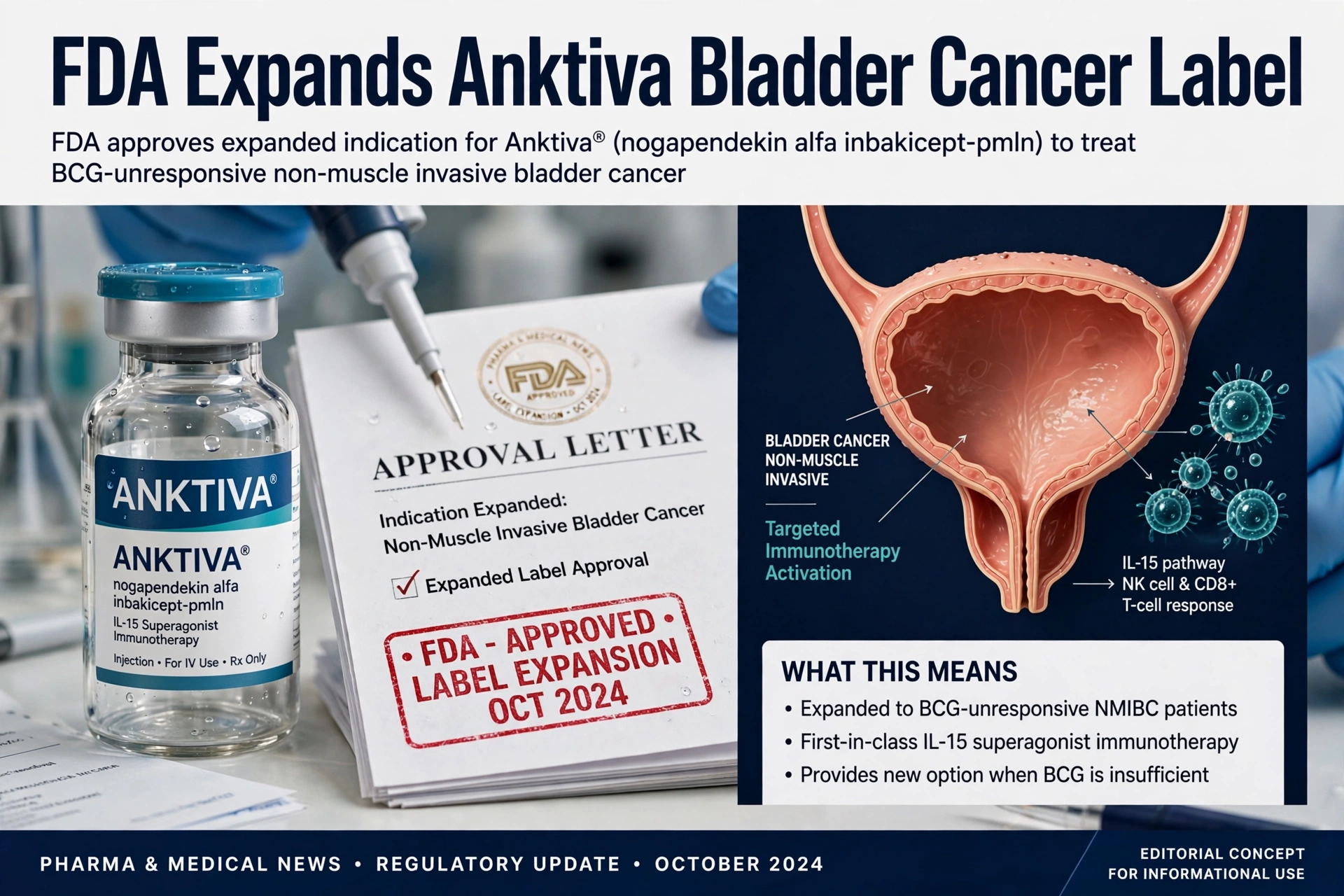
The Food and Drug Administration on Wednesday, October 14, 2026, expanded the approved indication for Anktiva, a therapy from ImmunityBio given with BCG, making it the first FDA-approved treatment specifically for adults with high-grade papillary-only non-muscle-invasive bladder cancer that has not responded to Bacillus Calmette-Guerin, the standard first-line immune therapy for the disease. The decision broadens an approval that until now covered only patients with carcinoma in situ, and it opens a nonsurgical option for a far larger group of patients who, until this week, had few approved treatments between repeated procedures and bladder removal.
Key Takeaways:
- – On October 14, 2026, the FDA expanded Anktiva (nogapendekin alfa inbakicept-pmln) plus BCG to cover adults with high-grade papillary-only BCG-unresponsive non-muscle-invasive bladder cancer.
- – It is the first FDA-approved treatment specifically for that group, broadening an indication that previously covered only carcinoma in situ.
- – Efficacy evidence comes from Cohort A of the QUILT-3.032 trial: 62% of 77 patients achieved a complete response (95% CI 51-73), with 58% of responders maintaining it at least 12 months.
- – The most common treatment-related adverse events are bladder-instillation effects such as dysuria, urinary frequency and hematuria, mostly grade 1 or 2.
What Changed in the Label
The FDA approved Anktiva, known generically as nogapendekin alfa inbakicept-pmln, in April 2024 for patients with BCG-unresponsive non-muscle-invasive bladder cancer with carcinoma in situ, with or without papillary tumors. The expanded label announced October 14 now indicates the combination for the treatment of adult patients with BCG-unresponsive non-muscle-invasive bladder cancer generally, adding patients whose disease is papillary-only, and ImmunityBio confirmed in its announcement that this is the first FDA approval to include BCG-unresponsive disease confined to papillary tumors.
The distinction is clinical, not cosmetic. Carcinoma in situ and papillary tumors are different presentations of the same disease family, and the FDA’s willingness to extend the label rests on the agency’s review of available scientific information, including the previously demonstrated efficacy of Anktiva plus BCG in the carcinoma in situ population, where the two forms share relevant biological features. Regulators could have required a new trial run exclusively in papillary-only patients, a process that would have taken years; instead they extrapolated from existing evidence, an approach the agency described alongside its approval materials.
Who This Is For
The population affected by the change is large. Non-muscle-invasive bladder cancer accounts for approximately 80% of all bladder cancer diagnoses in the United States, and an estimated 85% to 90% of patients diagnosed with that form present with papillary disease. Patients with high-grade papillary tumors that stop responding to BCG face an increased risk of recurrence and progression and historically have had limited nonsurgical treatment options, a gap that urologists have lamented for years.
“Patients with high-grade papillary disease that no longer responds to BCG remain at meaningful risk for recurrence and progression and historically have had limited nonsurgical treatment options,” said Sam S. Chang, M.D., professor of urology and chief surgical officer at the Vanderbilt Ingram Cancer Center. “The availability of an FDA-approved treatment for this population represents an important addition to the treatment landscape, providing appropriate patients with BCG-unresponsive disease another treatment option that may help preserve the bladder.” Bladder preservation is the practical stake for patients, since the alternative for refractory disease is often cystectomy, a life-altering surgery.
The Data Behind the Approval
The efficacy case comes from Cohort A of the QUILT-3.032 trial, in which 62% of 77 patients achieved a complete response, with a 95% confidence interval of 51 to 73. Among those who responded, 58% maintained the response for at least 12 months and 40% maintained it for at least 24 months. Those durability numbers are the ones that matter most in bladder cancer, where recurrence after initial response is common and where every failed therapy pushes patients closer to surgery.
Because the trial enrolled patients with carcinoma in situ, the FDA applied its extrapolation reasoning rather than pointing to a papillary-only dataset, and the agency’s press materials presented the approval as the first treatment for the papillary-only group on that basis. ImmunityBio said the expanded approval significantly increases the company’s addressable patient population in the United States beyond the original indication, and chief executive Richard Adcock said the company is focused on helping eligible patients access the therapy as it builds on strong commercial growth since the initial approval.
Safety and the Warning That Comes With It
The combination has a tolerable safety profile, with the most common treatment-related adverse events tied to bladder instillation itself, including dysuria, increased urinary frequency and hematuria, most of them grade 1 or grade 2 and consistent with the side effect profile of BCG alone. The most common overall reactions listed in labeling include increased creatinine, urinary tract infection, elevated potassium, musculoskeletal pain, chills and pyrexia.
The critical warning in the prescribing information is about time. Delaying cystectomy can lead to the development of muscle-invasive or metastatic bladder cancer, which can be lethal, and labeling instructs clinicians to reconsider removal of the bladder if high-grade disease persists after a second induction course of Anktiva with BCG. The approval is an option for bladder preservation, not a substitute for it, and the label is explicit that the clock does not stop because a new drug is available.
The Science and the Business
Anktiva is a first-in-class interleukin-15 receptor agonist, an IgG1 fusion complex built around an IL-15 mutant fused with the IL-15 receptor alpha that binds with high affinity to receptors on natural killer cells and CD4 and CD8 T cells. By mimicking the membrane-bound receptor, the molecule drives activation and proliferation of natural killer cells and generates memory killer T cells that retain immune memory against tumor clones, restoring an immune response that tumors had escaped.
The commercial context is significant for ImmunityBio, which trades on Nasdaq under IBRX and has built its revenue trajectory around Anktiva since 2024. Company statements accompanying the approval emphasized that access now extends to all patients with BCG-unresponsive non-muscle-invasive bladder cancer, and bladder cancer is among the most expensive cancers to treat over a patient’s lifetime because of the surveillance, treatment and disease management it requires. A broader label converts that clinical burden into a larger treated population for the company and, for insurers and health systems, a new cost line to evaluate.
What Comes Next
The immediate questions are uptake and evidence. Urologists will integrate the expanded label into treatment algorithms that currently move from BCG to surgery for refractory disease, and the pace of adoption will depend on payer coverage decisions, infusion and instillation logistics and physician comfort extrapolating from the carcinoma in situ data. ImmunityBio has said commercial growth was already strong under the narrower label.
For patients, the approval’s meaning is immediate and personal: a first FDA-endorsed nonsurgical option when BCG stops working and the remaining choices used to be repeated procedures or removal of the bladder. For the broader field, October 14 marks a test of the FDA’s extrapolation approach in bladder cancer, where the agency accepted shared biology across tumor forms as sufficient grounds to widen access years ahead of a dedicated papillary-only trial readout. How the treatment performs in that newly labeled population will determine whether the precedent becomes a pattern.
Conclusion
The Anktiva bladder cancer approval gives oncologists a second approved tool in a space that has had almost none, and it validates the FDA’s willingness to extrapolate from a well-studied carcinoma in situ cohort to a papillary-only population when the biology argues for it. For patients, the practical meaning is a chance to avoid both repeat tumor resections and radical cystectomy, keeping the bladder while controlling high-grade disease.
What happens next runs on two tracks: clinical, where ImmunityBio continues to collect real-world response data and where guidelines committees will decide how prominently the expanded indication sits in treatment pathways; and commercial, where the company will press to get eligible patients onto therapy quickly. Note: this article is informational and not medical advice; patients should discuss Anktiva plus BCG with a treating urologist or oncologist.
Frequently Asked Questions
What did the FDA approve on October 14, 2026?
The FDA expanded approval of Anktiva, nogapendekin alfa inbakicept-pmln, plus BCG to include adults with BCG-unresponsive high-grade papillary-only non-muscle-invasive bladder cancer, the first approved treatment specifically for that group.
Who qualifies for Anktiva plus BCG?
Adults with BCG-unresponsive non-muscle-invasive bladder cancer, now including patients with carcinoma in situ with or without papillary tumors and patients with papillary-only tumors, after their disease has not responded to BCG therapy.
What were the trial results for Anktiva?
In Cohort A of the QUILT-3.032 trial, 62% of 77 patients achieved a complete response, and among responders 58% maintained the response for at least 12 months and 40% for at least 24 months.
What is the main safety warning with Anktiva?
Labeling warns that delaying bladder removal surgery, cystectomy, can lead to muscle-invasive or metastatic bladder cancer that can be lethal, and doctors should reconsider surgery if high-grade disease persists after a second induction course.