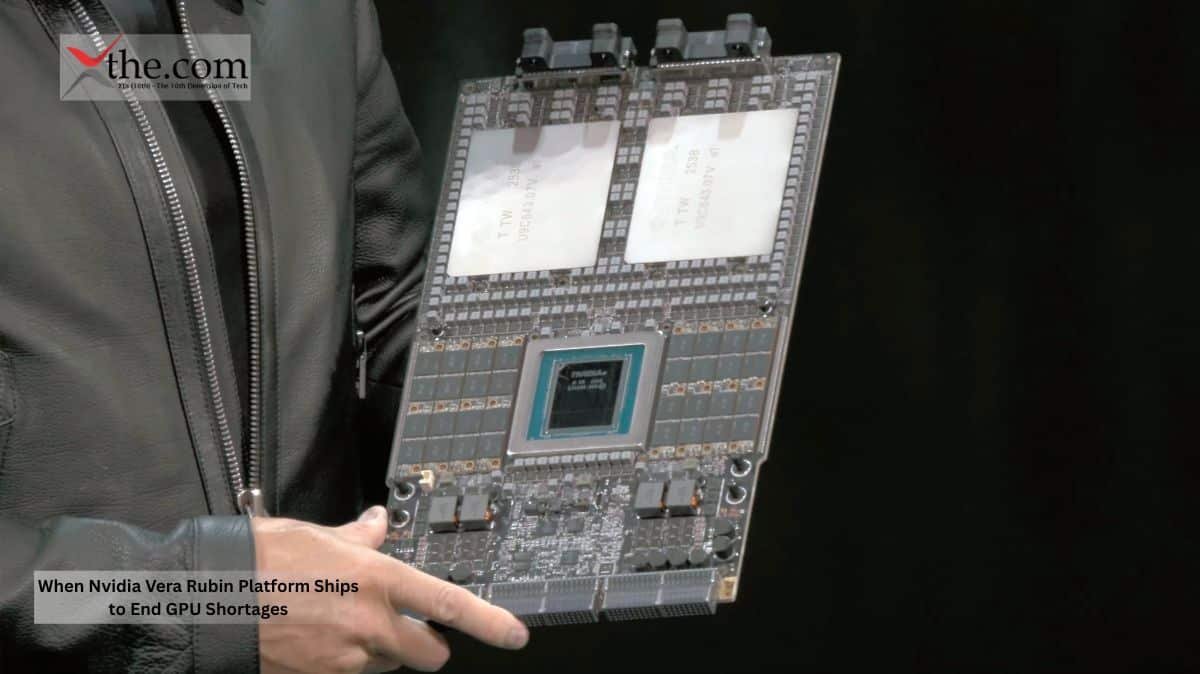
San Jose, California
Demand for enterprise-level AI infrastructure is approaching record-highs as companies seek to ensure next-gen computational capabilities before the next shortage cycle drives supply even tighter. With Nvidia’s latest Nvidia Vera Rubin platform emerging as the focal point of that global buying craze, Nvidia’s leadership has issued warnings that demand for that architecture could persist in an undersupply position throughout its lifetime.
Those warnings come after Nvidia posted one of its best growth quarters in data center revenue, driven by expansion in hyperscale AI infrastructure, sovereign AI initiatives, and enterprise-level generative AI capabilities. The broader AI infrastructure market is also increasingly dependent on advanced networking systems such as Cisco Nexus 9000 800G GPU cluster networking 2026 platforms because modern AI clusters require massive synchronized communication between accelerators.
Now, enterprises must begin preparing for yet another wave of platform shifts with the introduction of the Rubin architecture and next-gen memory.
For procurement leaders hoping to know when Nvidia Rubin chips will be available, the answer may lie in future-oriented infrastructure contracts more than ever before.
Why Rubin Has Created So Much Demand
The new Nvidia Vera Rubin system is the largest infrastructure upgrade the company has ever made.
The architecture is likely to deliver significant gains in AI training efficiency, inference speed, and distributed computing capabilities. According to industry experts, Rubin machines may serve as the core of trillion-parameter AI applications and future independent AI ecosystems.
There are several drivers of the demand:
- Increased complexity of AI models
- Increased adoption of AI by enterprises
- Investments in sovereign AI infrastructure
- Inferencing demands
- Distributed computing demands
At the same time, advanced networking technologies like RoCEv2 non-blocking data stream AI training latency optimization are becoming essential because AI workloads increasingly depend on synchronized GPU communication across massive infrastructure clusters.
That is important because memory throughput has become one of the most significant bottlenecks in AI model training and inference.
HBM4 Transforms the Equation for Infrastructure
One of the key upgrades in the NVIDIA Vera Rubin platform is its integration of cutting-edge hbm4 memory subsystem technology.
High Bandwidth Memory, or HBM, provides significant improvements in data processing speed and lowers the chances of bottleneck formation in distributed modeling processes on AI accelerators.
Some of the key advancements enabled by the implementation of HBM4 include:
- Enhanced memory bandwidth
- Quicker model synchronization
- Low latency communication
- Greater energy efficiency
- Improved scalability for AI workloads
The increased use of HBM4 memory subsystem integration technologies has become especially vital, as frontier AI models today require massive amounts of memory bandwidth to operate efficiently.
This challenge has also accelerated interest in Cisco 800G high-density fabric packet drop prevention systems because networking stability and memory synchronization are now tightly interconnected in hyperscale AI cluste
That is one reason why Nvidia’s new platform is being perceived as a generational shift in infrastructure building.
GPU Shortage Redefining Procurement Approach
The AI infrastructure industry has been facing acute hardware shortages for the past few years.
Procurement delays, escalating leasing costs, and the scarcity of accelerators led many businesses to either delay their AI deployments or enter bidding wars to secure infrastructure deals.
The continued emergence of supply-constrained server hardware ecosystems is set to redefine how companies plan for long-term technology adoption.
This is because organizations are beginning to focus more on:
- Long-term procurement contracts
Reserved capacity of infrastructure
Supplier diversification
Flexible leasing arrangements
Partnerships for early access
The upcoming release of the NVIDIA Vera Rubin system is expected to further increase momentum behind this trend, as demand for the product appears to exceed its production capacity.
Experts predict that future procurement of AI infrastructure will require long-term supplier contracts due to the anticipated shortage.
NVDA datacenter revenue Q1 2026 growth is yet more proof that enterprises have been ramping up AI spending at an incredible rate.
The following technologies are being prioritized by companies in a variety of fields:
- Generative AI applications
- Sovereign clouds
- AI-supported automation
- Large language models training
- Enterprise-level autonomy workflows
Such heavy spending is driving huge demand for state-of-the-art AI accelerators and distributed computing infrastructures.
Consequently, Rubin will enter the market during one of the boldest data center expansions in tech.
Indeed, many infrastructure players are completely rethinking their facilities and architecture based on the requirements of next-gen AI applications, which include:
- Increased power density
- New cooling solutions
- Improved networking fabrics
- Enhanced memory capacity
- AI-orchestration layer
Overall, the shift to next-generation infrastructure is changing procurement strategies across enterprises globally.
At the same time, networking optimization technologies such as Cisco Nexus RoCEv2 RDMA converged Ethernet scheduling are becoming equally important because inefficient networking fabrics can severely reduce expensive GPU utilization rates.
Supply Constraints Could Be Enduring
Though production increases have been aggressive, several experts see continued shortage potential for years to come.
There are a number of reasons that supply constraints are enduring:
- Advanced packaging constraints
- HBM memory supply issues
- Hyperscale demands
- Complicated semiconductor manufacturing schedules
- Sovereign AI infrastructure initiatives
The increasing difficulty in determining when Nvidia Rubin chips will be available for purchase is a function of the current environment.
In some cases, companies are negotiating hardware reservation contracts years down the road to lock up their future AI compute access.
The ongoing nature of the supply-constrained server hardware market also means that alternative accelerator options are being explored as enterprises look to diversify their infrastructure beyond reliance on a single vendor solution.
AI Infrastructure Becomes a Strategic Asset for Enterprise
AI infrastructure is no longer considered standard computing equipment.
Rather, advanced computing equipment has become a strategic asset for organizations, as it is integral to organizational competitiveness and automation processes.
Future competitive advantages for organizations could come from:
- Access to adequate AI compute hardware
- Infrastructure scalability
- Memory bandwidth access
- Energy efficiency
- Procurement resiliency
Companies unable to acquire enough computing hardware will likely find themselves hamstrung in terms of their development and automation processes.
This shift also explains rising interest in the broader question of how does Cisco Nexus 9000 800G RoCEv2 scheduling algorithm maintain non-blocking data streams between GPU server clusters to prevent the 50% performance drop caused by packet loss.
Conclusion
The coming NVIDIA Vera Rubin platform launch is definitely one of the most significant infrastructural launches in the contemporary era of AI. Given the combination of state-of-the-art HBM4 memory systems and next-gen accelerator systems, Nvidia is gearing up for yet another surge in demand for enterprise AI implementation.
At the same time, technologies such as Cisco Nexus 9000 800G GPU cluster networking 2026, RoCEv2 non-blocking data stream AI training latency, and Cisco Nexus RoCEv2 RDMA converged Ethernet scheduling are becoming increasingly essential components of modern AI infrastructure ecosystems.
The rise of GPU cluster 50% performance drop packet loss fix solutions also demonstrates how networking efficiency is now directly tied to the economics of hyperscale AI deployments.
Organizations seeking information on when NVIDIA Rubin chips will be available for procurement may find the answer depends on future strategic decisions.
Source- Nvidia Newsroom