






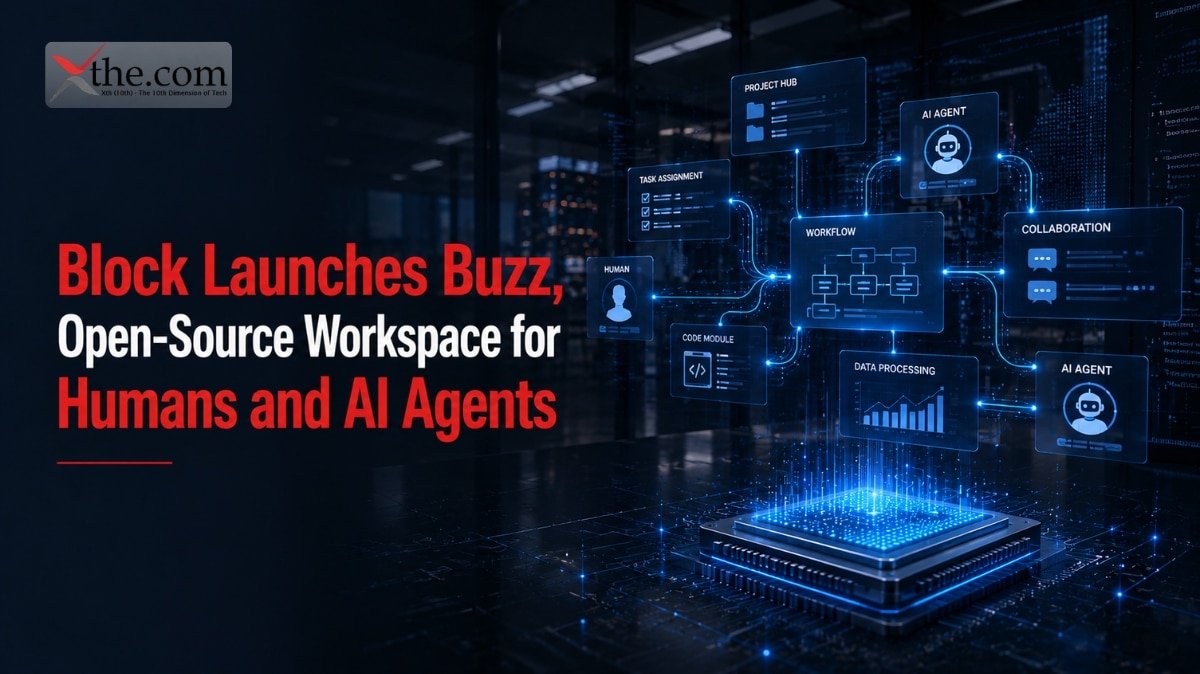
San Francisco, California | July 22, 2026
Many professionals now spend their workday moving between chatbots, project management tools, documentation platforms, and messaging apps. The main challenge is not content creation but coordinating decisions between humans and AI. Block’s launch of Buzz workspace introduces AI agents as active collaborators, not just assistants awaiting prompts. This announcement advances Block Jack Dorsey AI tool development and supports the company’s commitment to open-source AI agent workspaces for future-generation software collaboration.
Block Launches Buzz Workspace Signals a Shift Toward Agentic Computing
The announcement that Block launches Buzz workspace is more than a new productivity tool. It signals a strategic change to building software centered on autonomous AI participation, rather than simply adding chatbot features to existing products.
Buzz is an open-source platform that enables humans and AI agents to collaborate within the same environment. This approach lets software agents participate in projects, complete tasks, share context, and communicate directly with human team members.
For developers and enterprise teams, an open-source AI agent workspace delivers transparency often missing from proprietary platforms. Organizations can review code, adjust workflows, and create custom integrations without relying on closed ecosystems.
This launch emphasizes the increasing significance of Block Jack Dorsey AI tool initiatives as the company expands from financial technology into AI-native infrastructure.
Why Buzz Is Different From Traditional Productivity Software
Most workplace applications treat AI as an optional feature. Users interact with a chatbot, receive answers, and then continue their tasks manually.
Buzz uses a different architectural approach.
Instead of treating AI as an add-on, Buzz makes AI agents first-class participants in collaborative workflows. This distinction defines what many developers call an agentic workspace tool.
AI agents in Buzz can monitor ongoing work, carry out tasks, collaborate with other agents, and maintain project information throughout workflows, eliminating the need to restart conversations.
This native collaboration model underpins Buzz’s human-AI agent collaboration, enabling digital workers to participate continuously rather than only responding to prompts.
This design reduces repetitive communications and allows human teams to focus on judgment, strategy, and decision-making.
How Open Source Strengthens Block’s AI Strategy
Releasing Buzz as open source constitutes a strategic decision.
Developers prefer open platforms because they reduce vendor lock-in and encourage community innovation. Open-source ecosystems often evolve faster than proprietary ones, as many contributors identify bugs, improve security, and add specialized features.
Block’s open-source software launch follows this philosophy.
Block enables external developers to experiment with workflows, connectors, integrations, and specialized AI agents for various industries, rather than limiting innovation to internal teams.
This joint development model likewise builds trust. Organizations deploying AI systems regularly require visibility into software operations, especially when autonomous agents handle business data or operational tasks.
By adopting an open-source AI agent workspace, Block matches developer preferences for honesty and customization.
Jack Dorsey’s Product Vision Reaches Beyond Payments
Jack Dorsey has consistently supported decentralized technologies, open development, and software ecosystems that empower builders.
The introduction of Block Jack Dorsey AI tool initiatives through Buzz is consistent with this long-term philosophy.
Instead of competing with consumer AI chatbots, Block focuses on infrastructure that enables organizations to build intelligent workflows with autonomous software agents.
That distinction matters.
Large language models answer questions. Agentic systems complete work.
An accounting agent may prepare financial summaries overnight. A compliance agent could monitor regulation updates. A customer support agent might resolve routine service requests before employees begin their workday.
Buzz offers an environment where agents collaborate directly with people, rather than operating separately.
The Rise of Agentic Workspace Platforms
The market increasingly distinguishes between AI assistants and agentic systems.
Traditional assistants respond.
Agents participate.
This difference explains the growing interest in new agentic workspace tools.
Organizations want software that can handle multi-step assignments, remember organizational context, work with additional AI systems, and report completed work back to human managers.
The phrase Buzz humans AI agents collaboration indicates this emerging operational model.
Instead of using multiple applications, professionals could manage a unified workspace where AI teammates contribute continuously.
These systems may eventually support software engineering, legal documentation, customer operations, marketing, cybersecurity, and research analysis within collaborative digital environments.
What “Block Launches Buzz Open-Source AI Workspace” Means for Enterprises
The announcement of “Block launches Buzz open-source AI workspace” highlights a wider industry shift toward collaborative AI infrastructure.
Many businesses have already experimented with generative AI for writing emails, summarizing meetings, or generating software code.
The next competitive advantage is orchestration.
Organizations now seek platforms that coordinate multiple specialized AI agents while maintaining oversight, security, governance, and human approval.
This makes an open-source AI agent workspace attractive, as enterprises gain greater flexibility in deployment, compliance, and customization.
Companies in finance, healthcare, government, and other regulated industries often require this level of control before adopting autonomous AI technologies.
Buzz Workspace Humans AI Agents Can Reshape Digital Teamwork
The concept of “Buzz Workspace humans AI agents” goes beyond basic productivity enhancements.
Imagine a product launch involving marketing, engineering, legal, design, and customer support.
Instead of using many disconnected tools, multiple AI agents could draft documentation, monitor deadlines, review compliance, summarize meetings, and coordinate deliverables, allowing human leaders to focus on strategy.
That represents a meaningful evolution from chatbot-based assistance.
It also changes expectations for workplace software.
Future platforms may compete less on editing or messaging features and more on how effectively humans and AI agents collaborate within shared environments.
The success of Buzz humans AI agents collaboration will depend on reliability, transparency, governance, and user faith, not just AI capability.
Block’s Competitive Position in the AI Era
Block’s open-source software launch positions the company within a competitive market where technology firms are racing to define enterprise AI collaboration.
Microsoft integrates AI through Microsoft 365. Google expands Gemini across Workspace. Many startups build specialized AI operating systems for businesses.
Buzz offers a different proposition.
Instead of focusing on conversational AI, Block prioritizes collaborative environments in which autonomous agents are permanent members of project teams.
The architectural distinction may appeal to developers pursuing flexibility and organizations building long-term AI strategies, rather than those deploying isolated chatbot features.
The release also marks Block launches Buzz workspace as a key milestone in Block’s broader AI roadmap under Jack Dorsey’s leadership.
As enterprises shift from experimenting with generative AI to launching autonomous digital workers, platforms providing openness, transparency, and native agent collaboration may shape the future of workplace software. If this transition accelerates, Block launches Buzz workspace could be seen as an early sign of how humans and AI agents will share responsibility for knowledge work in the years ahead.
Source: Jack Dorsey’s Block Launches Buzz, a Nostr-Based Slack and GitHub Rival for AI Agents








