





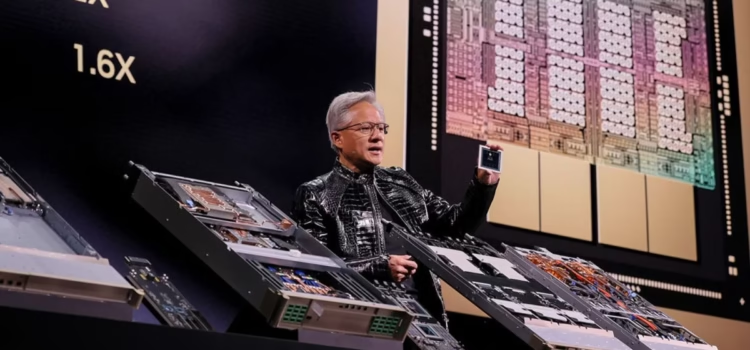
The Rubin platform launching in 2026 signals a major shift in machine intelligence. Instead of focusing only on training power, the industry is now moving toward efficient large-scale inference. Robin builds on its predecessor’s achievements in trillion-parameter models by streamlining the data pipeline for agentic AI. The new design treats the data center rack as a single computing unit, leveraging advanced memory and fast connections to eliminate legacy bottlenecks. To really understand how Nvidia Rubin compares to Blackwell in AI performance, it’s important to look closely at the hardware improvements that change how tokens are generated and processed at scale.
Architectural Foundations: Transistor Density And Process Nodes
The main difference between these two architectures starts with the silicon. Blackwell used a custom 4NP process to fit 208 billion transistors into a dual die design. Rubin almost doubles this with 336 billion transistors made using TSMC’s advanced 3NM (N3) process. This extra complexity makes room for more specialized logic units, especially in the Tensor cores, which handle most of the matrix multiplication. As a result, Rubin can run many more operations at once without using more power.
The 2026 architecture goes further than just increasing transistor count. It adds third-generation transformer engines that support NVFP4, a four-bit floating-point format. This doubles inference speed compared to the eight-bit precision used before. Blackwell started using low-precision training, but Rubin improved this for the reasoning phase of AI, where models handle longer chains of thought. Thanks to these hardware upgrades, companies can run more complex models without using much more energy or hardware.
Memory Subsystem: HBM4 and Unprecedented Bandwidth
Memory bandwidth has often limited AI performance, especially as models now use million-token context windows. Blackwell systems used HBM3e memory, offering up to eight TBs of bandwidth and 192 GB per GPU. Rubin goes even further, using BioRubin HBM4, which provides 22 TB of bandwidth and 288 TB of capacity. This 2.75 times speed boost helps avoid the memory wall that can slow large language models during inference.
Switching to HBM4 lets the NVIDIA Rubin versus Blackwell comparison focus on goodput, which means the real productive work a system does. With 288 GB of fast memory per chip, the Rubin GPU can store larger portions of a model’s KV and cache them locally. This reduces the cost of data transfers between GPUs, thereby reducing delays in real-time tasks. For teams using mixture of experts (MOE) models, this large memory pool means that routing decisions occur in microseconds rather than milliseconds.
Interconnect Evolution: NVLink 6 and Rack-Scale Coherence
Communication between chips is another key part of the 2026 performance upgrade. Blackwell used NVLink 5, which gave each GPU 1.8 TB/s of two-way bandwidth. The new Rubin GPUs use sixth-generation NVLink, raising this to 3.6 TB/s. This faster connection is important for NVLink 72 rack-scale systems, where 72 GPUs work together as one large computing unit. With double the interconnect bandwidth, most enterprise workloads no longer experience the usual distributed computing shadows.
System-Wide Integration: The Vera CPU Advantage
One major change in 2026 is the new Vera CPU, which replaces the Grace CPU used in Blackwell systems. Vera is built to manage the step-by-step reasoning and data tasks needed by autonomous agents. It connects directly to Rubin GPUs via 1.8 TB of NVLink, eliminating the PCIe bottleneck. This close connection enables the CPU to handle checkpointing and data preparation without interrupting the GPU’s intensive training or inference.
Inference Efficiency and Token Economics
For enterprises in 2026, cost per token is a key metric. NVIDIA says the Rubin platform can cut inference costs by up to ten times compared to Blackwell-class systems. This improvement comes from using disaggregated inference and the NVFP4 precision. By running the prefill and decode phases on hardware designed for each task, Rubin uses energy more efficiently. As a result, companies can now run advanced reasoning models that were previously too costly to operate at scale.
Training is now much more efficient, as the new platform requires only 1/4 as many GPUs to train a diverse set of expert models. Using less hardware lowers AI factory costs and makes it easier to manage cooling and power. Developers benefit from faster iteration and can test bigger models in the same amount of time. According to NVIDIA Rubin versus Blackwell, all performance comparison analysis, the 2026 architecture is designed for a future where AI is always available, not just a tool.
Future-Proofing the AI Factory
Looking ahead to 2027, choosing between these platforms depends on your long-term goals. Blackwell is still strong for standard training and established LLM workflows. Rubin, on the other hand, is built for the next wave of AI, including agentic AI and large-scale reasoning. With liquid cooling and exascale performance, Rubin is set to power the next generation of AI super factories. The right choice depends on whether your organization is focused on current needs or preparing for more complex autonomous workflows in the future.
Moving from Blackwell to Rubin is more than a simple hardware upgrade. It is a complete redesign of the AI compute stack. The 2026 platform doubles memory bandwidth, increases transistor density, and improves low-precision inference, setting a new standard for private and public clouds. The last generation showed that AI could scale, but this one shows it can also be efficient, secure, and cost-effective worldwide. This leap in technology means the 2026 infrastructure is ready to support the next decade of AI progress.


