





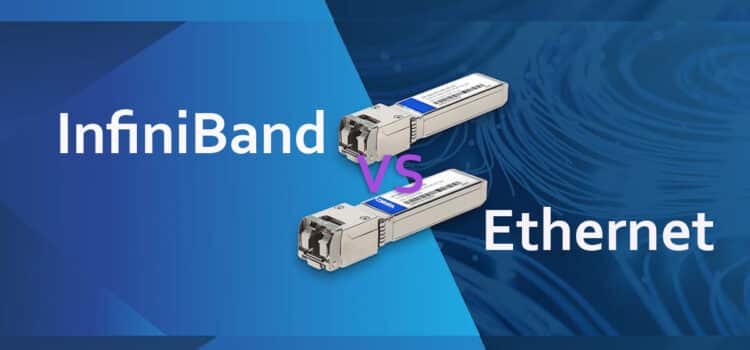
Today, high-performance computing (HPC), artificial intelligence (AI), and modern data centers all need ultra-fast, low-latency networks. InfiniBand and Ethernet are two leading technologies, each with its own strengths, design, and typical uses. Knowing how they differ helps you choose the best network for your needs.
InfiniBand Versus Ethernet Network: What Are They?
InfiniBand and Ethernet each have their own features and differences, so it is not possible to say one is always better than the other. Both continue to improve and are essential in different areas of networking.
What Is InfiniBand?
InfiniBand is often used in supercomputer clusters because it offers high reliability, low latency, and high bandwidth. It is also the top choice for connecting GPU servers.
InfiniBand has a layered design. The physical layer creates point-to-point links using high-speed serial connections. The data link layer manages packet transmission, while the network layer supports features such as QoS, virtualization, and RDMA. This setup helps InfiniBand stay efficient and reliable even with heavy workloads.
InfiniBand is also always improving with faster speeds, lower latency, and better in-network computing. New features like SHARP let network devices handle data aggregation and reduction, reducing data movement and speeding up group operations. With upgrades such as HDR 200G, NDR 400G, and HDR 800G, InfiniBand remains a top pick for new supercomputers and large HPC systems.
What’s Ethernet?
Ethernet is the most common protocol for local area networks (LANs) based on the IEEE 802.3 standard. It is popular because it is affordable, easy to use, and works well with many devices. Ethernet connects devices using copper or fiber cables, supports both wired and wireless setups, and comes in versions such as Fast Ethernet, Gigabit Ethernet, 10 Gigabit Ethernet, and Switched Ethernet. It uses physical media, such as twisted pair copper or fiber. Devices communicate via MAC addresses, while switches efficiently direct traffic within the network. Ethernet supports point-to-point and switched topologies, allowing seamless integration and straightforward scaling.
Ethernet has evolved from basic TCP/IP to advanced protocols like RoCE, which lower latency and boost efficiency. Thanks to AI, cloud, and big data, Ethernet now offers speeds from fast and gigabit up to 10G, 25G, 40G, 100G, 400G, and 800G. Modern Ethernet also supports lossless data transfer and improved congestion control, with groups like the Ultra Ethernet Alliance leading new developments. These changes make Ethernet a strong rival to specialized networks like InfiniBand.
InfiniBand Versus Ethernet: What are the differences between them?
InfiniBand was created to solve data transmission bottlenecks in high-performance computing. In contrast, Ethernet was designed to be a flexible and widely compatible network for businesses, cloud services, and data centers. As a result, InfiniBand and Ethernet differ in bandwidth, latency, reliability, technology, and the applications they support.
Architecture And Topology
InfiniBand uses a switched fabric design that enables point-to-point connections with very low latency. Its common topologies, such as fat tree and torus, are designed for HPC and AI clusters and support RDMA for fast data transfer. This efficient design makes InfiniBand great for environments where low latency is key. Ethernet, on the other hand, uses a layered design and supports many topologies, such as star or mesh.
Network Bandwidth
InfiniBand has developed faster than Ethernet for many years, mainly because it connects servers in high-performance computing and helps lower CPU usage. Ethernet, however, is more focused on connecting end devices, so it does not need as much bandwidth.
When network speeds exceed 10G, unpacking every packet consumes significant resources. The first HDR InfiniBand ran at 10 Gbps, enabling fast data transfers, reducing CPU load, and improving network utilization.
Network Latency
InfiniBand and Ethernet handle network latency differently. Ethernet switches usually use store-and-forward and MAC table lookups at layer 2, which slows their processing. They also have to manage additional services such as IP, MPLS, and Q-in-Q, which adds to the delay compared to InfiniBand switches.
For InfiniBand switches, layer 2 processing is much simpler. They use a 16-bit LID to find the forwarding path, and cut-through technology helps lower the forwarding delay to under 100 nanoseconds, which is much faster than Ethernet switches.
Network Reliability
Packet loss and retransmission can greatly affect high-performance computing. So, a reliable network protocol is needed to ensure the network remains lossless and dependable.
InfiniBand is a full network protocol with its own formats from layer 1 to layer 4. It uses end-to-end flow control to send and receive packets, which helps keep the network lossless. Ethernet used to lose packets, but new features like PFC, ECN, and RoCE v2 have made it nearly lossless. Modern Ethernet now offers high bandwidth, low latency, and almost no packet loss.
Scalability And Compatibility
Ethernet is popular because it scales well and works with existing systems. Its wide use and clear standards make it easy to add and manage in many settings. InfiniBand is powerful, but it can be harder to scale and often needs special hardware and software, which limits its flexibility.
Cost And Deployment Complexity
InfiniBand hardware is usually expensive and needs experts to set it up. Upgrades often depend on the vendor, which raises the total cost. Ethernet is more affordable, easier to install, and supports upgrades from different vendors, making it common in most data centers.
Security and Management
InfiniBand was built for high-performance computing and has only basic security and management features, which depend on the subnet manager and specialized tools. In contrast, Ethernet has been used in enterprise networks for years and provides strong security protocols and well-developed management systems.
Application Scenarios
InfiniBand is best suited for large AI training clusters, high-performance computing, and tasks that require very low latency and high data rates. It is often used for deep learning, real-time data processing, and complex simulations.
Ethernet is widely used in business networks, internet connections, and home setups because it is affordable and easy to set up. With RoCE technology, Ethernet can also support AI and machine learning clusters, distributed AI, and cloud-based AI services.
Conclusion
InfiniBand and Ethernet each have advantages for high-performance computing and data centers. As AI grows and data centers handle more work, networks need to keep up. InfiniBand has been the top choice for traditional HPC because of its low latency and high bandwidth. However, Ethernet has improved quickly and can now support modern AI clusters and large data centers. New advances like 400G and 800G Ethernet and RoCEv2 have made Ethernet even better for AI tasks. The Ethernet switch market is expected to grow from $5.44 billion in 2024 to $5.64 billion in 2025, with a CAGR of 3.7%.


