



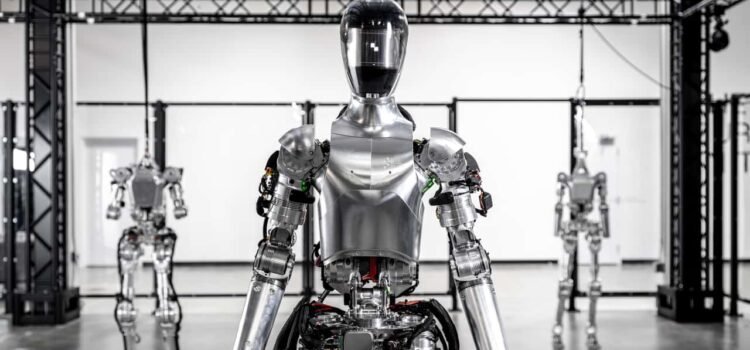
Figure, a robotics company specializing in general-purpose humanoid robots, has begun deploying its autonomous systems in US automotive factories. Shifting from laboratory experiments to real-world operations marks a significant transformation for American manufacturing. These robots are now operating in high-traffic plants, performing repetitive and physically strenuous work. Because their form mirrors human bodies, they integrate seamlessly into existing human-centric spaces, eliminating the need for facility redesigns. This introduction aims to address workforce shortages. The rollout enables robots and human employees to collaborate, streamlining vehicle assembly.
Transitioning From Lab To The Assembly Line
The first stage of this rollout targets material manipulation jobs that require precise handling and strong spatial awareness. These tasks were previously difficult to automate due to irregularly shaped parts and unpredictable movements. Tigas’s robots use advanced end effectors that emulate human hands, enabling them to grasp wire harnesses, specialized fasteners, and delicate trim pieces. Rather than following rigid instructions, the robots interpret and adapt to their surroundings as they operate.
With Integrated Vision Force Feedback, the robots modulate grip strength in response to sensed resistance. This capability prevents them from crushing lightweight plastic components or mishandling heavy metal parts. Such precision is crucial in auto manufacturing, where minor errors can have significant impacts. Unlike stationary robotic arms, these humanoid robots can navigate around production equipment to access storage bins. Their mobility ensures efficient part flow even during shift transitions or inventory updates.
Synchronizing Machines and Human Labor
One main goal for 2026 is to make sure humans and robots can work safely together. The figure uses Dynamic Proximity Buffers, so the robots slow down and stop right away if a person gets too close. These safety features are built into the hardware to ensure reliable operation in fast-paced environments. Right now, the robots help with line-side logistics, moving parts from delivery areas to the main conveyor. This saves human workers from having to walk long distances carrying heavy items.
The robots also advance ergonomic neutralization by assuming tasks that demand frequent bending or overhead reaching movements commonly linked with repetitive strain injuries among assembly staff. Offloading these high-stress assignments to robots helps companies extend worker longevity and reduce injury rates. The machines learn through behavioral mapping, observing human demonstrations, and replicating the actions. This approach facilitates rapid retraining when assembly processes change for new vehicle models.
Solving the Infrastructure Interoperability Puzzle
A key advantage of the Figure platform is its form factor compatibility with current industrial setups. While most automated systems require costly custom railings, cages, or specialized docking stations, humanoid robots are designed to fit into the same spaces as the people they support. They can climb stairs, pass through circular doorways, and work at bench heights identical to those of humans. This zero-refit approach lets manufacturers add automation step by step without stopping production for major facility changes.
The robots also use universal power connectivity, which allows them to recharge from standard industrial outlets or modular docking bays. This sustains the fleet running through multiple shifts with little downtime. A central fleet management system tracks the health and battery levels of every robot in the facility. If one unit needs maintenance, the system sends a backup unit to replace it. This kind of systemic redundancy is necessary for keeping modern automotive factories running smoothly.
Expanding the Horizon of General Purpose Utility
As figure robots are increasingly used, the company aims for cross-functional versatility, enabling a single robot to handle multiple tasks in a single shift. For example, a robot might sort engine parts in the morning and then move to quality control for visual inspections in the afternoon. This pliability sets general-purpose humanoids apart from single-task industrial robots. It gives manufacturers a liquid workforce that can adjust quickly to changes in market demand or supply chain needs.
The 2026 software update adds collaborative problem-solving to the robots. If a robot encounters an unexpected problem, it can alert a nearby human supervisor for help via a haptic signal. The supervisor gives a quick fix, which the robot remembers and shares with the rest of the fleet through the cloud. This collective learning means the entire robotic team improves each time a robot faces a new challenge. This ongoing improvement increases the plant’s overall productivity.
The New Pulse of American Production
As these new techniques are introduced in factories, we are seeing a steady transformation in the workplace. The factory is becoming more responsive with systems that work closely alongside human needs. We are moving toward a time when labor and logic work together, and every task is supported by technology that is always ready to help. Over time, the line between tool and worker may blur, forming a space where people and machines work in harmony. The factory is no longer simply a piece of heavy machinery, but a lively, efficient environment, always ready to support production.
Source: F.02 Contributed to the Production of 30,000 Cars at BMW


