






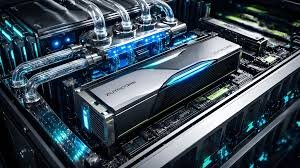
High-performance computing is evolving as NVIDIA’s B300 design introduces a new thermal management method for data centers. Previously, data centers struggled to remove heat from dense servers, limiting both density and reliability. The B300 replaces traditional air cooling with built-in liquid cooling, directly boosting efficiency. This enables more transistors per chip without overheating, increasing computational power. By adding cooling channels to the silicon, NVIDIA enables processors to run at full speed, boosting performance and stability.
Engineering the Shift to Native Liquid Cooling
The B300 series uses a special direct-to-chip liquid cooling system that replaces large copper heat sinks with microchannel cold plates. These plates sit closely against the processor, letting a non-conductive coolant pull heat away much more efficiently than air. As a result, this design directly addresses the thermal resistance that usually builds up between the chip and its cooler, which can hinder consistent operation. By removing this barrier, the system maintains steady temperatures even during heavy workloads, ensuring the hardware remains reliable over time and delivers stable, long-lasting performance.
NVIDIA’s B300 also includes a manifold-integrated chassis that simplifies cooling for large server racks. Rather than using separate hoses for each card, the rack itself delivers coolant to all the components, making large-scale deployment more efficient. This design reduces installation complexity and lowers the risk of leaks or flow issues, directly contributing to smoother operations and easier maintenance. The system is also built to manage the pressure drop associated with fast-moving coolant, ensuring even coolant distribution across all components and supporting maximum hardware uptime. This kind of integration is key to maintaining the dependability of cloud services and minimizing disruptions.
Overcoming the Constraints of Air-based Dissipation
Traditional air cooling has reached its air density ceiling because fans can’t move enough air to cool 1,000-watt processors, limiting server power and scalability. The B300 solves this by using liquid, which can carry away much more heat than air. Water and special coolants can remove up to four thousand times more heat than the same amount of air, directly enabling higher rack density. This means data centers can fit more compute power into less space and don’t need large HVAC systems or specialized hot-air setups, resulting in both cost and space savings. Switching to liquid cooling also solves the problem of server room noise. Air-cooled data centers rely on thousands of fast fans, which are loud and energy-intensive. The B300 uses quiet, low-speed pumps instead, so the system runs almost silently. Cutting parasitic power means more electricity is available for computing, improving efficiency. This also helps organizations run data centers more efficiently and sustainably.ise.
Strengthening Reliability Through Thermal Stability
Changes in temperature are a major cause of semiconductor failure, as components inside expand and contract. The B300 uses active thermal leveling to keep the temperature steady regardless of how the workload changes. This precise control means the processor remains within safe temperature limits. When the processor is idle, the system slows the coolant flow; when the workload increases, the flow speeds up immediately. This thermal equilibrium prevents tiny cracks and solder issues that often occur in air-cooled systems, directly expanding the mean time between failures (MTBF) of critical components.
Keeping the temperature steady also helps B300 chips avoid the performance jitters caused by thermal throttling. In older systems, when fans couldn’t keep up, the processor would slow down, causing delays. In cloud applications, the B300’s liquid cooling keeps performance steady even beneath heavy loads, directly enabling consistent processing for time-sensitive tasks. Such reliability is necessary for mission-critical telemetry and real-time financial processing where every millisecond matters. Air-cooled systems just can’t deliver this level of stability in dense setups, risking performance.
Simplifying Data Center Infrastructure Requirements
Using NVIDIA’s B300 design lets data centers clear out a lot of clutter, leading to significant CapEx reductions. For example, without large air ducts and raised floors, new sites can have lower ceilings and simpler ventilation systems, both of which are tied directly to lower construction costs. Reduced infrastructure also makes it easier to reuse existing municipal spaces. Additionally, modular cooling units (CDUs) at the ends of server rows form a closed-loop system, where their proximity minimizes energy loss from coolant movement, increasing overall efficiency.
The P300 hardware also includes predictive leak-detection sensors built into every unit’s firmware. These sensors detect even small changes in humidity or pressure and can shut down only the affected area before any damage occurs, directly reducing risk during operations. This self-heating infrastructure enables operators to use liquid cooling at scale without worrying about major leaks. The system can isolate a faulty part while the rest continue to run, maintaining high system availability even during maintenance and ensuring continuous operation.
Defining The Horizon Of Sustainable Power
As the need for computing power grows, thermal efficiency is becoming the main measure of success. The B300 moves away from brute-force cooling used in the past. It shows that the future of computing is about working in balance with the physical world, not just making faster chips. We are heading toward a time when data centers are quiet, liquid-cooled, and run smoothly with their surroundings. Soon, the idea of a cooling limit will look outdated.
We are moving into a domain of thermal transparency in which machines no longer struggle with their own heat. The design of global networks now focuses on stability, long life, and quiet, steady power. Every bit of coolant and every microchannel in the silicon helps keep things safe and reliable. The system now runs smoothly and quietly, keeping pace with our digital needs. In the future, the systems that support our lives will value their internal balance as much as their performance. This clear approach means the cloud’s future will be as cool and reliable as the water that powers it.
Source: Nvidia News


