



Today, we are announcing new capabilities in Azure AI Foundry. These features make it easier for developers to build, observe, and govern multi-agent systems. They also help organizations close the trust gap in AI.
As more organizations adopt agentic AI, eight out of ten enterprises now use some form of agent-based AI, according to PwC. Managing these systems is becoming more complex. Developers deal with scattered tools, and organizations struggle to ensure agents act responsibly. Our latest Azure AI Foundry updates are designed to tackle these issues directly.
Introducing Microsoft Agent Framework (Public Preview)
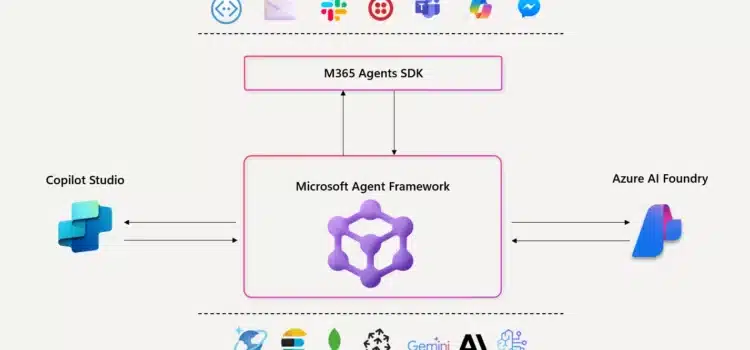
The Microsoft Agent Framework, now in public preview, is an open source SDK and runtime. It makes it easier to manage multi-agent systems. The framework combines AutoGen, a previous Microsoft research project, with the enterprise features of Semantic Kernel. Together, these form one commercial-grade framework that brings the latest research directly to developers.
With Microsoft Agent Framework, developers can:
- Start by experimenting locally, then deploy to Azure AI Foundry with built-in observability, durability, and compliance.
- Integrate any API using OpenAPI, work across different runtimes with Agent2Agent (A2A), and connect to tools on the fly with Model Context Protocol (MCP).
- Apply the latest multi-agent patterns, such as Magnetic One, and organize agents into workflows.
- Reduce switching between tools and platforms.
- Create multi-agent systems that connect Azure AI Foundry, Microsoft 365 Copilot, and other agent platforms.
This framework helps developers stay focused. An industry study found that half of developers lose over 10 hours each week due to scattered tools. This shows why solutions that simplify work and improve the developer experience are needed.
One organization that uses the Microsoft Agent Framework to reduce friction is KPMG. KPMG’s transformation began with KPMG Clara, its cloud-based smart auditing platform used on every KPMG audit worldwide.
KPMG Clara AI aligns with the open-source Microsoft Agent Framework built on semantic kernel autogen convergence.
This setup lets KPMG Clara AI link specialized agents to enterprise data and tools while using built-in safeguards and an open developer ecosystem. Open-source connectors enable agents to work with Azure AI Foundry and external systems, making it easier to scale multi-agent collaboration globally.
Foundry agent service and Microsoft Agent Framework connect our signals to data and to each other. Performance and observability features in Azure AI Foundry give KPMG firms what they need to succeed in a regulated industry. – Sebastian Stockle, Global Head of Audit Innovation and AI at KPMG International.
Contribute code and feedback to help shape agentic AI by engaging with the Microsoft Agent Framework.
Multi-Agent Workflows (Private Preview)
Building on the Microsoft Agent Framework, we are bringing these features to the cloud with multi-agent workflows in Foundry Agent Service. This new feature lets developers manage complex multi-step business processes using a structured workflow layer. It also maintains state throughout the process.
With multi-agent workflows, your teams can:
- Coordinate multiple agents across long-running tasks with persistent state (stored information that persists as tasks continue) and context sharing (allowing agents to share relevant information during collaboration).
- Automate complex enterprise scenarios, including customer onboarding, financial transaction processing, and supply chain automation.
- Leverage built-in error handling, retries, and recovery to improve reliability at scale.
You can create and debug workflows visually using the VS Code extension or Azure AI Foundry. Then, you can deploy, test, and manage them in Foundry along with your existing solutions.
Several customers are currently piloting this feature, and broader availability is planned soon.
Observability Across Popular Networks With OpenTelemetry Contributions.
We are also improving multi-agent observability by contributing to open telemetry. This helps standardize tracing and telemetry for agentic systems.
These improvements give teams better insight into agent workflows, tool calls, and collaboration. This is essential for debugging, optimization, and compliance. We worked with Outshift, Cisco’s incubation engine, to make these enhancements to open telemetry.
Thanks to these updates, Azure AI Foundry now offers unified observability for agents built with different frameworks, including Microsoft Agent Framework, Langchain, LangGraph, and OpenAI Agents SDK.
Voice Live API in Azure Foundry Is Now Generally Available
More Meta agent workflows now start with voice inputs and end with voice outputs. We are pleased to announce that Voice Live API is now generally available. This tool lets developers and businesses build scalable production-ready voice AI agents. Voice Live API is a unified real-time speech-to-speech interface that combines speech-to-text (STT), generative AI models, text-to-speech (TTS) avatars, and conversational enhancements into a single low-latency pipeline.
Companies like Capgemini, Healow, Astrotech, and Agora are using the Voice Live API to create customer service agents, educational tutors, HR assistants, and multilingual agents. Voice Live API is changing how developers build voice AI agents by offering an integrated, scalable, and efficient solution.
Responsible AI Capabilities In Public Preview
As agent observability and framework integration improve, it is just as important to ensure AI systems operate responsibly and securely, especially as they become a bigger part of key business processes.
McKinsey’s 2025 Global AI Trust Survey found that the biggest barrier to AI adoption is the lack of governance and risk management tools. To address this, we will soon release the following responsible AI features in public preview: Task adherence: Help agents stay aligned with assigned tasks.
- Prompt shields with spotlighting help protect against prompt injection. They also spotlight risky behavior.
- PII detection identifies and manages sensitive data.
These features are part of Azure AI Foundry, helping organizations build confidently and meet both internal and external standards.
To further empower developers, Azure AI Foundry offers more than just a platform it’s a trusted agent factory.
Azure AI Foundry is more than just a platform. It is a trusted agent factory for developers and businesses. Whether you are a CIO aiming to scale AI responsibly, a security architect focused on governance, or a developer building the next generation of intelligent agents, Azure AI Foundry gives you the tools, frameworks, and trust you need.
Microsoft stands out in the AI landscape with its commitment to open standards, interoperability, and responsible AI. The Microsoft Agent Framework, now in public preview, is a unified enterprise-grade framework that integrates cutting-edge research and allows developers to seamlessly orchestrate multi-agent systems with built-in observability, durability, and compliance.
Our framework, unlike others, supports integration with any API through OpenAPI. It also allows collaboration across runtimes with agent-to-agent (A2A) and dynamic tool connections using NCP. This helps developers avoid switching between tools and stay focused. It speeds up innovation.
The open-source nature of the framework invites developers to contribute and shape the future of agentic AI. This makes it a truly collaborative, forward-thinking platform. With Microsoft, organizations can trust that their AI systems will be powerful, efficient, responsible, and secure. It addresses the top barriers to AI adoption identified in McKinsey’s 2025 Global AI Trust Survey.


