






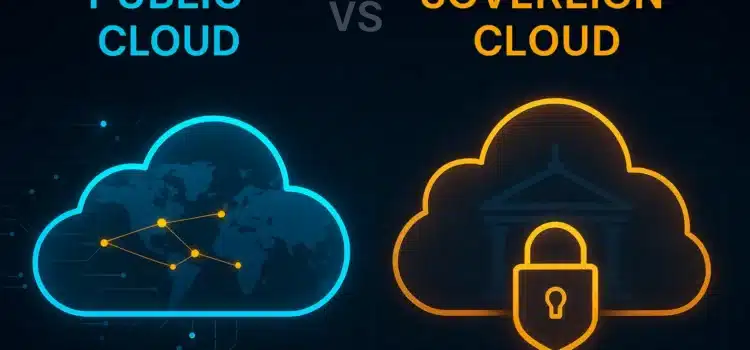
Businesses around the world use hyperscaler platforms to cut IT costs, improve scalability, and drive innovation.
But as concerns about data privacy, compliance, and national security increase, organizations, especially governments and regulated industries, are rethinking whether to use sovereign or public clouds. Regulators everywhere are asking key questions: Where is sensitive data stored? Who controls it? Who can access it?
These questions have led to the growth of sovereign cloud, which keeps data infrastructure and access under one nation’s control. In Europe, the General Data Protection Regulation (GDPR) and new EU digital sovereignty proposals drive this trend. India’s Digital Personal Data Protection Act sets similar rules, and other countries are following.
Both public and sovereign clouds are types of cloud computing, but they differ in data governance, location control, and compliance rules. Here, we examine the main differences by looking at their use cases.
Understanding the Cloud
The debate between sovereign and public cloud is about more than just technology.
It also involves business continuity, national compliance, and digital sovereignty. At first, sovereign and public clouds seem similar. Both store data, provide computing power, and help businesses grow. The real difference is in who has control and under which laws.
A public cloud is a model where third-party providers like AWS, Azure, and GCP deliver computing, storage, and applications over the internet. Its main features are:
- Multi-tenant architecture: resources are shared by many users
- Pay-as-you-go pricing: The users only pay for the services they consume.
- Highly scalable and flexible: resources can be adjusted instantly as needed
- Global infrastructure: data centers are spread worldwide, which allows for geo-redundancy
A sovereign cloud keeps all data storage, processing, and management within the legal borders of one country or region. Usually, a local provider or a trusted partner of a global hyperscaler runs it under strict compliance rules.
Its main features are:
- Data residency and sovereignty: Data is stored and processed only within the country’s borders.
- Full legal jurisdiction: Only local laws govern the data.
- Restricted access: Foreign entities, even the cloud provider’s parent company, cannot access the data.
- Enhanced compliance: It is designed for sectors with strict rules, such as government, defense, healthcare, and finance.
Sovereign cloud is quickly becoming the top choice for many sectors. Governments and regulated industries face more pressure to protect sensitive data, especially as geopolitical tensions and data breaches rise. Regulations such as the EU’s GDPR, India’s DPDP Act, France’s SecNumCloud, and Japan’s C5 standards are driving demand for local sovereign-compliant cloud solutions. Many countries are also concerned about foreign surveillance, especially under laws like the US Cloud Act, which lets US authorities access data stored abroad by American cloud providers.
Different Sectors, Different Priorities
Each industry reaches its own tipping point, which influences how it chooses cloud solutions.
A central bank might require that all customer data and risk models remain within the country. In contrast, a regional bank could use a hybrid approach, keeping core systems on a sovereign cloud and using public cloud for customer engagement.
A health technology platform might want to use artificial intelligence with sensitive patient data. While public cloud AI services are flexible, compliance rules require training data to remain on premises. To keep the trust of patients and regulators, the platform chooses a sovereign cloud.
When a government moves citizen services online, the public cloud can be efficient but may not offer enough security. By choosing a sovereign cloud, they make sure all infrastructure is owned, operated, and audited within the country.
Public cloud is still the top choice when speed, scalability, and cost matter most. It works especially well for hosting websites, mobile apps, and SaaS platforms, making it a great choice for startups and digital-first companies with limited budgets. Its global reach and advanced tools also make it ideal for AI and machine learning projects that require large, diverse datasets and powerful computing resources.
Public cloud platforms also offer robust backup and disaster recovery capabilities, leveraging geographic redundancy to keep businesses running smoothly. For DevOps teams, public cloud supports continuous integration and delivery pipelines and large-scale container management, making it a popular choice for agile software development.
On the other hand, sovereign cloud is best for situations where compliance, control, and national interests are most important. Government services and citizen portals, such as land records, tax systems, and digital identity programs like Aadhaar, require strict, secret data localization and governance, making sovereign cloud a top pick.
Critical infrastructure sectors such as utilities, power grids, and national defense also benefit from sovereign cloud, which offers greater control, traceability, and isolation. Healthcare systems that manage sensitive patient data under strict privacy rules also rely on the sovereign cloud. Financial institutions facing stringent compliance and audit requirements often choose sovereign cloud to remain in compliance and protect their operations.
Cloud decisions have become a board-level topic for CIOs and CTOs, especially regarding risk, governance, and reputation.
The main issue is not choosing one over the other, but finding the best way to use them together.
Many global cloud providers now offer sovereign cloud options to meet these needs:
- Microsoft Cloud for Sovereignty: supports Azure services in sovereign environments.
- Google Sovereign Cloud(partnering with T-Systems in Germany).
- AWS has dedicated local zones for governments.
- VMware Sovereign Cloud Initiative with local partners
Public clouds are known for their agility, cost savings, and wide range of features. In contrast, sovereign clouds focus on control, compliance, and trust. The best option depends on your organization’s rules, risk level, and the sensitivity of your data. As the digital world changes, many companies are choosing hybrid models. They use public cloud for everyday tasks and sovereign cloud for sensitive or regulated data, balancing innovation with control.
Source: Sovereign cloud vs public cloud – making an informed choice


