






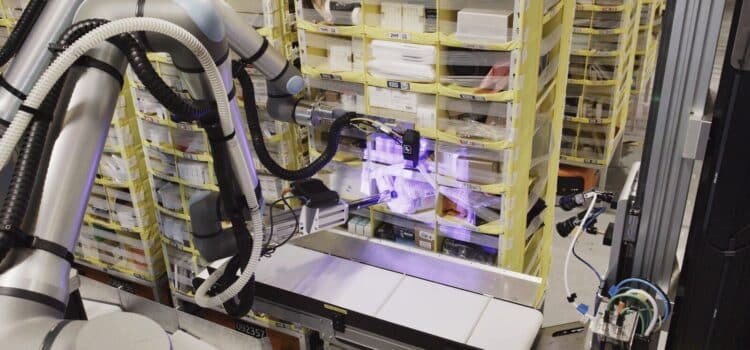
The introduction of advanced tactile sensing technology will enable warehouse machinery to perform delicate manipulation tasks that previously required human precision. The development of these new robotic systems marks a major advancement in warehouse automation, as robots are increasingly used to handle complex and fragile items.
Robotic systems equipped with sensing systems to measure pressure, texture, and resistance on an object will allow the robot to adapt its grasping ability as it interacts with the object. This added capability will help address one of the main challenges of robotic systems today: how to handle fragile and/or irregularly shaped items without damaging them while also scaling up.
Bringing the Sense of Touch to Robotics
Traditional warehouse robots have been very effective at repetitive tasks that involve numerous identical items, such as moving boxes or sorting standardized packages. At the same time, traditional warehouse robots have not been very effective at tasks that require fine motor skills, such as grasping soft, fragile, or uniquely shaped objects.
Through tactile sensing, Amazon has enabled its robots to interact with objects in ways similar to those of humans. For example, sensors integrated into a robot’s gripper provide continuous feedback on the force applied to an object, allowing the software to make micro-adjustments during object handling.
Amazon’s development has enabled robots to emulate one of the most sophisticated features of the human hand: the ability to manipulate and handle items without relying solely on visual feedback.
Enhancing Precision in Warehouse Operations
Introducing touch or feel sensation, in addition to the various levels of accuracy already achieved in warehouses, has resulted in not only robots being able to perform tasks that were previously only possible with human intervention but also textiles and electronic devices.
With this new capability, not only do robots have new and expanded capabilities to automate additional functions, reducing the reliance on human labor for performing intricate functions that require careful handling, but also, the robots are able to consistently accomplish these same functions with the same level of quality, as there will be no fatigue incurred in performing these functions by the robots.
Amazon continues to use these improvements to enhance efficiency while maintaining its high level of product safety during order fulfillment.
AI Integration for Smarter Manipulation
Systems that combine tactile sensing with artificial intelligence can learn from experience and adapt their behavior over time. Machine learning algorithms use sensor data processing to help robots identify and react to different objects and situations.
A robot learns to change its grip by studying three factors: the weight, shape, and material of the things it handles. The system improves its operational capacity through ongoing learning while also gaining the ability to handle different types of products.
AI integration enables tactile sensing technology to function as a predictive system, allowing robots to forecast object behavior during handling.
Scaling Automation Across Fulfillment Centers
Amazon has a significant logistics network; therefore, the scalability of intelligent robotics across this network is a major focus for the company. easing picking and packing accuracy.
Automation of more complex tasks will enable Amazon to achieve greater operational efficiency while providing the flexibility needed to handle the increasing variation in product inventory. As e-commerce continues its rapid expansion, the variety of product catalogs will grow.
The speed at which this computerization can be integrated into Amazon’s daily operations will depend on the number of units deployed.
Reducing Damage and Returns
Enhancing robotic manipulation delivers tangible benefits by reducing product damage during fulfillment. Damage to products reduces financial resources, negatively affects customer satisfaction, and increases return rates.
By leveraging tactile sensors to apply the appropriate amount of force, robots can lift, handle, or hold items securely without damaging them. This increased accuracy will help minimize damage during product movement, resulting in a more dependable delivery experience.
Amazon has put a concerted effort into reducing errors while pursuing an overarching goal of improving its entire logistics pipeline from the warehouse through to the end-use customer.
Human-Robot Collaboration
While technology has improved, people are still necessary for warehouse work. Robots with tactile capabilities will complement humans, not take over.
In a collaborative workplace, the robot will handle the repeatable and/or demanding parts of the job, allowing humans to focus on more difficult decision-making and supervisory tasks. This can increase an organization’s efficiency and reduce workers’ physical stress.
Amazon is investigating the continued integration of robots into the workflow to increase both productivity and worker safety.
Challenges in Tactile Robotics Development
Multiple challenges must be overcome in the development of reliable tactile sensing systems; they must perform well over long periods in industrial settings and detect very small pressure changes under repeated stress.
Moving tactile information into an AI system requires sophisticated algorithms capable of processing large amounts of instantaneous data. This project focuses on developing performance standards that enable the sensors to operate correctly across multiple device types and work environments.
Amazon is dedicating research and development resources to developing these technologies while enhancing its ability to scale effectively.
Conclusion: A New Level of Robotic Precision
Amazon has made significant advancements in its automation technology by developing robotic systems that employ advanced tactile sensing. They have developed a solution to one of the largest problems that typical robotics face when handling fragile items with precision.
When these systems are fully implemented in warehouse operations, they will revolutionize operations while also establishing new standards for operational efficiency, precision product delivery, and reliability at all points along the logistics supply chain.
Source: Amazon News


