



Menlo Park, California — Wednesday, July 29, 2026
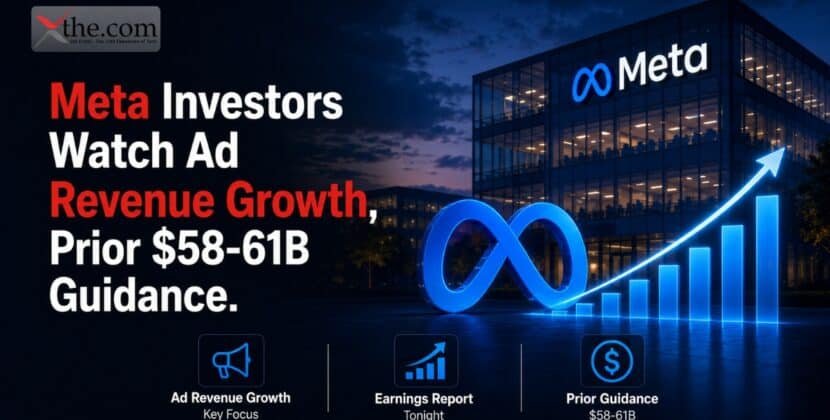
Meta wraps up its second quarter tonight, and Wall Street is focused on one key number: the $58 billion to $61 billion range the company shared with analysts three months ago. Since then, much has changed around that target, including how quickly Meta is spending, the progress of its AI projects, and whether advertising alone can keep supporting these investments.
The Baseline Investors Are Measuring Against
This is the heart of the Meta ad revenue growth watch heading into after-hours trading. Meta’s own Meta Q2 guidance $58-61 billion range, issued alongside first-quarter results, set the floor and ceiling that every subsequent estimate has been built around. Consensus has since shifted toward the upper half of that band, with Wall Street modeling roughly $60 billion in quarterly sales, implying year-over-year growth near 27 percent. That would mark a deceleration from the first quarter’s 33 percent surge, itself the company’s fastest expansion since 2021. Still, a deceleration from an unusually strong base is not the same as weakness.
The “Meta ad revenue growth prior guidance $58-61B” framing matters because it anchors expectations in Meta’s own words rather than analyst modeling. When a company sets a wide $3 billion range, it buys itself room to beat low estimates without much fanfare, or to disappoint high estimates without technically missing. Tonight’s print will show which side of that psychology plays out.
Engagement and Pricing Power Under the Microscope
Behind the headline revenue figure sit two operating metrics that Meta discloses each quarter and that analysts treat as leading indicators of ad business health: impressions delivered and price paid per ad. Both climbed at their fastest pace in years during the first quarter, with impressions up 19 percent and pricing up 12 percent. Investors tracking Meta user engagement metrics will want to see that combination hold, because it signals a platform that is both growing its audience and monetizing that audience more efficiently at the same time — a harder trick to repeat than to achieve once.
Efficiency is where the AI story enters the advertising narrative directly. Meta has spent several years rebuilding its ad-ranking and recommendation infrastructure around large-scale machine learning models, and management has repeatedly credited that work with the impression and pricing gains investors have rewarded. The wider theme of AI recommendation systems efficiency sits at the intersection of two investor questions: is the AI spending buying better ad performance today, and does that performance translate into durable pricing power tomorrow? A quarter that shows pricing growth cooling alongside rising costs would complicate the bull case considerably.
Closely related is the notion of advertising efficiency: AI-driven improvements compounding over time. Meta’s argument, echoed by sell-side analysts covering the stock, is that its recommendation engines are not a cost center, but the mechanism generating revenue growth itself. Skeptics counter that impression and pricing gains partly reflect a favorable advertiser demand environment rather than model improvements alone, making this quarter’s commentary from management a genuine test of the thesis rather than a formality.
The Spending Side of the Ledger
Any review of Meta’s quarter must include capital spending, which is now the most debated figure in the report. Meta increased its 2026 capex guidance to $125 billion to $145 billion, up from $115 billion to $135 billion, due to higher component costs and more data center construction. This increase directly impacts Meta’s data center AI investment costs, a number of investors now watch as closely as revenue.
The numbers are tough. Meta spent about $19.8 billion on capital expenses in the first quarter, which is much less than what its annual guidance suggests. To meet its targets, Meta will need to spend $35 billion to $42 billion each quarter for the rest of the year—more than twice what it spent in the same period last year. This is not a small difference; it shows a major change in how much each advertising dollar goes into servers and networking before profits.
Profitability numbers show the challenge. Adjusted earnings per share are expected to rise only about 1 percent from last year, even though revenue could grow by nearly 27 percent. This gap is mainly due to spending on infrastructure and Reality Labs, which lost $4.03 billion in the first quarter while bringing in just $402 million in revenue. CFO Susan Li expects Reality Labs’ full-year losses to be close to last year’s $19 billion, so improvement is unlikely soon.
Why the Range Itself Is the Story
The “Meta AI recommendation systems efficiency watch” angle is ultimately what separates this earnings season from a simple beat-or-miss exercise. Meta trades at a premium to industry peers on both forward price-to-earnings and enterprise-value-to-sales bases, a valuation that only holds up if investors believe the company is being priced as an AI infrastructure platform rather than a traditional advertising business. Under that framing, the capex trajectory carries as much weight as the revenue print, and management’s forward commentary on both fronts, delivered on tonight’s earnings call, may move the stock more than the numbers already known.
Expectations for the third quarter add more complexity. Analysts predict about $63.2 billion in revenue for the September quarter, and the market will watch to see if Meta’s new guidance, released tonight, is above or below that number. If the guidance is higher, it suggests management expects advertising to stay strong even as spending rises. If it is lower, it could restart the debate about whether AI investments are outpacing the revenue they are supposed to bring in.
For now, everyone—traders, analysts, and portfolio managers—continues to use Meta’s previous $58 billion to $61 billion range as their main reference until the company gives an update. What matters most is not just whether this quarter meets that range, but what Meta says about the future.
Source: Meta Earnings Put AI Spending and Ad Growth Back in Focus